About Melichthys vidua (Richardson, 1845)
Body Shape & Size
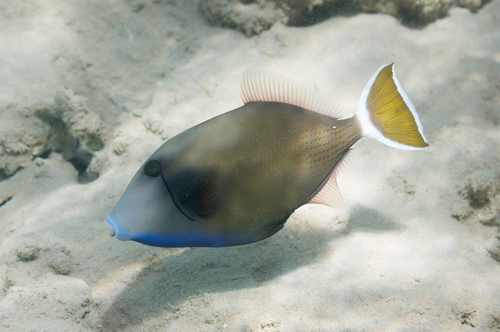
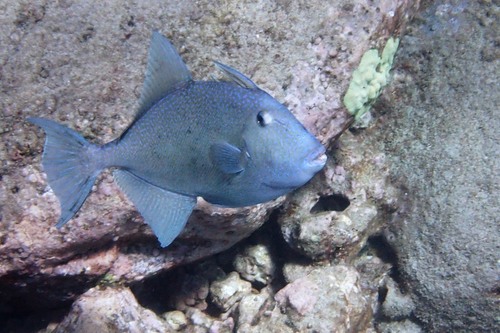
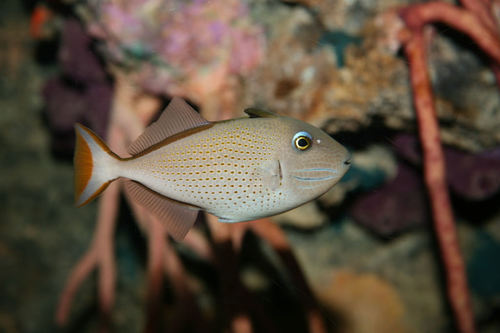
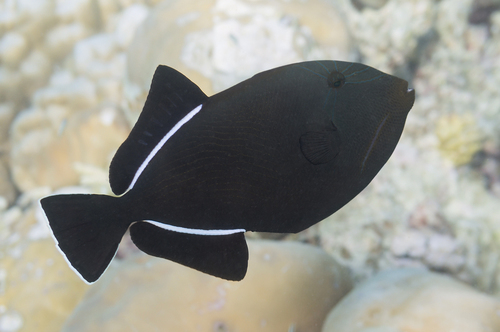
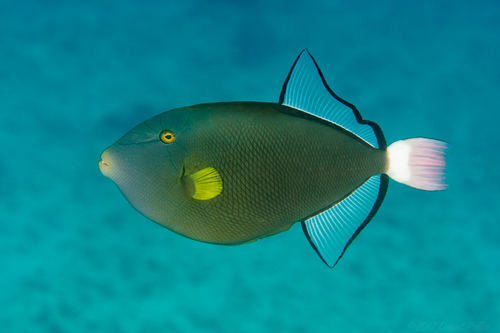
The pinktail triggerfish (Melichthys vidua) has an oval body, reaching a maximum length of 40 cm (16 in), and it is not sexually dimorphic.
First Dorsal Fin Structure
Like all triggerfish, its first dorsal fin is made of three spines that can be triggered up and down; this spine mechanism lets the fish lock itself inside crevices to deter predators when needed.
Locomotion Fins
Its anal fin and second dorsal fin move back and forth in undulating motions, and act as the main source of locomotion for the species.
Caudal Fin Characteristics
Its caudal fin is distinctly pink, and can change shape from a squared form to a wide rounded, almost truncated shape to enable different types of burst movement.
Pectoral & Pelvic Fins
Its pectoral fins are mostly unremarkable except for their bright green color, while its pelvic fins are nearly invisible, tucked neatly underneath the fish’s ventral side.
Head & Scales
This species has a small terminal mouth, small eyes, and a body covered in tough cycloid scales.
Geographical Distribution
Pinktail triggerfish are distributed across the Indian and Pacific Oceans. Their highest population density is around Indonesia and Oceania, but they can be found as far west as East Africa, as far east as the western coast of Panama, and as far north as southern Japan.
Habitat Preference
This species lives exclusively in shallow coral reefs, and prefers reef slope edges near the surface. This preference is likely linked to its planktivore diet, as currents from the open ocean provide a constant supply of plankton in this habitat.
Age-Specific Habitat
Adult pinktail triggerfish prefer areas with large corals, while juveniles prefer rockier sections of the reef, which offer better protection from predators.
Core Diet
Pinktail triggerfish are planktivores, and feed especially on microalgae. This diet is somewhat unusual for triggerfish, because most triggerfish species eat hard-shelled invertebrates such as crabs and urchins using their crushing teeth.
Ovivorous Feeding Behavior
The species is also ovivorous: it is known to follow spawning fish, both individually and in pairs, to eat their eggs. A wide range of fish from different orders have eggs that are preyed on by pinktail triggerfish, including Aulostomus chinensis, Parupeneus bifasciatum, Chlorurus sordidus, Acanthurus nigroris, Bothus mancus and Ostracion meleagris.
Egg Preference Rationale
The preference for these species comes from the fact that these fish spawn in pairs, which correlates with larger egg sizes.
Predator Avoidance Mechanism
To avoid reef predators such as sharks and eels, pinktail triggerfish use their trigger-like dorsal spines to lock themselves inside crevices, and stay there until the threat passes. Additionally, their large spines, tough scales, and body shape make them hard for predators to grab and swallow.
Parasite Host Role
Pinktail triggerfish host a variety of parasites, some of which need to complete part of their life cycle inside a fish host. Specifically, the trematode species Lepocreadium clavatum and Opisthogonoporis vitellosus were first described from specimens that parasitized pinktail triggerfish.