About Melastoma malabathricum subsp. malabathricum
Growth Form
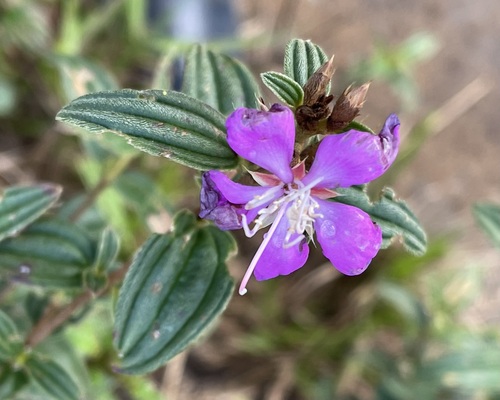
Melastoma malabathricum subsp. malabathricum (often referenced here as Melastoma affine) grows as a shrub reaching up to 2 meters (6.6 feet) in height.
Leaf Characteristics
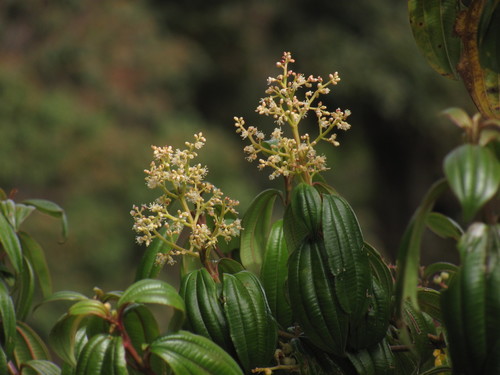
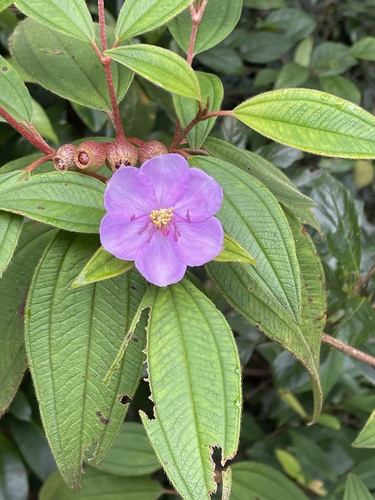
Its leaves are ovate, 6 to 12 centimeters (2.5 to 4.5 inches) long and 2 to 4 centimeters (1 to 1.5 inches) wide, covered in fine hairs and marked with longitudinal veins.
Flowering Period
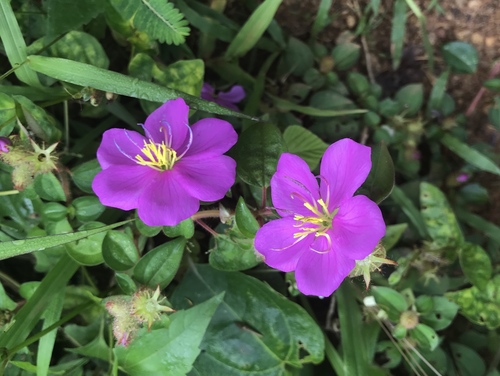
Flowers bloom in spring and summer, growing at the ends of branchlets.
Flower Structure
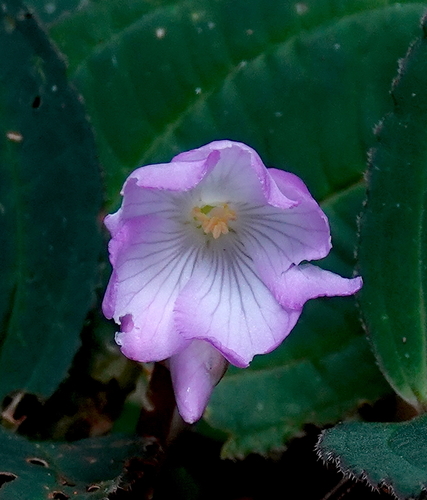
They are purple with five petals and five sepals, and have two distinct sets of stamens: five positioned opposite the petals, and five opposite the sepals. The stamens opposite the sepals have long anthers with a bilobed appendage at their base.
Fruit Characteristics
This subspecies produces purple fruits 8 millimeters long; the fruits split open to reveal reddish to purple flesh holding many small seeds. Its common name 'blue tongue' comes from the edible purplish-black pulp inside the fruit capsules, which stains the mouth blue.
Global Distribution
This plant is distributed from the Indian subcontinent through Southeast Asia, Malaysia, and Indonesia into Australia.
Australian Distribution
Within Australia, it occurs from the Kimberleys in Western Australia, across the Northern Territory and Queensland, and extends as far south as Kempsey on the mid north coast of New South Wales.
Habitat
It grows in wet areas of sclerophyll forest. In the Australasian region, it is an important pioneer species that colonizes disturbed wet-sclerophyll and rainforest habitats.
Pollinator Rewards
It produces no nectar, and instead provides pollinators with large amounts of pollen, which must be extracted through pores on the anthers.
Pollinators
It is pollinated by bees, particularly Xylocopa bombylans, X. aff. gressittii, Amegilla anomola, and Nomia species.
Reproductive Threats
Introduced honeybees outcompete native bees for pollen at its flowers, which negatively impacts the species' reproduction.
Cultivation
This is a fast-growing, adaptable shrub that is sometimes grown in cultivation, and can be propagated by either seed or cuttings.
Culinary Use
In Indonesia, the plant is used to make grass jelly (cincau perdu).
Genus Name Origin
Its fruits ripen to dark gray, and contain edible purple pulp around the seeds that stains the mouth black, which is referenced in the genus name.
Medicinal Uses
In Indonesia and the Solomon Islands, sap or leaf extract is used as a herbal medicine to treat a range of conditions, including diarrhoea, burns, ulcers, wounds, piles, and thrush.