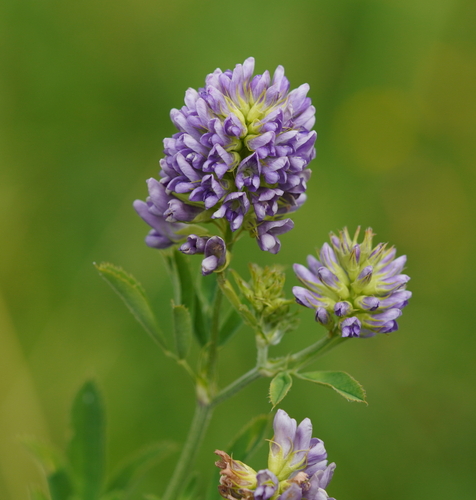
About Medicago sativa L.
Taxonomic Information
Medicago sativa L., commonly known as alfalfa, has an autotetraploid genome with tetrasomic inheritance.
Lifespan
It is a perennial forage legume that normally lives four to eight years, but can survive more than 20 years, depending on variety and climate.
Plant Height
The plant grows up to 1 metre (3+1⁄2 feet) in height.
Root System Depth
Its root system typically reaches a depth of 2–3 m (7–10 ft), depending on subsoil conditions, but may grow deeper than 15 m (49 ft) to access groundwater.
Seedling and Crown Structure
Alfalfa is a small-seeded crop with slowly growing seedlings; after several months of establishment, it forms a tough "crown" at the top of its root system. This crown holds shoot buds that allow alfalfa to regrow many times after grazing or harvesting.
Insectary Plant Benefits
Alfalfa is classified as an insectary plant, and can benefit other crops such as cotton when interplanted, because it hosts predatory and parasitic insects that protect the neighboring crop. Mowing the entire alfalfa stand during harvest eliminates this beneficial insect population, a problem that can be avoided by mowing in strips to leave part of the alfalfa growth standing.
Taproot Growth Rate
Alfalfa grows extensive taproots that can extend around 6 feet per year in loose soil. This allows the plant to access soil moisture unavailable to shallow-rooted plants, making it more resistant to drought and helping it reduce soil erosion.
Plant Resilience
Its deep root system, combined with perennial carbohydrate-storing crowns that act as an energy reserve, makes alfalfa very resilient.
Autotoxicity Trait
Alfalfa exhibits autotoxicity, meaning alfalfa seeds struggle to germinate and grow in existing alfalfa stands. For this reason, it is recommended that alfalfa fields be rotated with other species, such as corn or wheat, before reseeding.
Autotoxicity Mechanism
The exact mechanism of autotoxicity is not fully understood, but medicarpins and phenols both appear to play a role.
Autotoxicity Soil Factors
The level of autotoxicity remaining in soil depends on soil type (clay soils retain autotoxicity for longer), the cultivar of the previous alfalfa crop, and the age of the previous crop.
Autotoxicity Management
Autotoxicity can be measured with a soil assay, and resistance to autotoxicity varies by cultivar; 'WL 656HQ' is one tolerant cultivar.
Sprout Pathogen Risk
Alfalfa sprouts may carry microbiological pathogens, most commonly Salmonella or E. coli. These pathogens have caused numerous food product recalls and illness outbreaks, placing alfalfa sprouts in a "high risk" food safety category.
High-Risk Consumer Groups
People with weakened immune systems, including the elderly, pregnant women, and people taking prescription immunosuppressant drugs, should not consume alfalfa sprouts.
Seed Consumption Risks
Long-term human consumption of alfalfa seeds is linked to several safety concerns and medication interactions, including possible reactions similar to the autoimmune disease lupus erythematosus.
Additional Safety Concerns
Additional safety concerns exist for women during pregnancy or breast-feeding, people with hormone-sensitive conditions such as breast, uterine, and ovarian cancers, and people with diabetes.
Medication Interactions
Alfalfa may interact with warfarin (sold for example as Coumadin), birth control pills, and estrogens.
Canavanine Content
Raw alfalfa seeds and sprouts contain the amino acid canavanine. Most canavanine is converted into other amino acids during germination, so sprouts contain much less canavanine than unsprouted seeds.
Canavanine Effects
Canavanine competes with arginine, leading to the production of dysfunctional proteins. Raw unsprouted alfalfa has toxic effects in primates including humans, and can cause lupus-like symptoms and other immunological diseases in susceptible individuals. These effects can be reversed by stopping consumption of alfalfa seeds.
Cultivation Purpose
Alfalfa is widely cultivated across the world as forage for cattle. It is most often harvested as hay, but can also be made into silage, grazed directly by livestock, or fed as greenchop.
Forage Value
Alfalfa usually has the highest feeding value of all common hay crops, and is less frequently used as pasture. When grown on soils to which it is well-adapted, alfalfa is often the highest-yielding forage plant, and its primary benefit comes from the combination of high yield per hectare and high nutritional quality.
Livestock Feed Uses
Its main use is as feed for high-producing dairy cows, due to its high protein content and highly digestible fiber, and it is secondarily used as feed for beef cattle, horses, sheep, and goats. Alfalfa hay is a widely used source of protein and fiber for meat rabbits.
Poultry Feed Use
In poultry diets, dehydrated alfalfa and alfalfa leaf concentrates are used to add pigment to eggs and meat, because their high carotenoid content effectively colors egg yolk and body lipids.
Human Consumption
Humans also eat alfalfa sprouts in salads and sandwiches. Dehydrated alfalfa leaf is commercially available as a dietary supplement in several forms, including tablets, powders, and tea.
Grazing Risk
Fresh alfalfa can cause bloating in livestock, so care must be taken when allowing livestock to graze on alfalfa.
Nitrogen Fixation Symbiont
Alfalfa forms a symbiotic relationship for nitrogen fixation with nitrogen-fixing bacteria called rhizobia, which includes the species Sinorhizobium meliloti. This symbiosis leads to the formation of continuously growing indeterminate nodules that develop on root hairs.
Bacteroid Differentiation
Once inside the nodule, S. meliloti terminally differentiates into bacteroids, which lose the ability to return to free-living growth in soil. Bacteroids fix atmospheric nitrogen into bioavailable forms such as ammonia.
Symbiosis Resource Exchange
In exchange, the plant provides bacteroids with carbohydrates for growth, and bacteroids supply the plant with usable nitrogen. This mutualistic interaction improves soil nitrogen fertility as plant matter builds up in the surrounding soil.
Symbiosis Agricultural Benefits
This symbiosis allows alfalfa to produce nutritious feed regardless of the amount of nitrogen available in the soil. Alfalfa's nitrogen-fixing ability, which increases soil nitrogen, combined with its use as an animal feed, greatly improves agricultural efficiency.
Sowing and Soil Requirements
Alfalfa can be sown in spring or fall, and grows best in well-drained soils with a neutral pH between 6.8 and 7.5. It requires consistent levels of potassium and phosphorus to grow well.
Salinity Tolerance
It is moderately sensitive to salt levels in both soil and irrigation water, though it is still grown in the arid southwestern United States where salinity is an emerging issue.
Fertilization Requirements
Soils low in fertility should be fertilized with manure or chemical fertilizer, but correcting soil pH is particularly important.
Seeding Rate
A seeding rate of 13–20 kg/ha (12–18 lb/acre) is generally recommended, with adjustments based on region, soil type, and seeding method.
Nurse Crop Use
A nurse crop is sometimes used, especially for spring plantings, to reduce weed growth and soil erosion, but this can lead to competition for light, water, and nutrients.
Harvest Frequency
In most climates, alfalfa is cut three to four times a year, but can be harvested up to 12 times per year in Arizona and southern California.
Yield Levels
Total yields are typically around 8 tonnes per hectare (3+1⁄2 short tons per acre) in temperate environments, but yields as high as 20 tonnes per hectare (9 short tons per acre) have been recorded.
Yield Factors
Yields vary by region, weather, and the crop's maturity stage when cut. Later cuttings increase total yield, but result in reduced nutritional content.