About Medicago polymorpha L.
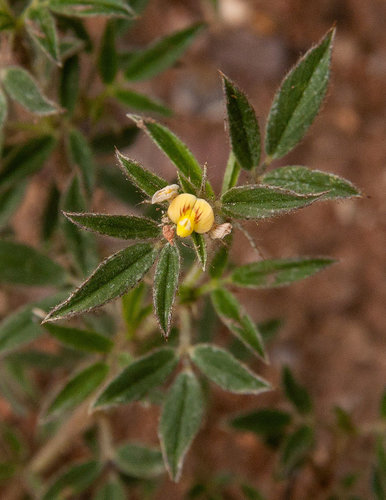
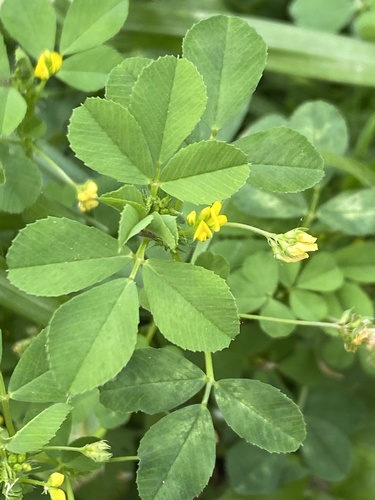
Medicago polymorpha L., commonly called burclover, is an annual broadleaf weedy forb. It grows in agricultural land, roadsides, other disturbed areas, and lawns. Its burr seed capsules cling to the clothing or fur of passing animals to help the plant spread geographically. In late summer, it damages lawn quality: its leaves turn yellow, and it produces 7 mm seed heads covered in hooked prickles. Burclover is good forage for livestock, though its fruit is prickly. All livestock classes except horses and mules can eat its leaves. New seedlings have oblong seed leaves, with a single rounded first true leaf. Later leaves are tripartite, with a characteristic clover-like shape that grows alternately on stems; leaflets have slightly serrated edges. Its tiny yellow flowers attract small butterflies and other pollinating insects. Mature stems reach up to 2 feet (60 cm) long, and usually sprawl along or under the ground. Stems often grow roots at their nodes, so even young plants that have grown undisturbed for a few weeks are very difficult to pull out. Pulling typically leaves tap roots and fragments of the plant network behind, and removing only top growth mechanically does not usually eradicate the plant. If not properly managed, burclover can become invasive and displace more desirable vegetation. As a member of the legume family Fabaceae, it produces clover-like, lipped, clustered flowers. In the plant's native territory, flowering occurs from March to June. The small 3–6 mm long bright yellow flowers grow in clustered flower heads of 2 to 10 flowers at stem tips. Its fruit is a pod that coils tightly 2 to 6 times, with rows of prickles along the pod's outer edge. Fruits are about 6–7 mm across; they start out green and relatively soft, then quickly turn brown and hard. Inside the pod are several kidney-shaped seeds, usually yellow or tan. The burred fruiting bodies are very difficult to remove from soft fabrics like fleeces and knitted socks. The plant is edible and eaten as a vegetable in China, primarily in Jiangsu, Zhejiang, and Shanghai. It has several Chinese culinary names: 草頭 (Wu: tsho-doe, Mandarin Pinyin: cǎo tóu), 金花菜 (Wu: cin-hau tse, Mandarin Pinyin: jīn huā cài), 三叶菜 (sān yè cài), and 秧草 (yāng cǎo), while 南苜蓿 (nán mùxu) is its Chinese scientific name. It is also consumed by indigenous Otomanguean communities in Southern Mexico, where it is called kkweej chakáj in the Triqui language, meaning 'edible green (of the) pig.'