About Mansoa alliacea (Desv. ex Beauverd) A.H.Gentry
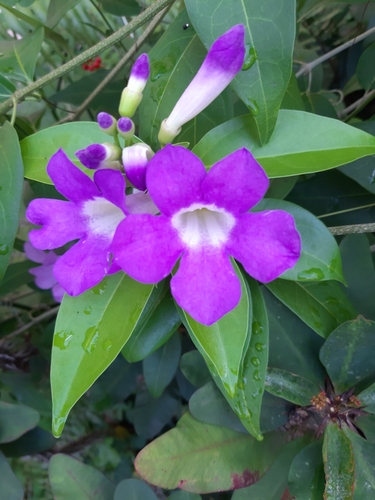
Mansoa alliacea (Desv. ex Beauverd) A.H.Gentry grows as either a shrub or a liana, producing numerous woody shoots from its root system and reaching a height of 2 to 3 meters. Its stems are mostly bare and slightly scaly. Its short-stalked leaves are arranged oppositely and are trifoliate, with petioles that can grow up to 3 centimeters long. The leaflets are slightly leathery, short-stalked, shaped from egg-shaped to elliptical, they are almost glabrous, slightly scaly, have entire margins, a rounded to pointed tip, and usually a pointed base, which is rarely rounded or truncated. The middle leaflet is often replaced by a long, usually three-part tendril that often falls off. Leaflets are slightly glandular, measure 10 to 27 centimeters long, and have leaflet stalks up to 3 centimeters long. Its pseudo stipules are inconspicuous. This species is native to tropical South America, where it grows wild in tropical rainforests including Brazil's Amazon forest, as well as in Ecuador, Peru, Colombia, Venezuela, the Guianas, and also occurs in Costa Rica. It has been exported overseas and grows in favorable climates in locations including Puerto Rico, Southern Africa, Thailand, and India, and it is cultivated in the West Indies. Among Amazon rainforest mestizos, it is called ajo sacha, a Spanish-Quechua name meaning "forest garlic" or "wild garlic". In the Amazon, it is used as a herbal remedy to treat pain and inflammation from arthritis and rheumatism, as well as colds, flu, fever, diarrhea, and skin ulcers. Its bark is added to ayahuasca preparations. Capsule and leaf products made from the plant are sold in stores in Brazil and Peru, and it appears as an ingredient in several multi-herb formulas marketed for colds, flu, and pain.