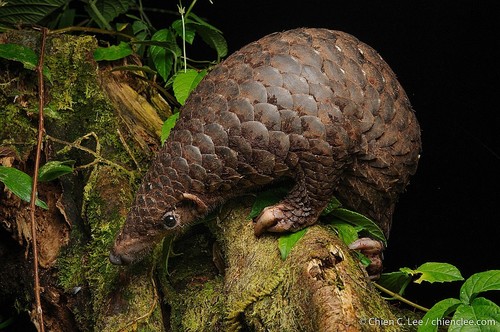
About Manis javanica Desmarest, 1822
Scientific Name
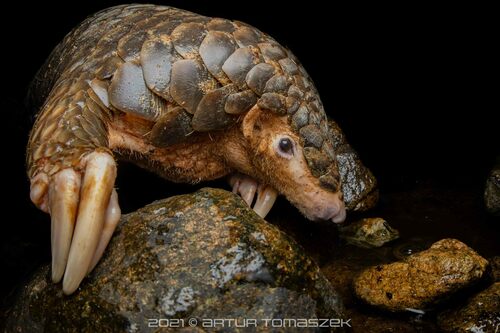
The Sunda pangolin, scientifically Manis javanica Desmarest, 1822, has granular skin on its feet, with distinct pads present on its front feet.
Claw Morphology
It has thick, powerful claws that it uses to dig into soil to find ant nests or tear open termite mounds.
Sensory Traits
This species has poor eyesight, but a highly developed sense of smell.
Feeding Anatomy
Since it lacks teeth, it uses a long, sticky tongue to collect ants and termites.
Scale Covering
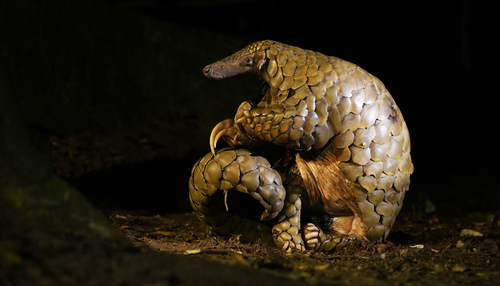
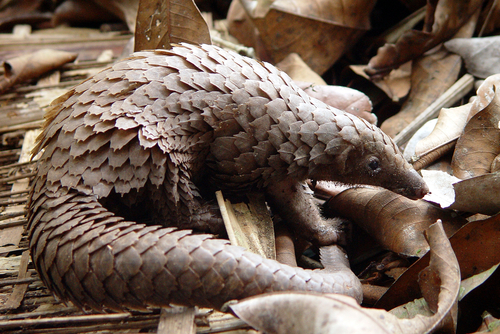
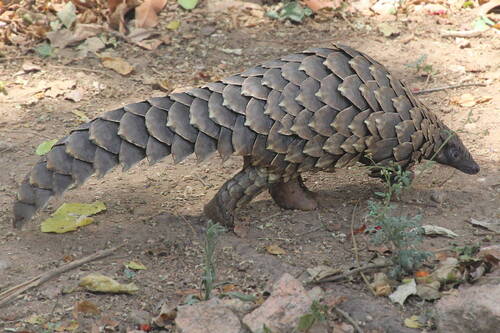
Unlike most other mammals, all pangolins are covered in rows of keratin scales and fibrous hair that act as protection from danger.
Scale Coloration
The Sunda pangolin’s scales are typically brown; some individuals have white scales along their tails for reasons that are currently unknown.
Body Measurements
This species reaches a head-body length of 40–65 cm (16–26 in), a tail length of 35–56 cm (14–22 in), and can weigh up to 10 kg (22 lb).
Sexual Size Dimorphism
Males grow larger than females.
Female Nipple Traits
Mature female Sunda pangolins have needle-like nipples for nursing young. Nipples do not grow or change visibly during nursing, and they are already present before the female reaches maturity.
Olfactory Adaptation Hypothesis
Researchers have suggested that pangolins have enlarged olfactory bulbs compared to other mammals, which aligns with their reliance on smell to feed using their snouts and tongues. This hypothesis has been supported by research conducted on the African tree pangolin, Phataginus tricuspis.
Auditory and Visual Adaptations
The auditory and visual systems of pangolins are not exceptionally developed, though research indicates their eye anatomy is well-adapted for nocturnal vision.
Reproductive Output
In terms of behaviour and ecology, Sunda pangolins give birth to one or two offspring each year.
Breeding and Birthing Timing
They breed in autumn, and females give birth inside a winter burrow.
Birthing Den Preference
When preparing for birth, females shift their den preference to favour hollows in mature forest trees. It is thought these hollows provide better protection and stability for the reduced mobility that occurs during birthing and caring for young.
Parental Care Period
Mothers spend more time at each individual den during the parental care period, which lasts approximately three months.
Home Range During Parental Care
Over these three months, the mother’s home range shrinks drastically, as she travels and forages while accompanied by her offspring.
Pre-Independence Activity Shift
Just a few weeks before the offspring becomes fully independent, the mother and her young show brief increases in diurnal activity.
Social and Activity Patterns
Sunda pangolins are occasionally found in pairs, but they are normally solitary, nocturnal, and timid.
Anti-Predator Behavior
When they feel threatened, they roll into a ball to protect their soft underparts.
Burrowing Behavior
They are strong diggers that create vegetation-lined burrows for insulation near termite mounds and ant nests.
Immunity Traits
Sunda pangolins have low immunity, which makes them sensitive to temperature fluctuations.
Predators
Their main predators are humans, tigers, and clouded leopards.
Distribution Range
Compared to other pangolin species, the Sunda pangolin has a much wider distribution across Southeast Asia.