About Manis gigantea Illiger, 1815
Taxonomy and Size Ranking
The giant pangolin, scientifically named Manis gigantea Illiger, 1815, is the largest of all pangolin species.
Recorded Weight
No average mass for the species has been measured, but one recorded specimen weighed between 30 kg (66 lb) and 40 kg (88 lb).
Body Length
Males grow larger than females: male body lengths range from about 137 cm (54 in) to 180 cm (71 in), while female body lengths range from about 112.5 cm (44.3 in) to 136.5 cm (53.7 in).
Scale Characteristics
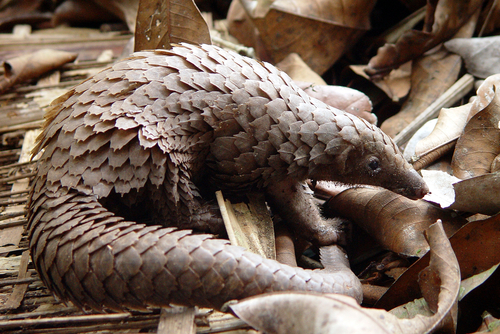
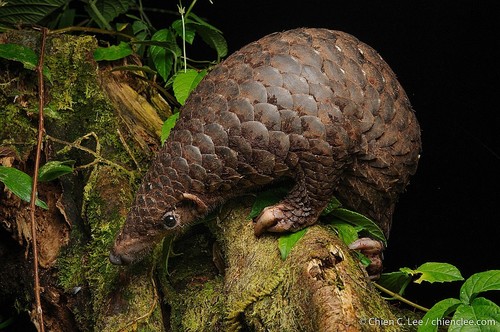
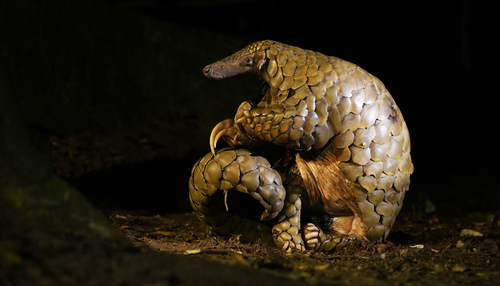
Like all pangolins, the giant pangolin has an armor of large, keratin-based scales that range in color from brown to reddish-brown.
Distinct Facial Features
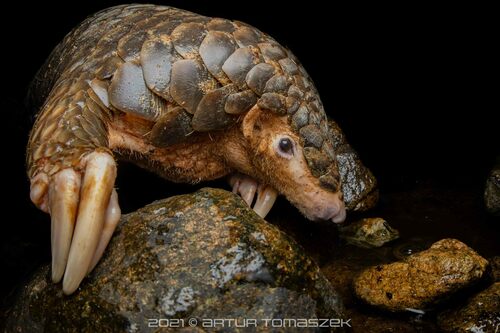
Notably, it also has eyelashes.
Body Morphology
It has a long snout, a long thick tail, and large front claws.
Sensory and Gland Traits
The giant pangolin has a strong sense of smell and large anal glands, whose secretions are thought to play an important role in animal communication.
Front Paw Walking Adaptation
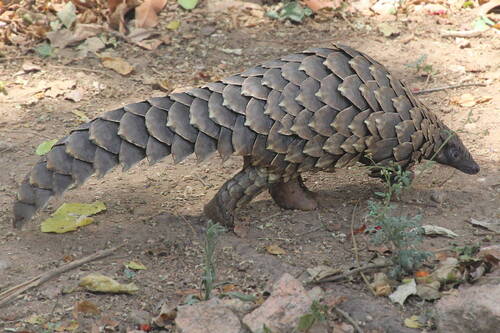
When walking, it carries most of its weight on its sturdy columnar rear legs, and curls its front paws to walk on the outer sides of its wrists instead of its palms, which protects its claws.
Bipedalism Comparison
Unlike its close relative the ground pangolin, the giant pangolin does not walk upright as a biped.
Population Distribution
The giant pangolin lives across multiple countries, with the largest population concentration found in Uganda and Tanzania.
Habitat Preferences
It primarily occurs in savannas, rainforests, and forests, and only occupies areas that have large termite populations and access to water.
Altitude Range General
It does not normally inhabit high-altitude areas.
Kenya Sightings
A small number of sightings have been recorded in western Kenya within the East African montane forests; the first of these sightings was reported in 1971, with additional sightings made in 2018.
Maximum Recorded Altitude
One of the 2018 sightings was of an individual at 2,466 metres (8,091 ft) above sea level, which is the highest altitude the giant pangolin has ever been recorded at.
Activity Pattern
Like other pangolins, the giant pangolin is nocturnal, which makes it difficult for researchers to observe.
Social Behavior
It is also typically solitary, though one observation has documented an adult sharing a burrow with a juvenile.
Reproduction Research Status
Very little is known about the reproduction of the giant pangolin.
Birth Records
Only two birth records exist for the species: one birth occurred in September, the other in October, and the newborn in each case weighed around 500 g (18 oz).
Neonatal Traits
As with all pangolins, giant pangolin infants are born with soft scales that harden as they mature, and are born with open eyes.
Newborn Locomotion
Newborn giant pangolins cannot walk on their legs, but can move by crawling on their bellies.
Juvenile Anal Gland Secretion
When they are between 6 and 8 weeks old, young giant pangolins often spew a yellow secretion from their anal glands that is commonly described as smelling like decay and cabbage.
Secretion Function
This secretion is used to deter predators and other animals from harming their mothers.