About Macrovipera lebetinus (Linnaeus, 1758)
Common Name and Species Classification
Macrovipera lebetinus, commonly called the blunt-nosed viper, is a large viper species.
Body Length
Females reach a total length of 150 cm (59.1 inches, approximately 5 feet), while males are slightly smaller, usually reaching 1.1 m (3 and a half feet) in total length.
Population Size Variation
Size varies between different populations, with the nominate subspecies M. l. lebetina being somewhat smaller.
Head Shape
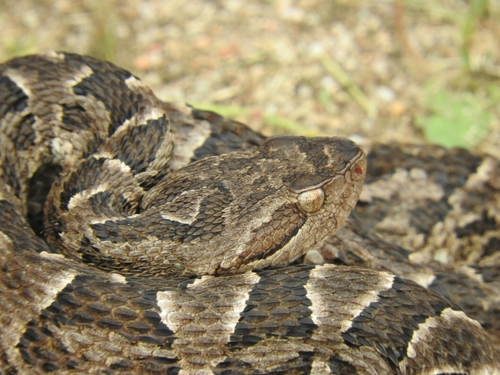
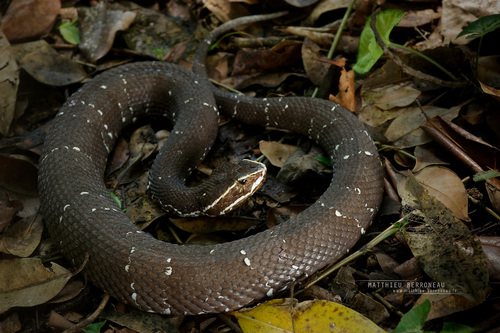
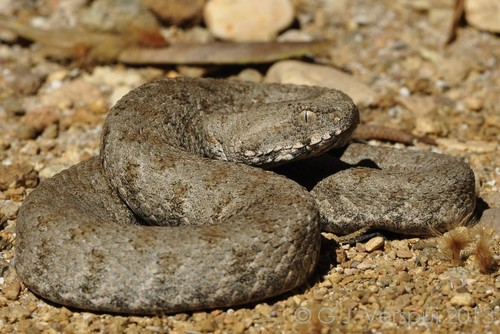
This species has a broad, triangular head that is clearly distinct from the neck.
Snout Morphology
When viewed from above, the snout is rounded and blunt, which gives the species its common name.
Nasal Scale Structure
The nasal and nasorostral scales are almost completely fused into a single plate, though some variation in this trait is seen.
Dorsal Scale Characteristics
Dorsal scales are strongly keeled, with the exception of the scales that border the ventrals.
Ventral and Anal Scale Features
The nominate subspecies M. l. lebetina usually has between 146 and 163 ventral scales, and the anal scale is single.
Color Pattern Variability
Despite its wide distribution, the color pattern of this species is less varied than expected.
Head Coloration
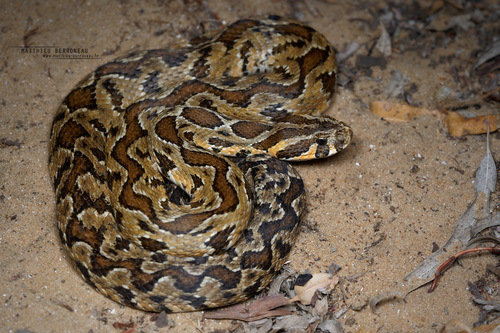
The head is normally uniformly colored, though it may occasionally be marked with a dark V-shape.
Dorsal Ground Color
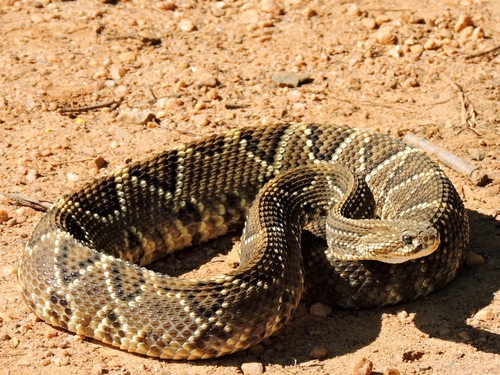
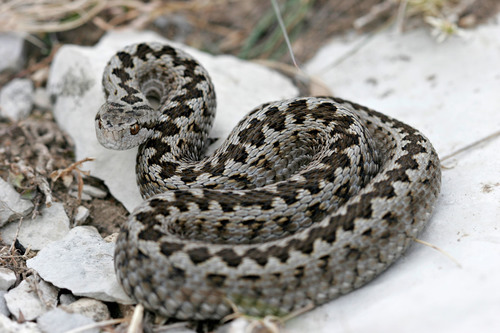
Dorsally, the body's base ground color can be gray, brown, beige, pinkish, olive, or khaki.
Dark Pattern Color Range
Any darker pattern that is present can be gray, bluish, rust, or brown.
Dorsal Spot Arrangement
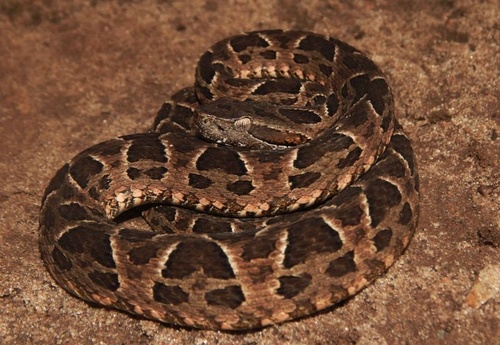
This pattern usually takes the form of a single middorsal row, or a double row, of large spots.
Double Spot Row Patterns
When two rows of spots are present, the spots may alternate or oppose each other, creating patterns ranging from saddled to a continuous zigzag.
Spot Color Variation
Spots are most often brown, dark gray, or black, but may sometimes be red, brick-colored, yellow, or olive.
High Temperature Habitat
This viper can be found under short trees with thick shade when outside temperatures are greater than 45 °C.
Geographic Range
Its confirmed geographic range includes Algeria, Tunisia, Cyprus, Turkey, Syria, Jordan, Israel, Lebanon, Iraq, Iran, Russian Caucasia, Armenia, Georgia, Azerbaijan, Turkmenistan, Uzbekistan, Kazakhstan, Tajikistan, Afghanistan, Pakistan, and Indian Administered Kashmir.
Yemen Occurrence Record
Scortecci reported this species from Yemen in 1929.
Original Type Locality
The originally given type locality for the species is "Oriente".
Restricted Type Locality
In 1928, Mertens and L. Müller suggested restricting the type locality to "Cypern", which is Cyprus.