About Lynx pardinus (Temminck, 1827)
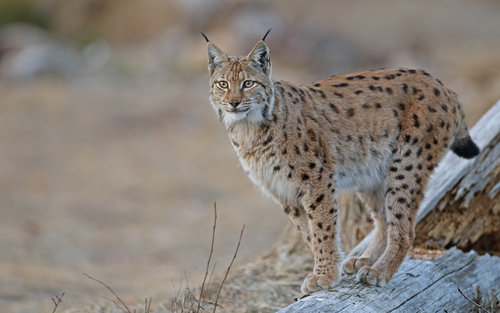
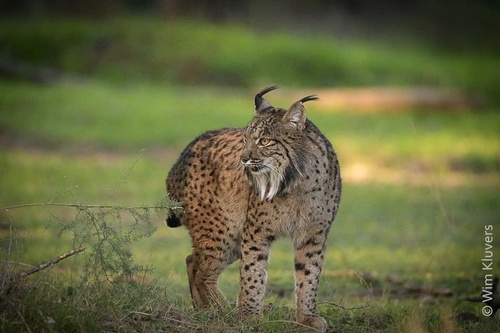
The Iberian lynx, scientifically named Lynx pardinus (Temminck, 1827), has short bright yellowish to tawny spotted fur. Its spots vary in shape and size, ranging from small round forms to elongate shapes; the spots are arranged in lines, and decrease in size from the back toward the sides. There are two distinct basic coat pattern variations: one found in Sierra Morena has many very small brown to blackish spots, while the other found in Doñana has fewer larger spots that form dotted lines. This species has a small head with tufted ears and a ruff, a short body, long legs, and a short tail. Males have a head and body length between 74.7–82 cm (29.4–32.3 in), a tail 12.5–16 cm (4.9–6.3 in) long, and weigh 7–15.9 kg (15–35 lb). Females are smaller, with a head-to-body length of approximately 68.2–77.5 cm (26.9–30.5 in) and a weight of 9.2–10 kg (20–22 lb). Fully white-furred Iberian lynx have only been recorded twice in total; the first ever photographed white Iberian lynx was documented on 22 October 2025 in Jaén, Spain. The Iberian lynx was once distributed across the entire Iberian Peninsula. In the 1950s, its northern population ranged from the Mediterranean to Galicia and parts of northern Portugal, and its southern population ranged from central to southern Spain. Its populations declined from 15 subpopulations in the 1940s to just two subpopulations in the early 1990s, with the sharpest declines seen in Montes de Toledo and Sierra Morena. Before 1973, it occurred in Sierra de Gata, Montes de Toledo, eastern Sierra Morena, Sierra de Relumbrar, and the coastal plains of the Doñana area. Between the early 1960s and 2000, the species lost around 80% of its former range. In 2012, it was restricted to very limited areas of southern Spain, with breeding only confirmed in Sierra Morena and the Doñana coastal plains. As of 2014, its range included Sierra Morena and Montes de Toledo in Castilla-La Mancha, the Matachel Valley of Extremadura in Spain, and the Guadiana Valley in Portugal. By the end of 2019, stable, viable populations had become established and total individual counts reached 856. As of 2024, 2,401 individuals have been counted: 2,047 in Spain and 354 in Portugal. Its distribution area has expanded, with breeding individuals now found in the northern and central parts of Extremadura (in Valdecañas and Cornalvo Nature Park), the Albacete region of Castilla-La Mancha, and the Sierras Subbéticas in Andalusia; an introduction project has also been launched in the autonomous region of Murcia. Fossil remains show that the Iberian lynx had an even wider range during the Late Pleistocene and early Holocene. Five lynx remains found in Arene Candide, Northern Italy, date to between 24,820–18,620 years before present. One specimen found in Cabias cave in southern France was radiocarbon dated to 3780±90 years before present. In 2021, a large concentration of 40,000-year-old Iberian lynx remains was discovered for the first time at the Ingarano archaeological site in Apulia, southern Italy. The Iberian lynx marks its territory using urine, scratch marks on tree bark, and scat. Adult home ranges remain stable over many years. Camera trapping surveys carried out in the eastern Sierra Morena Mountains between 1999 and 2008 found that six females had home ranges of 5.2–6.6 km2 (2.0–2.5 sq mi), while four males in the same area had home ranges of 11.8–12.2 km2 (4.6–4.7 sq mi). For reproduction, Iberian lynx kittens become independent between 7 to 10 months old, but stay with their mother until around 20 months old. Young survival depends heavily on the availability of prey. In the wild, both males and females reach sexual maturity at one year old, though they rarely breed until a territory becomes vacant; one recorded female did not breed until she was five years old, when her mother died. The maximum longevity of the Iberian lynx in the wild is 13 years. Difficulty finding mates leads to increased inbreeding, which results in fewer kittens and a higher rate of non-traumatic death. Inbreeding also causes lower semen quality and higher infertility rates in males, which hinders efforts to improve the species' overall fitness.