About Lynx lynx (Linnaeus, 1758)
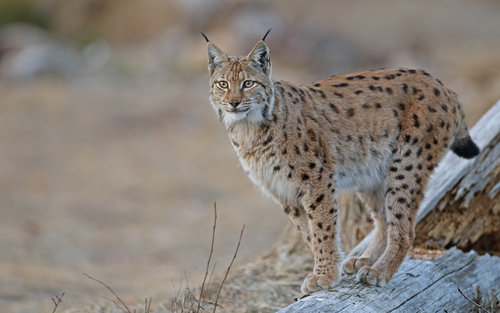
The Eurasian lynx has a relatively short, reddish or brown coat marked with black spots, whose number and pattern vary greatly. Its underparts, neck, and chin are whitish. Individuals living at the southern end of the species’ range have more brightly colored fur with a greater number of spots. In winter, the fur becomes much thicker, and ranges in color from silver-grey to greyish brown. Some individuals have dark brown stripes across the forehead and back. This species has powerful, relatively long legs, with large webbed and furred paws that function like snowshoes. It also has a short "bobbed" tail with a completely black tip, black tufts of hair on its ears, and a long grey-and-white ruff. It is the largest of the four existing lynx species. Males measure 76–106 cm (30–42 in) in body length, while females measure 73–99 cm (29–39 in), and all individuals stand 55–75 cm (22–30 in) tall at the shoulder. The tail is 11–24.5 cm (4.3–9.6 in) long, bringing the total body length of the largest males up to 130 cm (51 in). For both sexes in Russia, body weight ranges from 12 to 32 kg (26 to 71 lb), but weights over 30 kg (66 lb) are achieved very rarely and may be exaggerated. A Eurasian lynx from the Altai Mountains has been reported to weigh 35 kg (77 lb). Individuals living in Fennoscandia and areas further west are considerably smaller, with weights ranging only 7–26 kg (15–57 lb), though individuals from the Carpathian Mountains can reach sizes comparable to those from the Altai. The Eurasian lynx lives in rugged terrain that provides plenty of hideouts and stalking opportunities. Depending on the location, this habitat can include rocky-steppe, mixed forest-steppe, boreal forest, and montane forest ecosystems. In the more mountainous parts of its range, Eurasian lynx move down to lowlands during winter, following prey species and avoiding deep snow. Even though the species has adaptations for moving through snow, it struggles with loose, deep snow, and cannot survive in areas with snow depths over 100 cm (39 in). It tends to be less common in areas where grey wolves (Canis lupus) are abundant, and wolves have been recorded attacking and even eating lynx. The Eurasian lynx’s mating season runs from January to April. Females typically enter oestrus only once during this season, with each oestrus period lasting four to seven days. If a first litter is lost, a second oestrus period is common. The species does not appear able to adjust its reproductive behavior based on prey availability. Gestation lasts 67 to 74 days. Pregnant females build dens in secluded locations, often sheltered by overhanging branches or tree roots. The den is lined with feathers, deer hair, and dry grass to create bedding for newborn kittens. At birth, Eurasian lynx kittens weigh 240 to 430 g (8.5 to 15.2 oz) and open their eyes 10 to 12 days after birth. Kittens initially have plain, greyish-brown fur, and develop full adult coloration around 11 weeks of age. They start eating solid food at six to seven weeks old, when they also begin leaving the den, but are not fully weaned until they are five or six months old. The den is abandoned two to three months after the kittens are born, but young lynx typically stay with their mother until they are around 10 months of age. Eurasian lynx reach sexual maturity at two or three years old, and have lived up to 21 years in captivity. Females usually give birth to two kittens per litter, and litters with more than three kittens are rare.