About Lupinus angustifolius L.
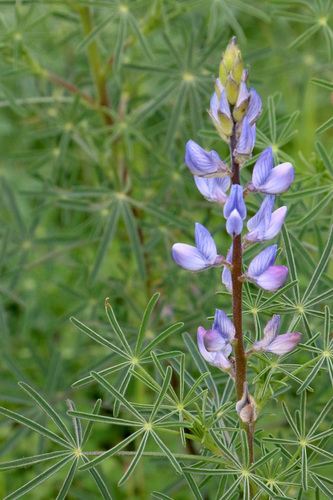
Lupinus angustifolius L. is a lupin species with several common names, including narrowleaf lupin, narrow-leaved lupin, and blue lupin. It is native to Eurasia and northern Africa, and has become naturalized in parts of Australia and North America. This species has been cultivated for more than 6000 years, used as a food crop for its edible legume seeds, as livestock fodder, and as green manure. Domestication of narrow-leaved lupin is thought to have begun in the 1930s to 1940s, when the discovery of alkaloid-free mutants allowed plant breeders in Germany and Sweden to develop the first forage cultivars. The first fully domesticated varieties of L. angustifolius were developed in the 1960s by John Gladstones at the University of Western Australia. After that, plant breeders in Germany, Poland, Belarus, and Russia used Australian sweet, non-shattering L. angustifolius genetics to create sweet grain varieties adapted to northern European conditions. These varieties have improved flowering time regulation, more uniform maturation, better tolerance to cool environments, and increased resistance to fungal diseases. Australia uses the common name 'Australian sweet lupin' to highlight that its domesticated narrow-leafed lupin has total alkaloid levels that meet the Food Standards Australia and New Zealand standard of 0.02% total alkaloids or less in seeds. Blue lupin production grew quickly in Western Australia through the 1980s and 1990s, but ongoing weed issues and falling market prices made cultivation less profitable and harder to manage. As a result, many growers switched to growing canola or left fields fallow, leading to a sharp production decline: from a peak of 1.5 million tonnes in 1999 to just under 300,000 tonnes in 2012. In 2023, Western Australia produced 400,000 tonnes of blue lupin. Poland, the world's second largest producer of lupins after Australia, has seen narrow-leaved lupins grow in importance in recent years. In Russia, the area planted with narrow-leaved lupins reached 78,971 hectares in 2019. This plant is used as green manure, or as a grain legume for animal feed or human consumption. Thanks to its ability to fix nitrogen and its low nutrient requirements, it works well as a soil improver when planted on exhausted fields. Its strong roots can also reduce soil compaction. The entire plant, including its seeds, is widely used as livestock fodder, because it has high protein and energy content. Lupins have high levels of fermentable carbohydrates and low levels of starch, making them a suitable feed for ruminants. They are also a valuable feed for monogastric animals, due to the high digestibility of lupin nitrogen and their low level of protease inhibitors. For human consumption, lupins are mainly eaten as fermented foods, bread and pasta products, milk products, or sprouts. As of 2020, only 4% of lupin produced is consumed by humans, with the vast majority used as stock feed. Lupin beans are seeing increasing use as a plant-based protein source in global markets.