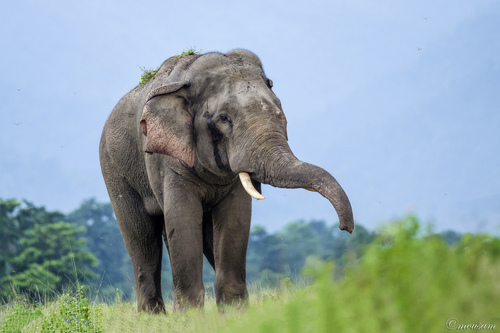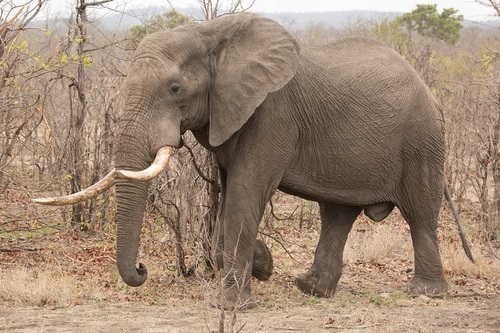
About Loxodonta cyclotis (Matschie, 1900)
Scientific Name and Size Comparison
The African forest elephant, scientifically named Loxodonta cyclotis (Matschie, 1900), is considerably smaller than the African bush elephant, though estimates of its full size have been contradictory.
2000 Size Study Findings
A 2000 study found that adult males (bulls) reach a shoulder height of 2.4–3 m (7.9–9.8 ft) and weigh 4–7 t (4.4–7.7 short tons), while adult females (cows) reach a shoulder height of 1.8–2.4 m (5.9–7.9 ft) and weigh 2–4 t (2.2–4.4 short tons).
2003 Gabonese Reserve Size Data
However, a 2003 study of forest elephants at a Gabonese reserve did not record any elephants taller than 2.16 m (7.1 ft).
2015 Size Study Findings
A 2015 study alternatively suggested that fully grown male African forest elephants in optimal condition average only 2.2 m (7.2 ft) tall and 2 t (2.2 short tons) in weight, with the largest individuals—making up less than 1 in 100,000 of the total population—reaching no more than 2.75 m (9.0 ft) tall and 3.5 t (3.9 short tons) in weight.
Skin Appearance
This species has grey skin that takes on a yellow to reddish appearance after wallowing.
Body Hair Characteristics
Its body is sparsely covered in coarse black hair, which is 20–200 mm (0.8–8 in) long around the tip of the tail.
Tail Length Range
Individual tail lengths range from half the height of the rump to almost reaching the ground.
Toenail Count
African forest elephants have five toenails on their fore feet and four toenails on their hind feet.
Body, Ear and Trunk Features
Their back is nearly straight, their oval-shaped ears have small elliptical tips, and the tip of their trunk has two finger-like processes.
General Tusk Characteristics
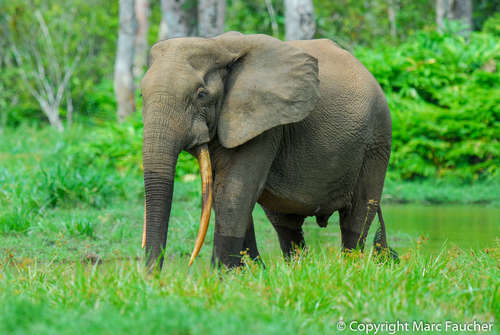
Both male and female African forest elephants have straight tusks that point downward; these tusks are pink, thinner and harder than those of the African bush elephant.
Tusk Growth Patterns
Tusk length and diameter vary between individuals. Bull tusks grow throughout life, while cow tusks stop growing once they reach sexual maturity.
Tusk Function
Tusks are used to push through dense undergrowth in the species' habitat.
Largest Confirmed Tusk Record
The largest confirmed tusk recorded for this species is 2.41 m (7.9 ft) long and 60 kg (130 lb) in weight.
Unconfirmed Large Tusk Record
A larger tusk measuring 2.96 m (9.7 ft) long and 70 kg (150 lb) has been recorded, but it may belong to a hybrid of African forest and African bush elephants.
Average Tusk Size Estimate
Average tusk size is uncertain because historical measurements were grouped together with those of African bush elephants, but based on the size of the largest known tusks, average tusks may fall in the range of 1.6–2 m (5.2–6.6 ft) long and 25–30 kg (55–66 lb) in weight.
Central African Distribution
African forest elephants are distributed across Central Africa, where populations live in large contiguous rainforest tracts from Cameroon to the Democratic Republic of the Congo.
Gabonese Population
The largest stable population lives in Gabon, where suitable habitat covers 90% of the country.
West African Distribution
They are also found in the evergreen moist deciduous Upper Guinean forests of Ivory Coast and Ghana in West Africa.
2015 Angola Sighting
In 2015, a group of about 10 to 25 African forest elephants was sighted in Kambondo forest, on the escarpment east of Luanda.
Population Decline Causes
It is estimated that the Central African African forest elephant population declined by around 86% over the 31 years preceding 2021, due to poaching and habitat loss.
Habitat Loss from Conflict
In areas including Cameroon, the Democratic Republic of the Congo, the Republic of the Congo and the Central African Republic, much appropriate forest habitat has been reduced after years of warfare and human conflict.
2021 Gabonese Population Estimate
As of 2021, an estimated 95,000 forest elephants live in Gabon; prior to this count, the population was estimated at 50,000 to 60,000 individuals.
Social Group Structure
African forest elephants live in family groups. Studies of groups in Gabon's Lopé National Park conducted between 1984 and 1991 found groups contained between three and eight individuals.
Large Group Observations
Groups of up to 20 individuals have been observed in the Dzanga-Sangha Complex of Protected Areas, made up of adult cows, their daughters and subadult sons.
Allomothering Behavior
Family members practice allomothering, meaning they care for calves collectively.
Adult Male Social Behavior
Once young bulls reach sexual maturity, they leave the family group and form loose temporary bachelor groups, but usually live alone. Adult bulls only associate with family groups during the mating season.
Home Range and Movement Rate
Family groups travel approximately 7.8 km (4.8 mi) per day and move within a home range of up to 2,000 km² (770 sq mi).
Seasonal Movement Drivers
Their seasonal movement is tied to the availability of ripe fruits in primary rainforests.
Trail Use
They use a complex network of permanent trails that pass through stands of fruit trees and connect forest clearings to mineral licks; these trails are reused by humans and other animals.
Fission-Fusion Society Evidence
In Odzala-Kokoua National Park, groups were observed meeting frequently at forest clearings, indicating the species has a fission–fusion society.
Group Interaction Behavior
Groups stayed longer when other groups were present, with smaller groups joining larger groups and bulls joining family units.
Female Sexual Maturity Age
Female African forest elephants reach sexual maturity between 8 and 12 years of age, depending on population density and available nutrition.
Female Breeding Interval
On average, they begin breeding at 23 years of age and give birth every 5–6 years. This results in a lower birth rate than that of the African bush elephant, which begins breeding at 12 years of age and produces a calf every 3–4 years.
Newborn Weight
Newborn African forest elephants weigh around 105 kg (232 lb) at birth.
Newborn Mobility
They can stand and move almost immediately after birth, which allows their mother to roam and forage, and also reduces the risk of predation.
Calf Suckling Behavior
Calves suckle using their mouth while holding their trunk over their head.
Tusk Emergence and Weaning
Tusks do not emerge until around 16 months of age, and calves are not weaned until they are roughly 4 or 5 years old. By this age, tusks are around 14 cm (5.5 in) long and start to interfere with suckling.
Lifespan and Puberty Timeline
African forest elephants have a lifespan of 60 to 70 years and mature slowly, reaching puberty in their early teens. Bulls generally reach puberty one to two years after females.
Musth Onset and Characteristics
Between 15 and 25 years of age, bulls experience musth, a hormonal state marked by increased aggression. During musth, males secrete fluid from the temporal gland located between the ear and eye.
Musth Duration Variation
Younger bulls typically experience musth for shorter periods, while older bulls experience it for longer.
Musth Visual and Scent Displays
When in musth, bulls walk more erectly with their head held high and tusks turned inward; they may rub their heads on trees or bushes to spread musth scent, and may flap their ears while producing a musth rumble to carry their scent toward other elephants.
Additional Musth Behavior
Additional musth-associated behaviors include urination: bulls allow urine to exit slowly and spray the inner sides of their hind legs.
Musth Function
All these behaviors advertise the musth state to receptive females and competing bulls.
Bull Herd Interaction
Bulls only return to the herd to breed or socialize; they do not provide parental care for offspring, but do act in a fatherly role toward younger bulls to display dominance.
Breeding Seasonality
Females are polyestrous, meaning they can conceive multiple times per year, so the species does not have a fixed breeding season. However, conceptions do peak during the year's two rainy seasons.
Conception Details
Females generally conceive after two or three matings. While the female uterus has enough space for twins, twin conceptions are very rare.
Gestation Period
Gestation lasts 22 months.
Population Growth Potential
Based on the species' maturity, fertility, and gestation rates, African forest elephant populations can increase by 5% annually under ideal conditions.