About Loxodonta africana (Blumenbach, 1797)
Skin and Hair
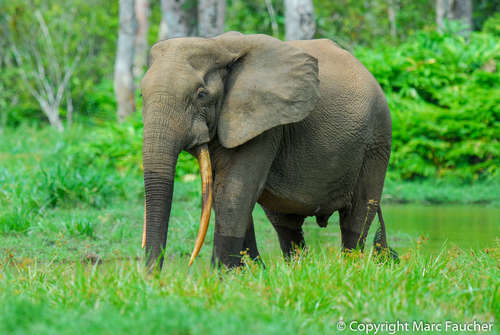
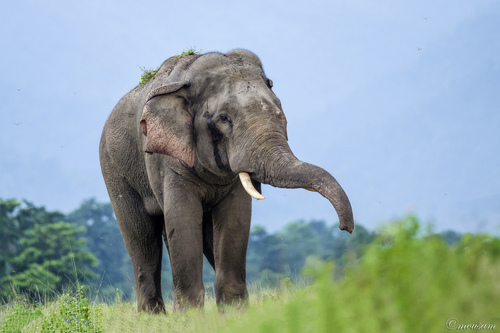
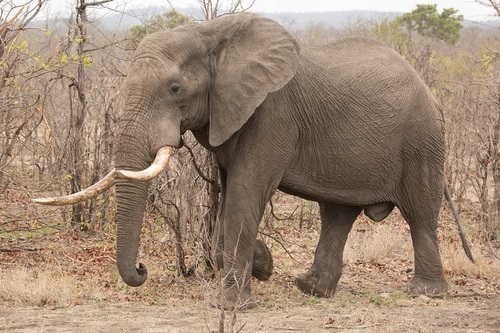
The African bush elephant (Loxodonta africana) has grey skin with very few hairs.
Ear Structure and Function
Its large, pointed, triangular ears can grow up to 2 m × 1.5 m (6 ft 7 in × 4 ft 11 in) and cover the entire shoulder; flapping these ears creates air currents and exposes large inner blood vessels to help the elephant lose excess body heat in warm weather.
Body and Trunk Features
This species has a forward-sloping occipital plane, a distinctly concave back, sturdy tusks that curve outward and point forward, and a long trunk ending in two finger-like tips.
Geographic Range
African bush elephants are found across sub-Saharan Africa, including the countries of Uganda, Kenya, Tanzania, Botswana, Zimbabwe, Namibia, Zambia, Angola, Malawi, Mali, Rwanda, Mozambique and South Africa.
General Habitat Use
They occupy a wide range of habitats from sea level up to mountain slopes, including subtropical and temperate forests, dry and seasonally flooded grasslands, woodlands, wetlands, and agricultural land.
Arid Habitat Adaptation
In Mali and Namibia, they also live in desert and semi-desert areas.
Southern Africa Population Growth
Some regional African bush elephant populations are growing. In South Africa's Kruger National Park, annual population growth of 4.2% was recorded between 2003 and 2015, with an estimated 17,000 elephants in the area as of 2015—the largest population in the country.
Kruger National Park Population Management
This growth followed the end of culling in the mid-1990s, but the large population is now considered problematic for the local environment and its wildlife, so conservationists aim to manage growth using natural processes.
Southern Africa Population Status
Populations are also increasing across other parts of southern Africa; Botswana holds more African bush elephants than any other country, with 130,000 individuals. A 2019 study found overall regional populations were steady, but noted an unusual rise in elephant carcasses, potentially linked to a new wave of poaching that was previously uncommon in the area.
East Africa Population Size
In East Africa, roughly 137,000 elephants are spread across six countries across grassland and woodland habitats.
East Africa Poaching Impact
The main threat to this population is illegal hunting and poaching: between 2006 and 2013, East Africa's African bush elephant population dropped by 62% due to heavy poaching pressure. Tanzania, which holds 80% of East Africa's population, lost the most elephants, while the species became locally extinct in Somalia.
East Africa Conservation Successes
In contrast, South Africa saw an elephant population increase, and Kenya has also recorded population growth following successful conservation and government action.
Ethiopia Historical Distribution
In Ethiopia, African bush elephants were historically found at elevations up to 2,500 m (8,200 ft). By the late 1970s, the population had declined to only two remaining groups: one in the Dawa River valley, and one near the Kenyan border.
Ethiopia Population Trend
As of 2015, Ethiopia has an estimated 1,900–2,151 elephants, down from 6,000–10,000 in the 1970s. It is estimated that between the 1980s and 2010s, Ethiopia's elephant population declined by roughly 90%, leading to the species being classified as endangered there.
West Central Africa Threats
In West and Central Africa, elephant populations are primarily threatened by habitat loss and fragmentation linked to rapid human population growth. Elephants only occur in isolated pockets across the region, and most local populations are decreasing.
Habitat Conversion Impact
Large areas of sub-Saharan African habitat have been converted for agriculture and infrastructure development. This transformation eliminates stable habitat for African bush elephants and restricts their ability to roam freely.
Additional Habitat Fragmentation Causes
Commercial logging and mining operations have further fragmented land, giving poachers easier access to elephants.
Human-Elephant Conflict
As human development expands, human-elephant contact becomes more frequent, as elephants search for food and water. Farmers often come into conflict with elephants that damage their crops, and frequently kill elephants that enter villages or forage on crops.
Other Mortality Causes
Deaths from browsing the invasive rubber vine plant have also been recorded.
Male Sexual Maturity
For reproduction, spermatogenesis begins in male African bush elephants around 15 years of age, but males do not start sexual cycles or experience their first musth until they are 25 to 30 years old.
Female Sexual Cycle
Females ovulate for the first time at 11 years old, and are in estrus for 2 to 6 days. In captive individuals, the oestrous cycle lasts 14 to 15 weeks.
Fetal Development
Fetal gonads enlarge during the second half of pregnancy.
Mating Season
African bush elephants mate during the rainy season.
Musth Male Mating Behavior
Musth males travel long distances to find females, join large family units, listen for females' loud low-frequency calls, and attract females by calling and leaving strong-smelling urine trails.
Female Mating Behavior
Females seek out musth males, follow their calls and urine trails. Musth males have more mating success than non-musth males.
Mating Dynamics
A female may move away from males that attempt to check her estrous condition, and will run away if pursued by multiple bulls. After a female chooses a mating partner, she stays away from other bulls, which the chosen bull threatens and chases away.
Mating Competition
Competition between bulls can sometimes override the female's choice of partner.
Gestation Period
After mating, females have a 22-month gestation period.
Birth Interval Variation
Birth interval estimates vary by location and hunting pressure: 3.9 to 4.7 years in Hwange National Park, 2.9 to 3.8 years in 1970s areas with high adult hunting pressure, and an average of 5 years in Amboseli National Park.
Observed Birth Event
One elephant birth was observed in Tsavo East National Park in October 1990. 80 elephants including eight bulls gathered within a 150 m (490 ft) radius of the birth site that morning.
Pre-Birth Social Behavior
A small group of calves and females stood near the pregnant female, rumbling and flapping their ears, and one female appeared to assist the pregnant mother.
Birth Process
During labour, fluid drained from the mother's temporal and ear canals, and she gave birth while standing. The newborn calf got to its feet within 30 minutes and was able to walk 20 minutes after birth.
Post-Birth Maternal Behavior
The mother expelled the placenta around 100 minutes after birth and immediately covered it with soil.
Calf Growth Rate
Captive-born calves weigh 100 to 120 kg (220 to 260 lb) at birth, and gain around 0.5 kg (1.1 lb) per day.
Lactation Period
Females lactate for roughly 4.8 years.
Calf Feeding Development
Calves only nurse from their mother for the first three months, after which they begin independent feeding and slowly increase feeding time until they reach two years of age.
Calf Nursing Differences
During the first three years, male calves spend more time nursing and grow faster than female calves. After this period, females reject male calves from nursing more often than they reject female calves.
Lifespan and Generation Length
The maximum lifespan of the African bush elephant is 70 to 75 years, and its generation length is 25 years.