About Lotus corniculatus L.
Plant Classification and Height
Lotus corniculatus L. is a perennial herbaceous plant. Its height varies between 5 to 20 centimetres (2 to 8 inches), and may occasionally grow taller when supported by other plants; its stems can reach up to 50 cm (20 in) long.
Common Name Origin
The common name 'bird's foot' comes from the appearance of its seed pods attached to their stalk.
Leaf Characteristics
Its leaves have five leaflets, with the central three held noticeably above the other two, which explains why it is also called 'trefoil'. It has no tendrils.
Flower Structure
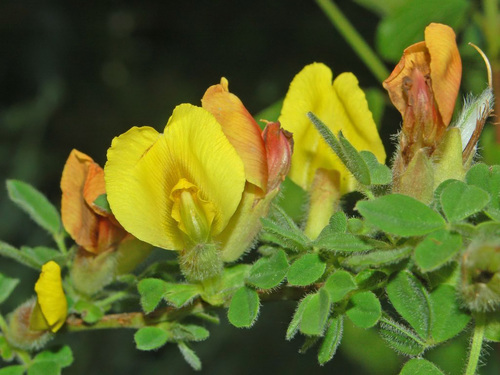
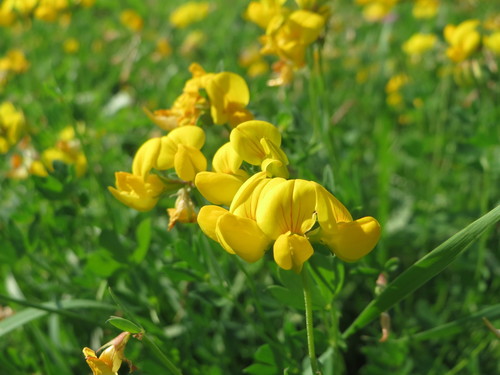
Its flowers grow in clusters on a moderately long stalk. The five green sepals are fused into a tube that surrounds the base of the petals. The five yellow petals have a shape typical of pea plants: the lower two petals are fused into a boat shape, the uppermost petal is erect, and the remaining two form side wing structures. The 10 stamens and single carpel are hidden by the petals.
Flowering and Fruiting
Flowers bloom from June to September, and after blooming develop into small pea-like pods or legumes.
Regional Common Names
In Britain, this plant had many common English names that are now mostly out of use. Most of these old names referred to the yellow and orange colour of the flowers, an example being 'butter and eggs'. One common name that remains in use is eggs and bacon (or bacon and eggs). Its leaves have a similar appearance to the leaves of some clovers.
Native Distribution
Lotus corniculatus has a broad worldwide distribution. It is native to temperate Eurasia and North Africa, and is common across all of Britain and Ireland.
Habitat Preferences
It grows in habitats including old fields, grassy areas, and roadsides. It typically grows sprawling, matching the height of the surrounding grassland. It can tolerate fairly close grazing, trampling, and mowing, and is most often found in sandy soils.
Flower Visitors
Bumblebees are the most common visitors to its flowers. In the Chicago Region, mostly non-native bees have been observed visiting the flowers, including Andrena wilkella, Anthidium oblongatum, Apis mellifera and Megachile rotundata. Native bees Bombus impatiens and Megachile relativa have also been observed visiting Lotus corniculatus flowers, though Megachile relativa visits only rarely.
Ecological Role
This plant is an important nectar source for many insects, and is also used as a larval food plant by many Lepidoptera species, such as the six-spot burnet and the silver-studded blue. It is also a host plant for the wood white butterfly, Leptidea sinapis.
Agricultural Uses
In agriculture, it is used as a forage plant, grown for pasture, hay, and silage. It is a high quality forage that does not cause bloat in ruminants, and taller-growing cultivars have been developed specifically for this use. It may be used as an alternative to alfalfa in poor soils.
Ornamental and Landscaping Uses
A double-flowered variety of this plant is grown as an ornamental. It is regularly included as a component of wildflower mixes in Europe.
Ecosystem Services
It can also prevent soil erosion and provide good habitat for wildlife.
Traditional Medicinal Use
In the traditional medicine of the Sannio region of Italy, diluted infusions of this plant were used to treat anxiety, insomnia, and exhaustion.