About Lomatium orientale J.M.Coult. & Rose
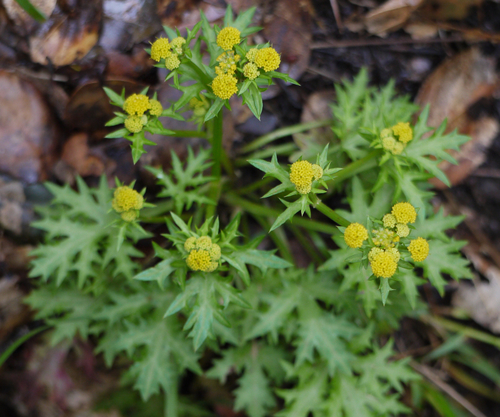
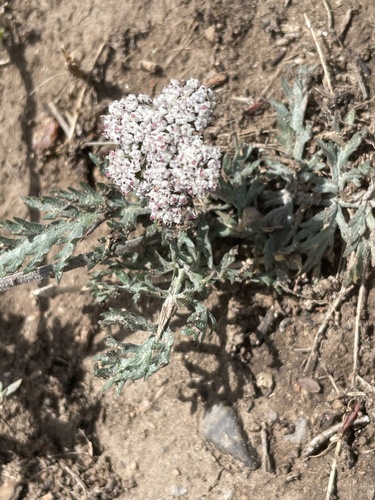
Lomatium orientale J.M.Coult. & Rose, also called salt-and-pepper, is often difficult to distinguish from other species in the Lomatium or Cymopterus genera. It is most commonly confused with Cymopterus montanus, Cymopterus glomeratus, and Lomatium nevadense. Like all Lomatium species, Lomatium orientale is a completely herbaceous perennial with no woody tissue. Mature plants reach 10 to 40 cm in height, and nearly all of its leaves grow from the plant base, making them basal leaves. This species has a long taproot that can be either slender or thick. Its active growing season runs from early spring to the start of summer; in Colorado, this corresponds to the months of April through June. The leaves of Lomatium orientale are pinnate-dissected: each leaf is divided all the way down to its central vein, with widely spaced leaflets near the base, and smaller, more closely spaced leaflets near the tip. Each individual leaflet is also partially dissected, making the overall leaf structure tripinnate. Leaf surfaces are covered in fine downy hairs, giving the leaves a soft texture. Leaves are 3 to 8 cm long, most often triangular in outline, pale blue-green in color, and have an overall appearance resembling lace or a fern. Plants with shinier, greener, narrower leaves are likely to be Cymopterus glomeratus instead. While most leaves are basal and grow directly from the plant's crown, Lomatium orientale sometimes produces leaves on its flowering stem, with leaf bases that wrap completely around the stem, called cauline leaves that are wholly sheathing. Lomatium orientale grows in open habitats including hillsides, rocky slopes, and sagebrush meadows. It occurs on both plains and lower foothills. In mountain habitats, it shows a moderate preference for seasonally moist slopes. This species is distributed across 17 U.S. states and two Canadian provinces. Most recorded populations are found in the Great Plains portions of Montana, North Dakota, South Dakota, Minnesota, Nebraska, Wyoming, Kansas, and Colorado. There is an isolated population in southern New Mexico, and small populations in parts of Iowa, Oklahoma, and Texas. There are also observation records from Washington state, Idaho, Utah, Arizona, Missouri, Manitoba, and Saskatchewan, though no precise locations are recorded for these occurrences. The flowers of Lomatium orientale are visited by the Sheridan's green hairstreak butterfly, Callophrys sheridanii, and the Colorado white butterfly, Pontia sisymbrii. Although Lomatium orientale is hardy and early-blooming, it is not commonly grown in gardens. Its flowers are not showy, and both seeds and plants are rarely available through the horticultural trade. The City of Fort Collins recommends this species for gardens due to its very low water requirements and its value as a food source for insects. The Cheyenne people prepared an infusion of the fresh or dried roots and leaves of this plant to treat bowel pain. The Navajo people sometimes rubbed Lomatium orientale roots in hot ash to remove the plant's strong flavor, then ate the roots raw or baked, though this plant was never a staple food source for the Navajo.