About Lomatia myricoides (C.F.Gaertn.) Domin
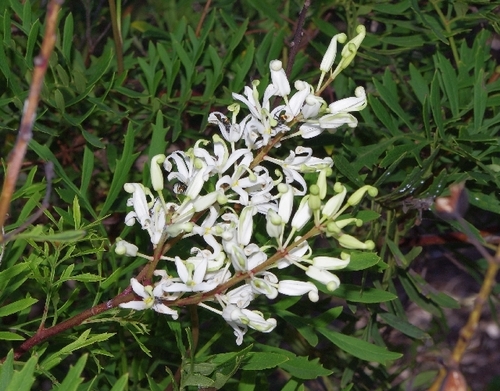
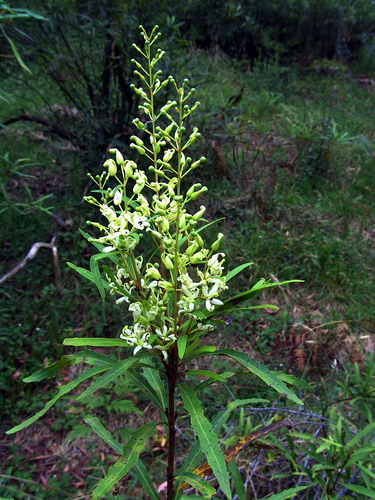
Lomatia myricoides grows as a woody shrub or small tree, reaching 2 to 5 metres (6.6 to 16.4 feet) in height, and rarely grows as tall as 8 metres (26 feet). Its leaves are usually linear, and sometimes lance-shaped or oblong; they measure 50 to 200 millimetres (2.0 to 7.9 inches) long and 5 to 20 millimetres (0.20 to 0.79 inches) wide, and end in a pointed apex. The leaves are glabrous, and their edges may be smooth or marked with several serrations. Flowers grow in clusters in leaf axils; these clusters are 50 to 100 millimetres (2.0 to 3.9 inches) long, and are usually shorter than the leaves. The flowers are white, cream, or greenish-yellow. Flowering occurs between December and February, and the fruit produced are follicles 25 to 35 millimetres (0.98 to 1.38 inches) long that contain winged seeds.
The natural range of Lomatia myricoides extends from the New South Wales Central Coast south into eastern Victoria, reaching as far as the Dandenong Ranges. It grows in moist sheltered areas, including riverbank forests and montane forest, and can be found on loamy or sandy alluvial soils, or basalt-derived soils. Along watercourses, it is commonly associated with watergum (Tristaniopsis laurina), grey myrtle (Backhousia myrtifolia), cedar wattle (Acacia elata), coachwood (Ceratopetalum apetalum), tantoon (Leptospermum polygalifolium), and coral fern (Gleichenia dicarpa). In montane areas, it grows as an understory plant alongside trees including broad-leaved manna gum (Eucalyptus mannifera) and broad-leaved peppermint (Eucalyptus dives), and shrubs including daphne heath (Brachyloma daphnoides) and prickly broom heath (Monotoca scoparia).
Lomatia myricoides has a woody lignotuber, which it uses to regenerate after bushfire. Small ants and flies forage for nectar from its flowers. It is not commonly grown in cultivation, but grows well in semi-shade in locations with some moisture, and appears to tolerate infection by Phytophthora cinnamomi. Joseph Maiden recorded that the wood of this species is light and hard, and can be worked easily.