About Lobularia maritima (L.) Desv.
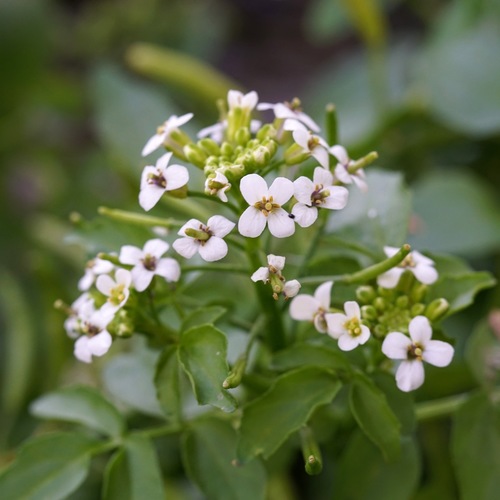
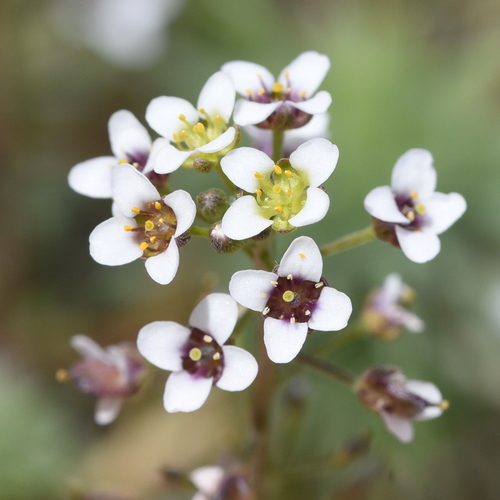
Lobularia maritima (L.) Desv. is most often an annual plant, rarely a short-lived perennial. It grows 5–30 cm (2–12 in) tall and 20–30 cm (8–12 in) wide, with a highly branched stem that bears dense clusters of small flowers. Its leaves are 1–4 cm long and 3–5 mm broad; they are arranged alternately, are sessile, quite hairy, oval to lanceolate, and have an entire margin. The flowers are around 5 mm (0.20 in) in diameter, have a sweet scent similar to honey, and have four sepals plus four rounded petals that are most often white, but may also be pink, rose-red, violet, yellow, or lilac. The plant's six stamens have yellow anthers. Flowering occurs throughout the growing season in most areas, and year-round in regions that have no frost. This species is insect-pollinated (entomophily); its sweet honey-like fragrance attracts bees, flower flies, stingless wasps, and butterflies. It produces numerous elongated, rather hairy seedpods that are oval to rounded, with each pod holding two seeds. Seeds are dispersed by wind (anemochory). This plant is native to the Mediterranean Basin and the Macaronesia region, which includes the Canary Islands, Madeira, and Cape Verde. It is widely naturalized in other temperate areas of the world, including the United States. An endemic subspecies grows only in the local flora of the Columbretes Islands in the western Mediterranean. It is commonly found on sandy beaches and dunes, but can also grow in cultivated fields, on walls, slopes, and waste ground. It prefers calcareous soil, and grows at altitudes from 0 to 300 metres (0–984 ft) above sea level. Lobularia maritima is cultivated for gardens, and many horticultural varieties have been developed with purple or pink flowers. It is best planted in early spring, and requires very little maintenance once established. While it is an annual, it can reseed itself in temperate climates. Trimming away spent blooms will encourage it to produce more abundant flowers. When grown in gardens, it is typically used as groundcover, since it rarely grows taller than 20 cm (8 in). It is also planted in cracks between paving and in walls, and is especially associated with coastal growing locations. It prefers partial shade, and is highly resistant to heat and drought. Cultivated varieties with darker-colored flower colors perform better in cooler temperatures. The petals, leaves, and tender stems of Lobularia maritima can be eaten either raw or cooked.