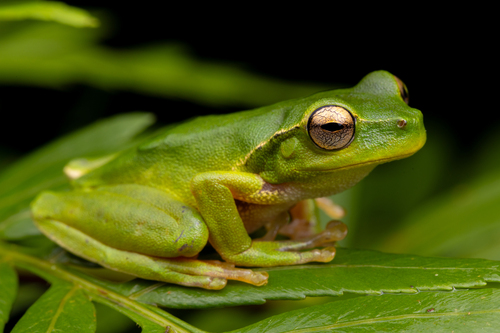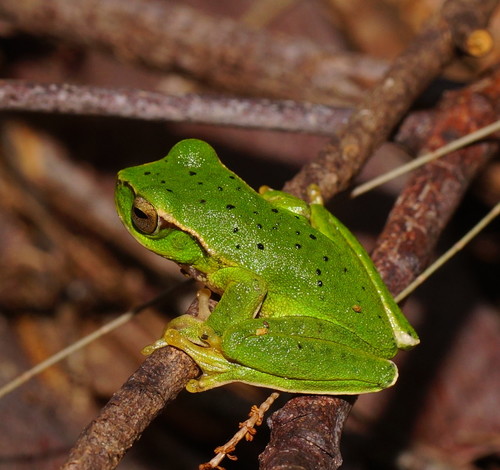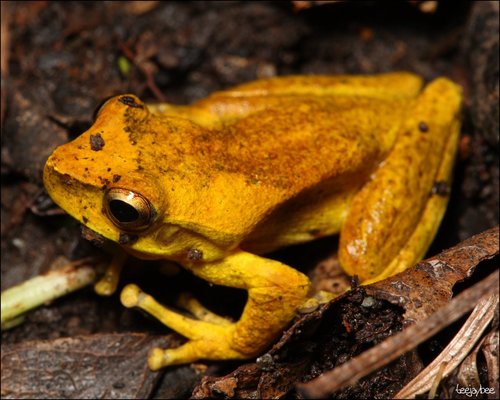
About Litoria revelata Ingram, Corben & Hosmer, 1982
Size
This frog species, Litoria revelata, reaches 40 mm (1.6 in) in length.
Dorsal Coloration
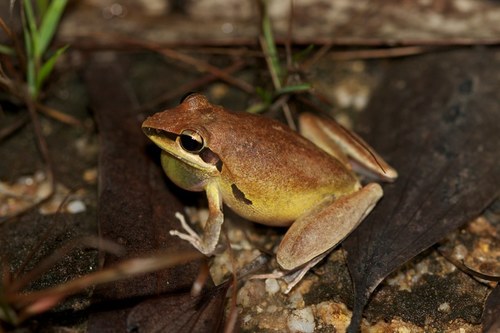
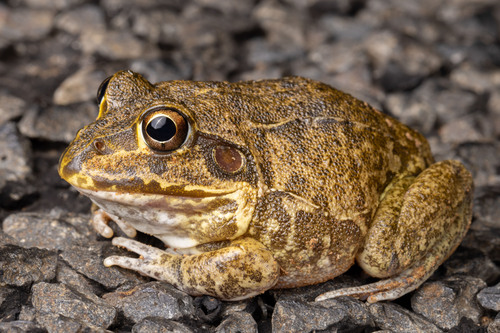
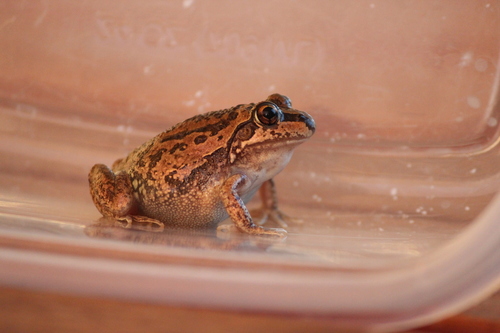
Its dorsal side ranges in color from cream to red-brown, with a darker band running down the center. A dark stripe runs from the nostril across the tympanum to the shoulder.
Leg Coloration
The back of the legs is red, and the thigh is yellow-orange; large black dots appear on the thigh and the back of the legs.
Ventral and Iris Coloration
The belly is cream, and the iris is golden.
Breeding Season Male Coloration
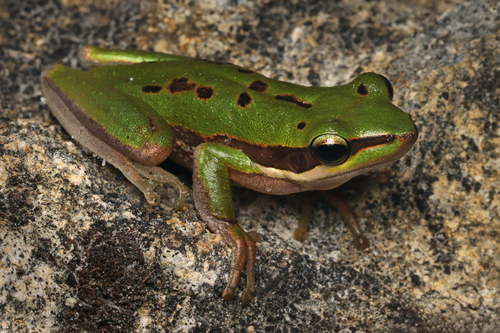
During the breeding season, males change color to bright yellow.
Population Distribution Overview
Litoria revelata has four geographically separate populations.
Queensland Populations
Two of these populations are found only in Queensland: the northernmost population is located on the Atherton Tableland in northern Queensland, and another is in the Clarke Range in mid-northern Queensland.
Border Region Population
A third population occurs along the border of Queensland and New South Wales, stretching from Ballina, New South Wales to Tamborine National Park, Queensland.
Southern New South Wales Population
The southernmost population is also the largest, located in mid-northern New South Wales. Its range extends between Ourimbah in the south and Myall Lakes National Park in the north, with an additional subpopulation around Port Macquarie that is part of this larger southern group.
Taxonomic Note
It has been noted that these four separate populations may actually represent more than one distinct species.
Aquatic Habitat
This species lives in still water habitats including dam impoundments, ditches, swamps, and still sections of streams.
Terrestrial Habitat
These habitats are found within heathland, wet or dry sclerophyll forest, and rainforest.
Breeding Call
During the breeding season from spring to autumn, males produce a high-pitched whirring call that is similar to the call of Verreaux's tree frog.
Calling Site
Males call from either the ground or vegetation that borders the breeding area.