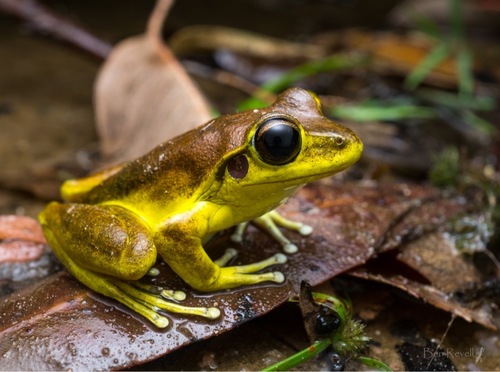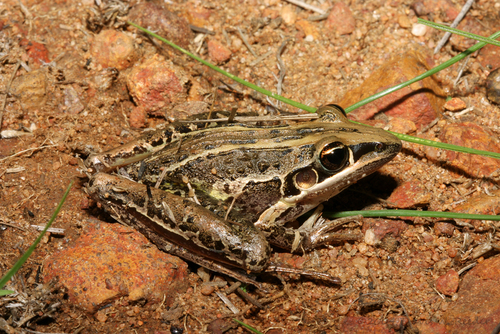
About Litoria nasuta (Gray, 1842)
Common Name and Color Variability
This frog species, Litoria nasuta, is highly variable in color and patterning.
Body Size and Shape
It grows up to 55 mm in length, with extremely long legs and a very streamlined body.
Dorsal Surface Characteristics
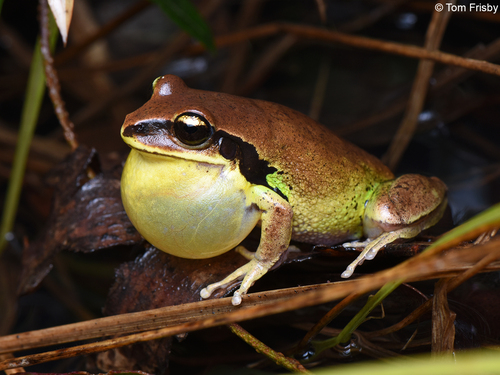
Its dorsal surface is brown, featuring longitudinal skin folds or warts that are darker than the surrounding skin.
Ventral Surface Characteristics
The ventral surface is white and granular.
Facial Stripe Pattern
A brown stripe runs from the nostril, across the eye, through the tympanum, and ends between the armpit and groin.
Tympanum Appearance
The tympanum is brown, surrounded by a white circle.
Limb and Breeding Male Coloration
The thighs have black markings on a yellow background, and the throats of breeding males are yellow.
Terrestrial Habitat Adaptation
Though classified as a tree frog, adult Litoria nasuta spend most of their lives on land, because their small toe discs prevent them from climbing.
Australian Distribution Range
Commonly called the striped rocket frog, or simply the rocket frog within its native range, this species is found mainly in coastal areas from northern Western Australia to Gosford in New South Wales, with an isolated population located further south in the Sydney suburb of Avalon.
Papua New Guinea Distribution
It also occurs in the southern lowlands and southeast peninsula of Papua New Guinea.
Habitat Types
It inhabits swamps, ponds, and flooded grasslands in forests and open woodland, and is a ground-dwelling frog in tropical forests.
Wet Season Dispersal
It is known to disperse widely during the wet season.
Breeding Season and Location
Striped rocket frogs breed in standing water during the wet season, which runs from December to March.
Egg Clutch Size
Females lay between 50 and 100 eggs per clutch.
Tadpole Characteristics and Metamorphosis
The tadpoles are mottled brown and reach around 6 cm in length, and can complete metamorphosis from the larval stage to adulthood in about one month.
Male Breeding Call Structure
During the breeding season, males produce a distinctive repeated "wick wick" call to attract mates, followed by a "but... but" section; the full call may last several seconds.
Vocal Sac Function
The call is produced when the large vocal sac near the throat expands, pushing outward like a balloon.
Calling Period and Behavior
Males call from spring through early autumn while perched on the banks of water bodies or sitting in shallow water, and breeding activity increases after rain.
Jumping Ability
This species can leap 2 meters (6.5 feet), which is roughly 36 times its own body length.
Jumping Ability Comparison
For comparison, this is equivalent to a 1.8-meter (6-foot) human making a 64.8-meter (213-foot) jump.