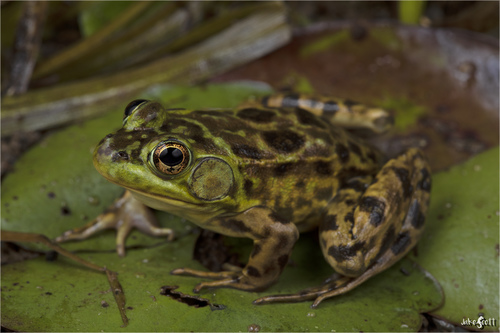
About Lithobates septentrionalis (Baird, 1854)
Common and Scientific Name
This species, commonly known as the mink frog, has the scientific name Lithobates septentrionalis (Baird, 1854).
Adult Size
Adult mink frogs are small, reaching a length of 4.8 to 7.6 cm (1.9 to 3.0 in).
Dorsal and Ventral Coloration
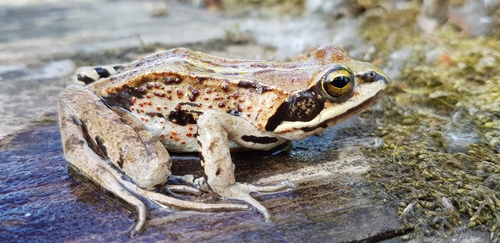
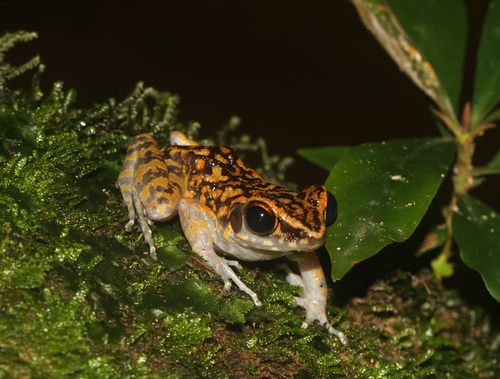
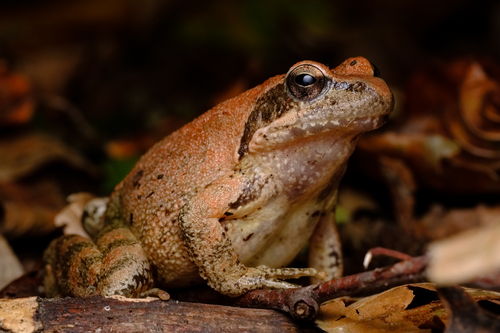
Their back (dorsum) is typically green, marked with darker green and brown blotches, while their belly is cream, yellow, or white.
Sexual Dimorphism - Throat Color
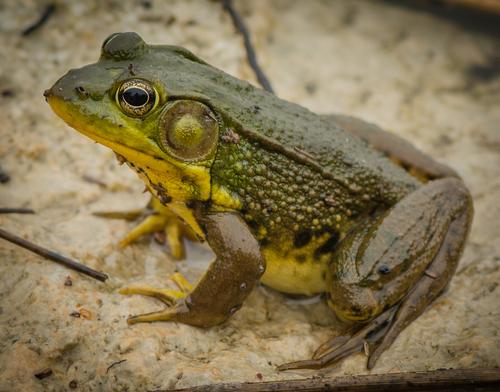
Mink frogs display clear sexual dimorphism: males usually have a bright yellow throat, while females have a white throat.
Sexual Dimorphism - Tympanum Size
Male mink frogs have a tympanum (eardrum) larger than the eye, while the female tympanum is smaller than the eye or equal in size to it.
Shared Species Traits
All mink frogs have a pale underside and bright green lips.
Distribution - United States
Mink frogs are distributed across North America: in the United States, they can be found in Minnesota, New Hampshire, Wisconsin, Michigan, Maine, Vermont, and New York.
Distribution - Canada
In Canada, they occur in Nova Scotia, New Brunswick, Newfoundland and Labrador, Quebec, Ontario, and Manitoba.
Southern Range Limit
This is a largely aquatic frog species whose entire southern range limit sits at the highest latitude of any North American frog.
Southern Population Extinction
Evidence indicates that more southern populations of this frog have gone extinct within the past century.
Habitat
The mink frog is predominantly aquatic, living among vegetation (especially lily pads) in ponds, swamps, and wooded-area streams.
Adult Diet
It feeds on a wide variety of prey including spiders, snails, beetles, and other invertebrates.
Tadpole Diet
Mink frog tadpoles feed primarily on algae and decaying plant matter.
Mating Period
Mating for mink frogs typically occurs in late spring and early summer.
Breeding Site Preferences
They prefer cold, well-oxygenated wetland breeding sites.
Male Courtship Behavior
At these sites, during late night hours (and occasionally during the day), males call to attract females while floating on the water surface or resting partially on floating vegetation.
Female Egg Laying
A single female can lay between 500 and 4000 eggs at a time, usually in deep water.
Egg Mass Characteristics and Hatching
Egg masses are typically found close to floating vegetation and hatch within just a few days after being laid.
Larval Stage Duration
Tadpoles stay in the larval stage for approximately one year before undergoing metamorphosis into froglets.
Sexual Maturity Timeline
Male mink frogs reach maturity one year after metamorphosis, while females reach maturity in two years.