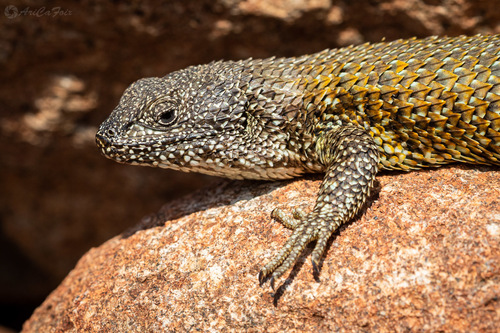
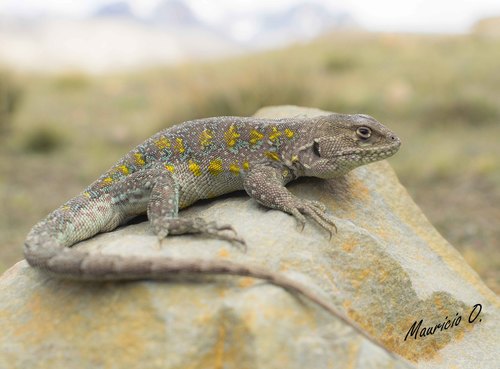
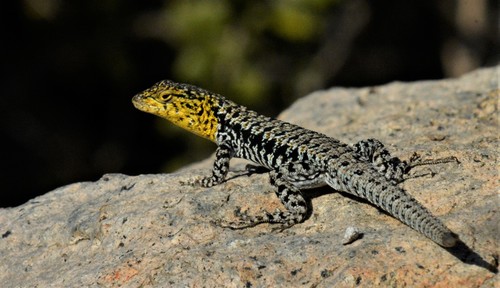
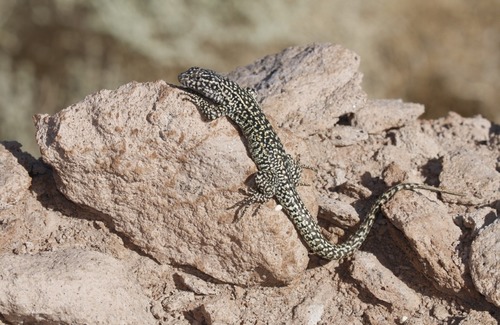
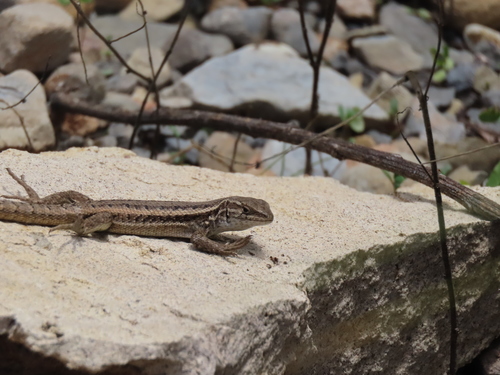
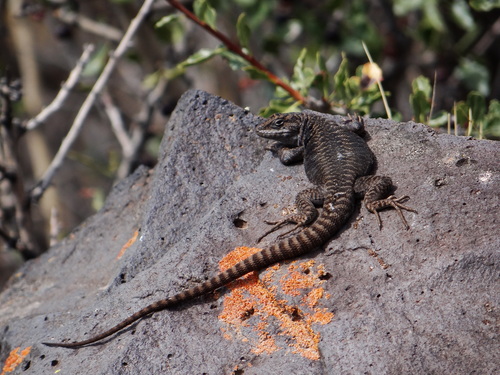
About Liolaemus chiliensis (Lesson, 1830)
Common Names and Size
Liolaemus chiliensis, commonly called the Chilean tree iguana or weeping lizard, is relatively large compared to other lizards, reaching a total length of 25 centimetres (9.8 in) and a maximum body weight of 24.03 grams. Individuals at more southern latitudes tend to be smaller than those from more northern latitudes, corresponding to the cooler lower temperatures southern populations experience.
Coloration
This species has dull, muted green and gray coloration that helps it camouflage against rocks and vegetation.
Sexual Morphology
Females have a longer axilla to groin distance than males.
Ploidy Morphology Effects
Polyploidy causes morphological differences between individuals of different ploidy, specifically in head shape and various body proportions, though the mechanisms behind these differences are currently unclear.
Auditory Anatomy
Like most reptiles, this species has a tympanic membrane. Its otoliths detect both acceleration and sound, and its hearing range spans from 500 Hz to 2000 Hz, with a hearing threshold of 40 dB.
Distress Call Recognition
These lizards are highly adept at recognizing the distress calls of other members of their own species.
Reproduction and Diet
It is an oviparous, carnivorous species that feeds mainly on insects and other invertebrates.
Native Range
This lizard is native to the Neotropics, found in Chile and Argentina across the Chilean Matorral, Patagonian Steppe, and Valdivian Temperate Forests.
Distribution Range
Its distribution ranges between 30°S and 40°S latitude, from sea level up to 2100 meters in altitude, with a full range extending from Coquimbo (29°S) to Valdivia (39°S).
Habitat
Its habitat includes bushes and branches. These lizards bask in bushes that obscure them from predators, making them harder to detect.
Microhabitat Use
While they are skilled at running and climbing, and are often found on higher branches than expected, they are typically ground-associated dwellers that live within dense shrubs rather than directly on open ground.
Activity Patterns
Liolaemus chiliensis is active throughout the day, and is observed more frequently between September and February. This increased observation rate may be due to the species’ mating season falling in this window, the warmer weather of these months, or increased human outdoor activity leading to more frequent sightings.
Oviparity Traits
As an oviparous species, females lay eggs that hatch outside the mother’s body after an incubation period, with no maternal attendance after laying. Females prefer to lay their eggs under rocks, which provides eggs protection from predators.
Reproductive Timing
Females can become gravid as early as October, and typically lay eggs in November, shortly after the start of the Southern hemisphere warm season.
Clutch Size
Clutches usually contain between 7 and 11 eggs, with the maximum recorded clutch size being 18 eggs. Significant variation in clutch size has been documented, and larger females generally lay more eggs than smaller females.
Clutch Size Drivers
This trend also holds for body mass and body volume, since larger lizards are almost always more voluminous. This means the previously recorded variation in clutch size may actually stem from unaccounted-for variation in the size of the female lizards that laid the clutches.