About Linaria vulgaris Mill.
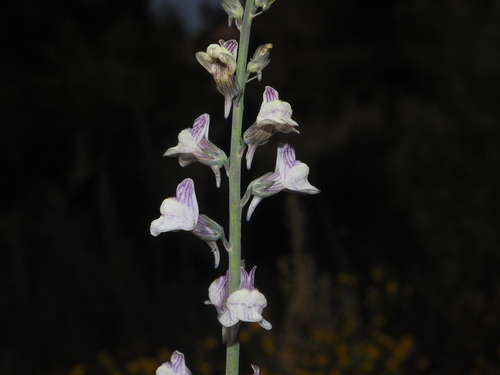
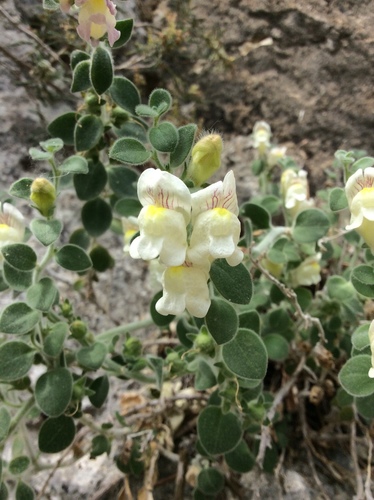
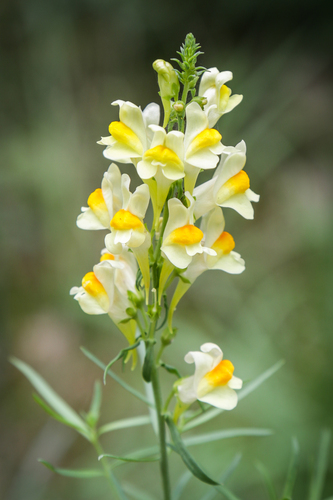
Linaria vulgaris Mill. is a perennial plant with short spreading roots, and stems that grow from erect to decumbent, reaching 15–90 cm (6–35 in) in height. Its leaves are fine, threadlike, and glaucous blue-green, measuring 2–6 cm (3⁄4–3+1⁄4 in) long and 1–5 mm (0.04–0.20 in) broad. Its flowers resemble smaller, slimmer snapdragon flowers, and are 25–33 mm (0.98–1.30 in) long. The flowers are mostly pale yellow, with a variable orange-yellow shade on the lower tip, and grow in dense terminal racemes from mid-summer to mid-autumn, which falls between June and October in Britain. Bumblebees are the most common visitors to the flowers. Rarely, symmetrical five-spurred peloric flowers may occur on the plant. The fruit is an oblong to globose capsule 5–11 mm (0.20–0.43 in) long and 5–7 mm (0.20–0.28 in) broad, containing numerous small seeds. In terms of ecology, this plant grows widely across ruderal sites, along roadsides, in dunes, and on disturbed and cultivated land. Because the flower is largely closed by its underlip, pollination requires strong insects such as bees and Bombus species (bumblebees). Linaria vulgaris serves as a food plant for a wide range of insect species, including the sweet gale moth (Acronicta euphorbiae), mouse moth (Amphipyra tragopoginis), silver Y (Autographa gamma), Calophasia lunula, gorgone checkerspot (Charidryas gorgone carlota), toadflax pug (Eupithecia linariata), satyr pug (Eupithecia satyrata), Falseuncaria ruficiliana, bog fritillary (Boloria eunomia), Pyrrhia umbra, brown rustic (Rusina ferruginea), and Stenoptilia bipunctidactyla. The plant may be mildly toxic to livestock, and it has also been used to treat cattle with rumination problems. For cultivation and uses, while Linaria vulgaris is most commonly found growing as a wildflower, it is sometimes cultivated as a cut flower, as its blooms last a long time in a vase. Like the related snapdragons (Antirrhinum), it is often grown in children's gardens for its "snapping" flowers, which can be made to "talk" when squeezed at the base of the corolla. The plant requires good drainage, but it is otherwise able to adapt to a variety of growing conditions. It has escaped from cultivation in North America, and is now naturalized across many U.S. states and Canadian provinces, where it is common on roadsides and in poor soils. Regarding traditional medicine, despite being commonly considered a weed, this plant has been used in folk medicine to treat a range of ailments. A tea made from its leaves has been taken as a laxative and strong diuretic, and also used to treat jaundice, dropsy, and enteritis accompanied by drowsiness. For skin diseases and piles, either a leaf tea or an ointment made from the flowers has been used. Additionally, a tea brewed with milk instead of water has been used as an insecticide. There is some evidence that supports the plant's diuretic and fever-reducing properties. This species has a long history of use in traditional medicine, and further information is available in Barker (2001).