About Ligustrum japonicum Thunb.
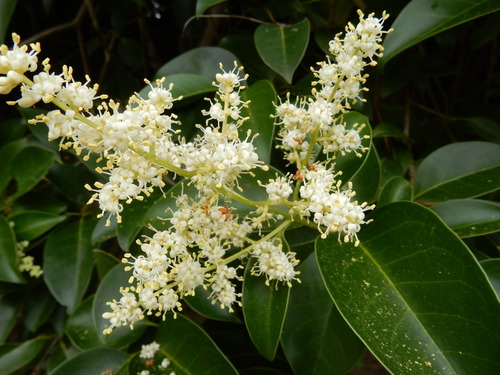
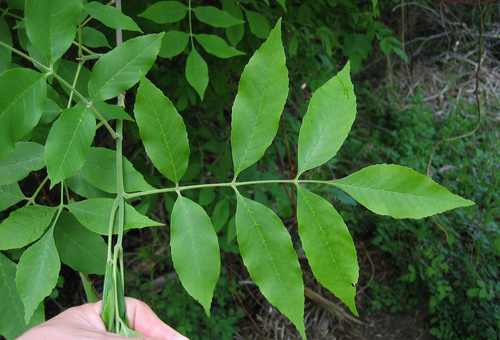
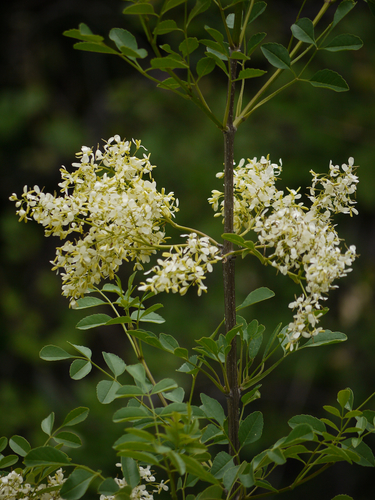
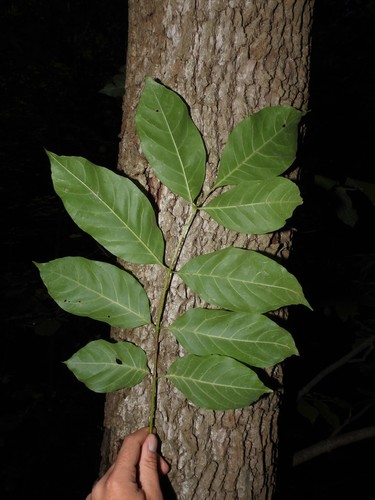
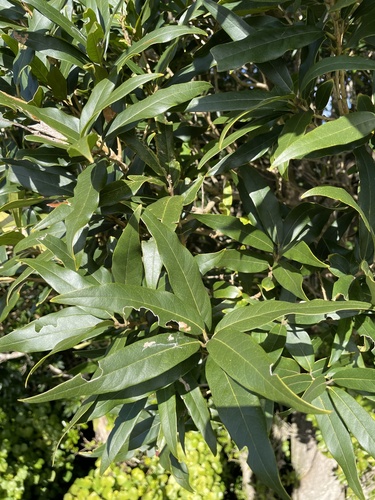
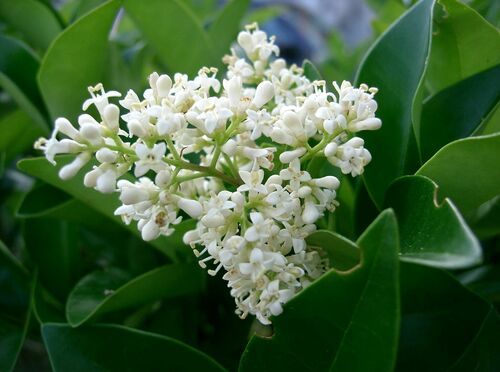
Ligustrum japonicum Thunb., commonly called Japanese privet, is an evergreen shrub or small tree. It typically grows 2–5 meters (6 ft 7 in – 16 ft 5 in) tall, and rarely reaches 6 meters (20 ft). Its stems have smooth, pale grey-brown bark. The leaves are opposite, 5–10 cm long and 2–5 cm broad, with an entire margin. They have a thick, leathery texture, are glossy dark green on the upper surface, and paler, ranging from glaucous to yellowish green on the lower surface. The white flowers have a four-lobed corolla 5–6 mm long, and grow in 7–15 cm long clusters in early summer. Its fruit is an oval drupe 10 mm long, which ripens to purple-black with a glaucous waxy bloom in early winter; in Japan, the fruits are popularly compared to mouse or rat droppings. This species is closely related to the Chinese species Ligustrum lucidum, and differs from it in its smaller overall size (L. lucidum grows into a tree over 10 m tall) and its elongated oval fruit, rather than the subglobose fruit of L. lucidum. Flowering occurs in early spring, with occasional repeat flowering in summer, early autumn, or both. The fruit ripens in autumn. It can grow in sun or shade, in both damp and dry, disturbed and undisturbed areas, and is commonly found in floodplain forests, wetlands, and pine flatwoods. Japanese privet is native to Japan and Eastern Asia, and was introduced to the United States from Japan and Korea in 1845. Ligustrum japonicum is commonly grown as an ornamental plant in many parts of the world. It is valued for its evergreen leaves, white flowers, adaptability to a wide range of landscape conditions, tolerance of pruning, disease resistance, and wide availability. Some Ligustrum species have escaped cultivation and become naturalized in natural areas. For example, sixteen countries report naturalization of Chinese privet. In the United States, Chinese privet is established in 20 states and is considered invasive. Exotic plant invasion is recognized as one of the main causes of global ecosystem degradation and biodiversity loss. After its arrival in North America in 1845 from Japan and Korea, Ligustrum japonicum escaped cultivation and has become an invasive plant, particularly in the American South. It is occasionally grown as an ornamental in Europe and North America, and several cultivars have been selected for garden use, including 'Rotundifolium' with leaves nearly as broad as long, and 'Silver Star' with leaves that have creamy-white margins. Its widespread use in ornamental horticulture has led it to spread to various states across the United States. In Florida, the FLEPPC does not list Ligustrum japonicum as an invasive species, but it has escaped cultivation in 11 southeastern states including Texas, Arkansas, Louisiana, Mississippi, Georgia, South Carolina, North Carolina, Tennessee, and Pennsylvania. Currently, 11 different species and hybrids from the privet genus are commercially available in the US. The fruit of Ligustrum japonicum is used in herbal medicine as a cardiotonic, diuretic, laxative, and general tonic. Fruits of this species have been used in traditional medicinal practices and supplements in Korea and Japan, and it is used for its tonic effects in traditional Japanese medicine. It has been reported to have various bioactivities. Ligustrum japonicum has different effects on osteogenic and adipogenic cells in the human body. Studies examining ALP activity and lipid accumulation using human bone marrow-derived stromal cells have found an increase in ALP production. Accumulation of intracellular triglycerides is a well-known marker of osteoclastogenesis and adipogenesis, and the increase in ALP is caused by substances present in the fruits of Ligustrum japonicum.