About Leucospermum truncatum (H.Buek ex Meisn.) Rourke
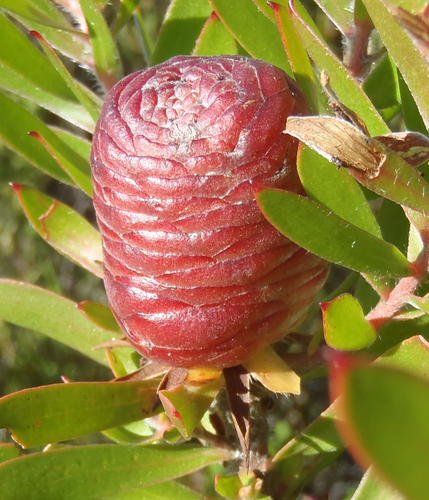
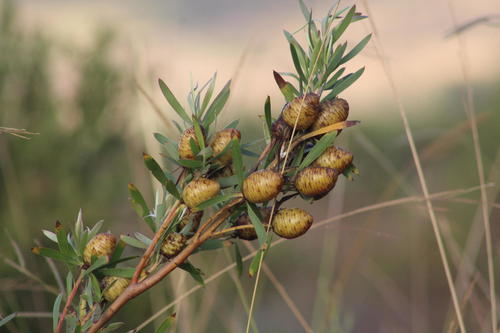
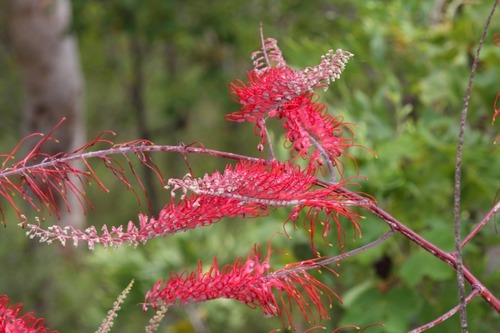
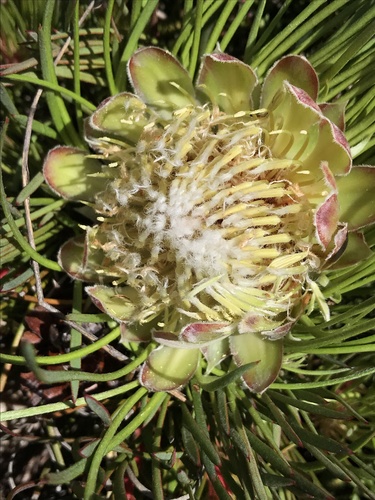
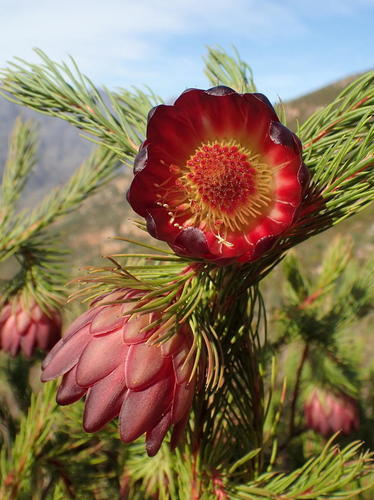
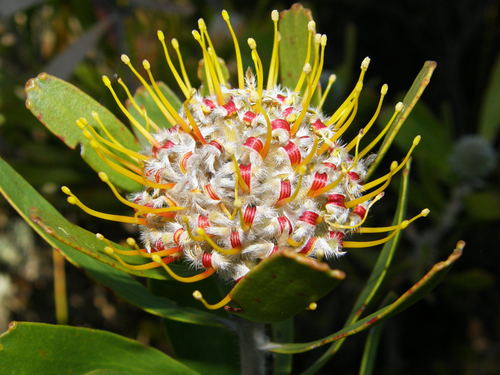
Leucospermum truncatum is a rounded, upright, well-branched shrub that grows up to 2 m (6.6 ft) tall, with a single main stem at its base covered in tiny soft crinkly hairs. It has simple long spade-shaped leaves arranged alternately, with a squared-off tip. Most leaves have three blunt teeth with rounded bony tips, but some have none, five, or seven. Leaves measure 4.5–9 cm (1.8–3.5 in) long and 8–15 mm (0.31–0.59 in) wide. Flowering stems are stiffly upright, with a diameter of 0.5 cm (0.20 in). Flower heads are globe-shaped, typically occurring in clusters of two or three, and sit on a stalk up to 2 cm (0.79 in) long. Each flower head has a diameter of 3–4 cm (1.2–1.6 in). The style of this species is yellow, 18–35 mm (0.71–1.38 in) long, and straight or slightly curved toward the center of the flower head. The pollen-presenter, a thickened structure at the tip of the style comparable to the head of a pin, is cylindrical with a blunt end, 1–2 mm (0.039–0.079 in) long, and initially holds bright yellow pollen. The stigma is a transverse groove located at the very tip of the pollen-presenter. At the base of the ovary, there are four linear hypogynous scales that measure approximately 1 mm (0.039 in) long. Leucospermum belongs to the subtribe Proteinae, which consistently has a basic chromosome number of twelve, giving this species 2n=24. Leucospermum truncatum grows in fynbos on coastal limestone ridges, at elevations from sea level up to 240 m (790 ft). Its range stretches from Soetanysberg in the west, across the Bredasdorp district, to Vermaaklikheid, and it only grows on deposits of the Alexandria Formation. The plant’s roots often grow into crevices in exposed pure limestone outcrops. This species forms open thickets alongside Protea obtusifolia, Leucadendron meridianum, and Leucadendron muirii. Across the species’ range, average annual rainfall is about 40–50 cm (16–20 in), with most rain falling in winter. Flower heads are primarily pollinated by birds. Seeds are released from the fruit around two months after flowering. Ants collect the seeds and store them underground, a seed dispersal strategy called myrmecochory. These plants rarely survive the natural wildfires that occur every one to two decades in fynbos. After fire, rain carries fire-created chemicals underground that trigger the stored seeds to germinate, allowing the species to regenerate after fire.