About Leucospermum royenifolium (Knight) Stapf
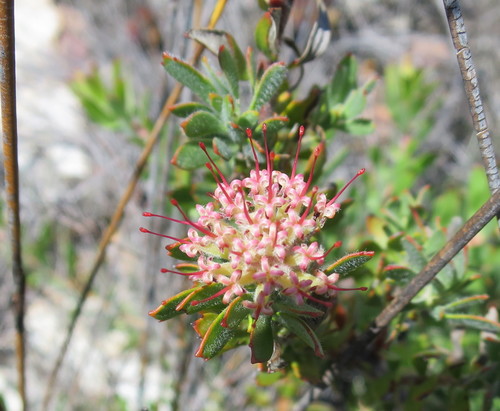
Leucospermum royenifolium (Knight) Stapf is a spreading shrub that is somewhat upright to creeping, growing to around 0.5 m (1.7 ft) high. It can form dense mats 1–3 m (3–10 ft) across. Its main horizontal branches are woody near the base, covered by a 3–5 mm (0.12–0.20 in) thick layer of bark. Flowering stems are also somewhat upright to creeping, 2–3 mm (0.08–0.12 in) in cross-section, starting out with powdery hairs and becoming hairless over time. Leaves spread at roughly a 45° angle to branches, are elliptic in shape, 1.5–2.3 cm (0.6–0.9 in) long and 4–6 mm (0.16–0.24 in) wide. They narrow to a point at the base, have a pointed tip, and mostly have an entire margin, very rarely with two or three teeth. Leaf surfaces initially have powdery hairs, which are quickly lost.
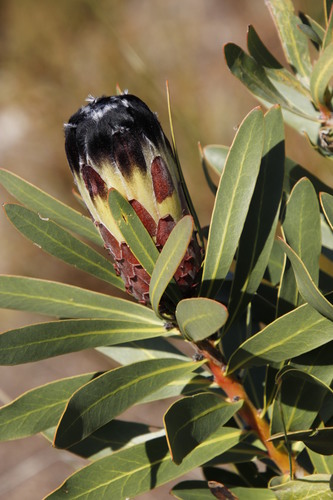
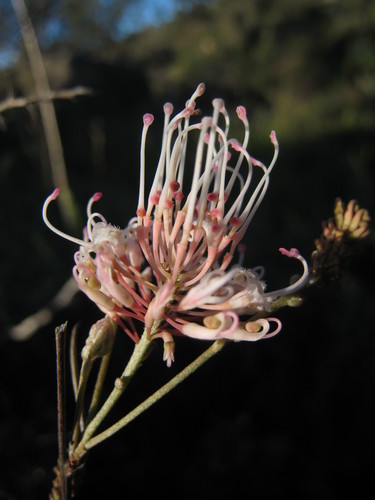
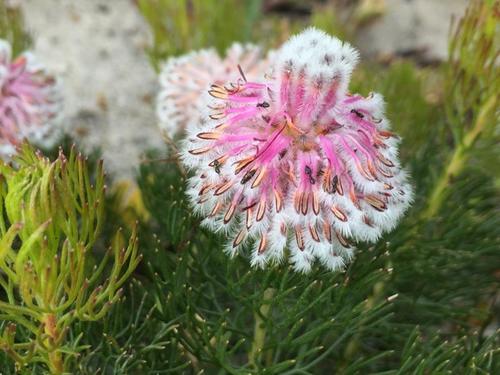
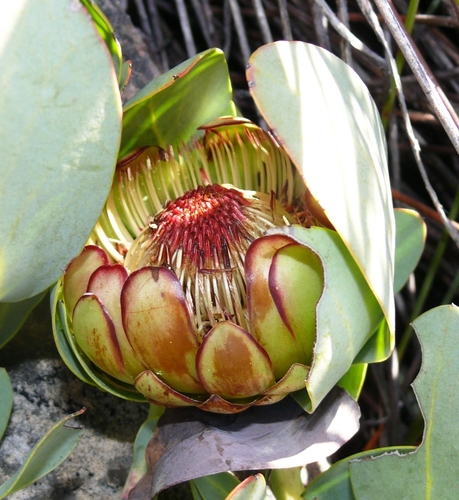
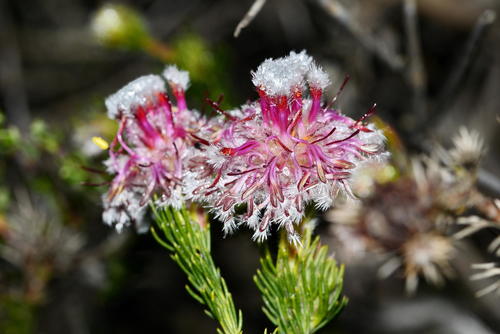
The flower heads of Leucospermum royenifolium are globe-shaped, 1−2 cm (0.4−0.8 in) in diameter. They are either seated or carried on a short stalk up to 1 cm (0.4 in) long. They sometimes grow individually, but mostly occur in groups of three to five; on vigorous new shoots, 20 to 40 flower heads can occupy the uppermost leaf axils. The common base of all flowers within one head is broadly cone-shaped, around 5 mm (0.20 in) long and 4 mm (0.16 in) wide. Bracts subtending the flower head are oval with a pointed tip, around 5 mm long and 3 mm (0.12 in) wide, with a cartilaginous texture, covered in a dense mat of soft woolly hairs. The tips of the highest whorl of bracts are somewhat pointed and curved downward. The 4-merous perianth is 1–1.5 cm (0.4–0.6 in) long. It is pale cream to ivory when young, later turning deep pink, straight when in bud, somewhat compressed sideways, and covered in a mat of short woolly hairs. The fused lower lobe section, called the tube, is around 4 mm (0.16 in) long, powdery on its upper half, and hairless and narrower at the base. The middle free lobe section, called claws, is around 1 cm (0.4 in) long; it starts cream and greenish, later turning pale carmine, and each claw curls back to its base when the flower opens. The upper lobe section, called limbs, is lance-shaped with a pointed tip, around 1.5 mm (0.06 in) long, with upright, stiff hairs on its outer surface. The style is 13–16 mm (0.52–0.64 in) long, tapering toward its tip, starting pale greenish cream and later turning pinkish carmine. The slightly thickened tip, called the pollen presenter, is cylinder-shaped with a blunt tip, holds the stigma groove, and is around 1 mm (0.04 in) long. Four opaque, thread-shaped scales around 2 mm (0.08 in) long subtend the ovary. The fruit is ellipsoid, whitish, around 7 mm (0.28 in) long, somewhat pointed, and lacks a beak. The flowers of this species are sweetly scented.
This species occurs along the full length of the Langkloof on the northern edge of the Outeniqua Mountains, extending east to Misgund. It is also found in the Swartberg from Meiringspoort in the west to Kouga Local Municipality, and across the Baviaanskloof Mountains all the way to Scholtzberg. It grows exclusively on north-facing slopes made of Witteberg Quartzite or Table Mountain Sandstone, at altitudes between 600–1250 m (2000–4000 ft). It grows in arid fynbos vegetation, and sometimes occurs in renosterveld. Compared to most other Leucospermum species, the eastern pincushion grows under climatically demanding conditions, receiving an average annual precipitation of 250–375 mm (10–15 in), which is almost evenly distributed across the year with only a small peak in winter. The region sees occasional winter frosts and very hot summers. The tough corky bark covering the plant’s basal branches gives it some protection against the wildfires that naturally occur in fynbos, and the plant regenerates by growing new shoots from its existing main branches. Its small flowers are pollinated by bees, flies and butterflies. Around two months after flowering, ripe fruits fall to the ground. Native ants collect these fallen fruits and carry them to their underground nests. Ants eat the elaiosome on the seeds, leaving the smooth hard seeds unharmed and protected from rodents, birds and fire. Seeds will germinate after periodic fynbos wildfires clear the above-ground vegetation.