About Leucospermum prostratum (Thunb.) Stapf
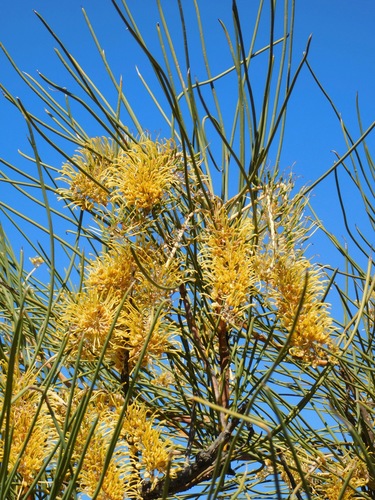
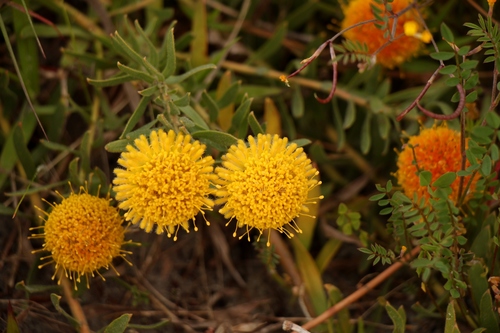
Leucospermum prostratum is a low, creeping shrub with trailing branches that can reach up to 2 m (6.6 ft) long. Most of these trailing branches grow from a woody underground rootstock. Its flowering branches are straight, slender, roughly 2 mm (0.079 in) in diameter, covered in very short soft hairs, and branch very rarely. The leaves are roughly erect, smooth-edged, linear, and measure 2–4 cm (0.79–1.57 in) long by 2–6 mm (0.079–0.236 in) wide. They have no leaf stalk or stipules at their base, are covered in short felty hairs that often wear away as the leaves age, and have a dull olive-green color. The flower heads are compact and composed of many flowers. They are produced individually, or sometimes in groups of two or three near the end of branches, each growing from a 1–3 cm (0.39–1.18 in) long stalk. Each head is shaped like half a globe, 2–2½ cm (0.8–1.0 in) in diameter. The common base that holds all flowers in one head is 6 mm (0.24 in) in diameter with a wide, flat top, which is easiest to see when a flower head is cut lengthwise into two equal halves. The involucral bracts, which subtend the entire flower head, are lance-shaped with a pointed tip, 5–7 mm (0.20–0.28 in) long and 1–1½ mm (0.04–0.06 in) wide. They overlap, have a rubbery texture, are softly hairy on their outer surface, and have a tuft of hairs at their grey tips. The woolly bracts that subtend individual flowers are lance-shaped, 7 mm (0.28 in) long and 2 mm (0.079 in) wide, with edges that roll inward to clasp the perianth. The perianth is 8–10 mm (0.31–0.39 in) long and straight. It is bright yellow when flowering begins, and changes to a warm orange as it ages. The perianth tube is hairless, cylindrical, and 3 mm (0.12 in) long. The four perianth lobes curl back on themselves and may be slightly hairy. The style is straight, 1–1½ cm (0.4–0.6 in) long; it is pale initially, and becomes orange as it matures. The style is tipped with a blunt cylindrical pollen presenter 1 mm (0.039 in) long, with the stigma groove located at the very tip. Four awl-shaped scales 1 mm (0.039 in) long subtend the ovary, and these scales produce nectar. The flowers of Leucospermum prostratum have a sweet scent. This species, commonly called yellow-trailing pincushion, occurs from the Kogelberg, along the southern coast from Pringle Bay to Franskraalstrand. It ranges inland to the Groenland Mountains in the west, and to Papies Vlei and the Elim hills in the east. It prefers sandy coastal flats; when it grows in hills, it is restricted to sandy patches of weathered Table Mountain Sandstone. Across its distribution range, average winter precipitation is between 65–100 cm (26–39 in). L. prostratum can survive even very intense, repeated wildfires that are natural to fynbos ecosystems, because it can regenerate new growth from its underground rootstock. The plants are pollinated by bees, butterflies, and flies. Seeds are released from the flower heads around two months after flowering. Ants collect the released seeds and carry them to their underground nests. Chemicals released by wildfire have a positive effect on the germination of L. prostratum seeds.