About Leucospermum praemorsum H.Buek ex Meisn.
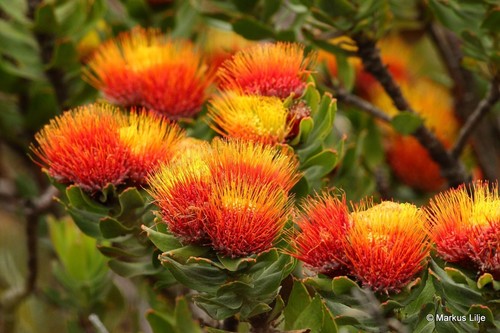
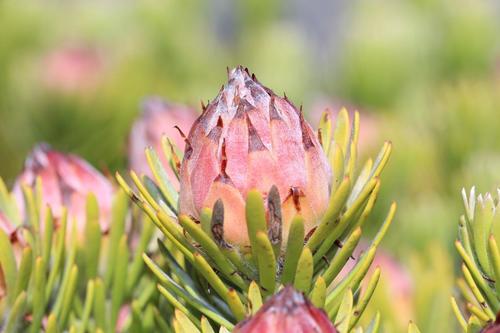
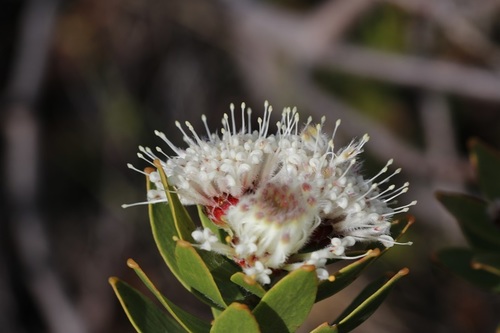
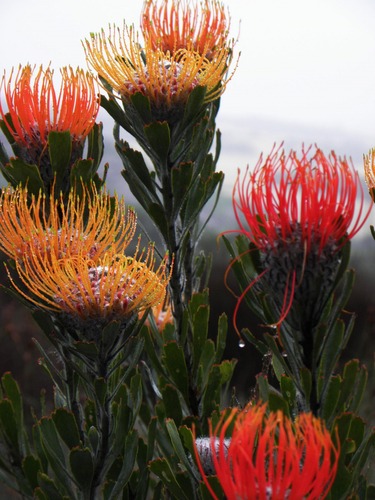
Leucospermum praemorsum (common name Nardouw fountain pincushion) is a large shrub or small tree, reaching up to 5 m in height and 7 m in diameter. It has a stout base trunk up to 30 cm thick, covered in smooth grey bark, and begins branching 30 cm above ground level. Its flowering stems are stiff and upright, 5–7 mm thick; they start out grey-felty, but quickly lose their hairs. Hairless leaves are oblong to inverted lance-shaped, 7–8 cm long and 1½–2 cm wide, tapering at the base to a stalk up to 2 cm long, which has spiderweb-like felting at its base. The leaf tip looks bitten-off, bears 3 to 5 teeth, and is slightly wavy. Flower heads are initially broadly flattened inverted cone-shaped, around 7 cm across, and become narrowly inverted cone-shaped after pollination. Each flower head sits on a very short stalk ¾−1 cm long. The common shared base of flowers within a single head is low cone-shaped with a pointed tip, about 2 cm long and 1½ cm wide. Pinkish-grey bracts that subtend the entire flower head are loosely arranged, narrowly lance-shaped to line-shaped, up to 2 cm long, with a long, slightly incurved pointed tip; they appear greyish from long, spreading, silky hairs. The bract that individually subtends each single flower is inverted lance-shaped, suddenly narrowing into a pointed tip, densely covered in woolly hairs on its lower half, with the tip greyish from a covering of long spreading silky hairs. The 4-merous pale carmine perianth is 2½–3 cm long, uniformly covered in villous hairs, and strongly incurved while in bud. The lowest, fully fused section of the perianth, called the tube, is around 8 mm long, hairless and narrow at the base, and covered in powdery hairs further up. The upper part (or limbs), which enclosed the pollen presenter in the bud, is made of four narrowly lance-shaped lobes with pointed tips, covered in short felty hairs and some long silky hairs. A style 5–6 cm long emerges from the perianth; it is initially orange, and later deepens to a deep crimson color. When the flower opens, the uppermost part of the style curves toward the center of the head. The thickened greenish pollen presenter at the tip of the style is egg-shaped to cylinder-shaped, about 2½ mm long and ¾ mm thick, with a groove functioning as the stigma across its very tip. The ovary is subtended by four pale yellow, awl-shaped scales around 3 mm long. This species occurs from near Lokenberg to Gifberg in the Calvinia district, south to the plateau surrounding Nardouwberg, near Wupperthal and Biedouw Valley. It grows at 300–750 m altitude in dry conditions, in deep sandy soils formed from Table Mountain Sandstone. Even though the area only receives 250–380 mm of average annual precipitation, which falls mostly in the winter half-year, the plants also benefit from frequent local mists. On the Nardouwberg plateau, the species grows in large stands within sparse vegetation that additionally includes tufts of the large restionid Willdenowia lucaeana, a few Leucadendron procerum shrubs, small annuals, and geophytes. Low biomass and extensive areas of bare sand mean wildfires are probably rare and superficial. As a result, most Nardouw fountain pincushion specimens are 50 to 80 years old, and have grown into small trees often over 5 m high, with trunks up to 30 cm across. It has been recorded that around 90% of specimens in one stand near Clanwilliam died after the ant Melissotarsus beccarii tunneled into their bark, and their symbiotic partner the scale insect Morganella conspicua (family Diaspididae) extracted sap; the ants tend these scale insects in a mutualistic relationship. Morganella conspicua completes its entire life cycle inside these bark tunnels, and has apparently adapted to this lifestyle by losing its protective scales. This species is pollinated by birds. When ripe fruits fall to the ground around two months after flowering, native ants collect the seeds and carry them back to their underground nests. Seeds remain safe here from overhead fires and seed-eating rodents and birds, until they germinate after a fire destroys the mature aboveground shrubs.