About Leucospermum pedunculatum Klotzsch ex Krauss
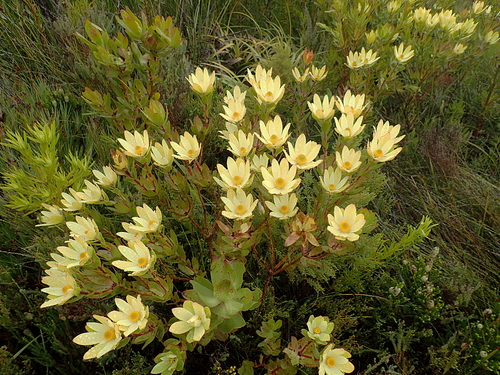
Leucospermum pedunculatum (white-trailing pincushion) is a low, spreading shrub that grows 15–30 cm (½–1 ft) high, forming dense mats up to 3 m (10 ft) in diameter. It grows from a single, stout, upright main stem that can reach around 30 cm (1 ft) high and 1–15 cm (0.4–6 in) in diameter. Stout, horizontally spreading branches grow from this main stem. The powdery, hairy flowering stems at the mat’s edge are slender, 2–3 mm (0.08–0.12 in) thick, and bear short side branches, each of which produces one flower head at its tip.
The leaves of this species are line-shaped, sometimes slightly sickle-shaped, 3–6 cm (1.2–2.4 in) long and 2–5 mm (0.08–0.20 in) wide. They range from hairless to very finely powdery, are well spaced from each other, and sometimes point upwards on trailing stems. Leaf color is bright green in the western part of the species’ distribution, and more olive-colored in the eastern part, where plants also grow more upright.
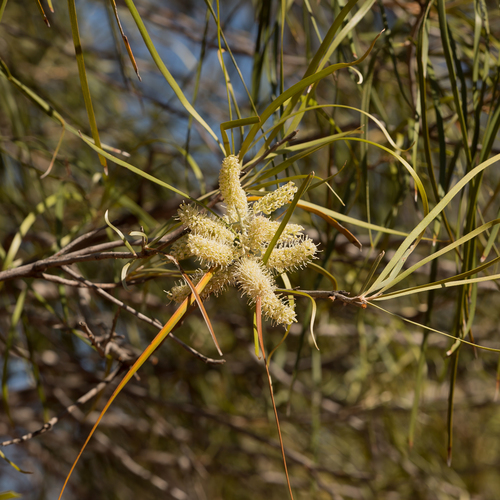
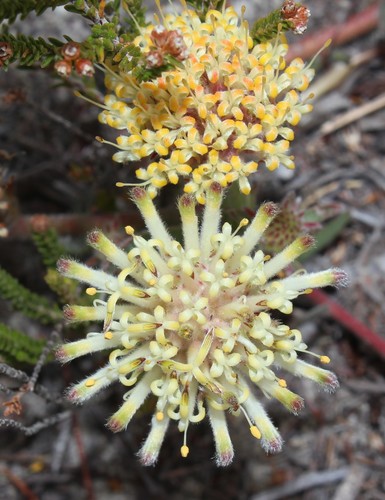
The flower heads are globe-shaped, 2½−3 cm (1.0−1.2 in) in diameter, and are most often produced individually. Each flower head sits on a prominent stalk (peduncle) 2–4 cm (0.8–1.6 in) long. The common base shared by all flowers in one head is very low conic, almost flat, about 4 mm (0.16 in) high and 7 mm (0.28 in) across. The bracts that subtend the entire flower head are lance-shaped with an acuminate (pointy) tip, about 6 mm (0.24 in) long and 1½ mm (0.06 in) wide. They have a cartilaginous texture, are covered in straight hairs, overlap rather loosely, and have tips that curve slightly backward. The bract that subtends each individual flower is inverted lance-shaped, about 7 mm (0.28 in) long and 2 mm (0.079 in) wide, with a pointed tip. Its margins enclose the base of the flower, and its outer surface is covered in dense woolly hairs.
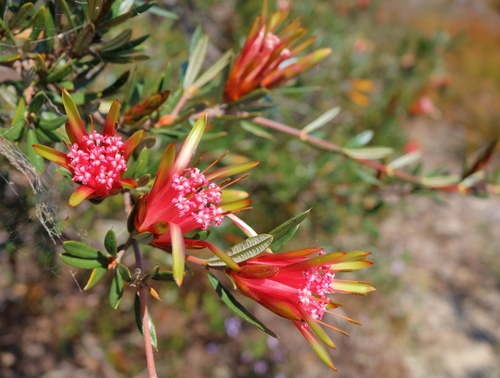
The 4-merous perianth is straight, cylinder-shaped in bud, and is initially white to pale cream before changing to carmine. The lower fused portion of the perianth (called the tube) is about 7 mm (0.28 in) long; it is powdery in its upper section, and hairless and narrower at its base. The middle section, where all four lobes become free when the flower opens (called claws), has all lobes equally recurved toward their upper end, and is covered in straight hairs. The upper portion of the lobes (called limbs) is narrowly lance-shaped with a recurved, pointy tip, about 2 mm (0.079 in) long, and is covered on its outer surface with upright, stiff hairs. The style is straight, 1¾–2 cm long, initially pale cream, later becoming carmine colored. The slightly thickened tip of the style, called the pollen presenter, is pointy cylinder-shaped, slightly cleft, about 1½ mm (0.06 in) long, with a stigma-forming groove across its very tip. Four opaque, line-shaped scales about 1 mm (0.04 in) long subtend the ovary. The flowers of Leucospermum pedunculatum are sweetly scented.
This species occurs along the south coast of South Africa’s Western Cape province, in a narrow strip between Cape Agulhas (Springfonteyn) in the southeast and Danger Point (Franskraal) in the west. All populations grow no more than 6½ km (4 mi) from the sea, at altitudes no higher than 200 m (600 ft). It mostly grows on white sandy flats of Tertiary or Quaternary origin that rim limestone ridges running parallel to the sea. While a small number of plants grow in wind-blown sand accumulated between limestone hills, they never grow directly on limestone itself. At higher altitudes within its range, the species also grows on weathered Table Mountain Sandstone. Average annual precipitation across its distribution is 375–650 mm (15–25 in), with most rain falling in the winter half of the year. Plants can survive the natural wildfires that occur in the strandveld and fynbos vegetation where they grow, by regrowing from their main stem, but only if the fire is not too intense. Leucospermum pedunculatum is pollinated by rodents, which are likely attracted to its sweet, yeasty scent.