About Leucospermum glabrum E.Phillips
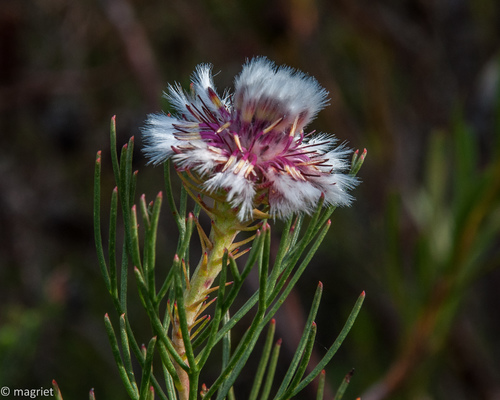
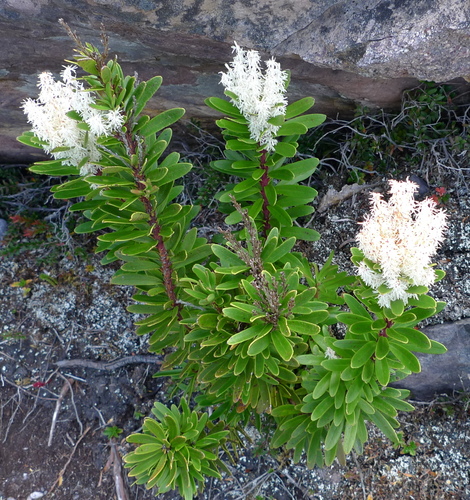
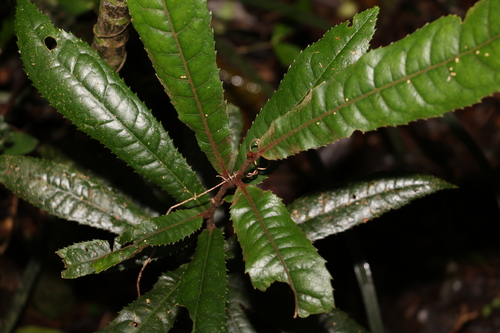
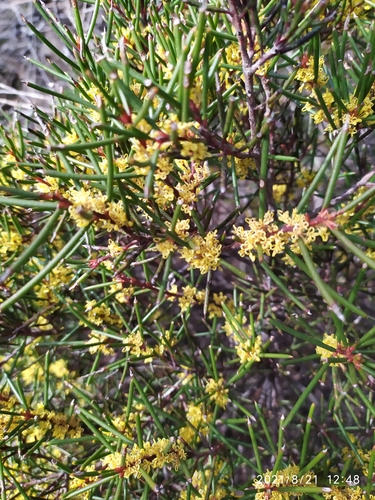
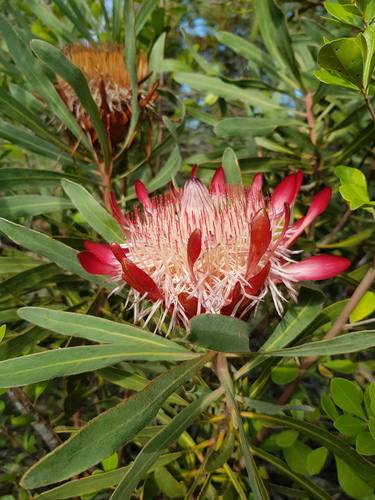
Leucospermum glabrum E.Phillips, also known as the Outeniqua pincushion, is an upright, rounded shrub that reaches up to 2.5 meters (8 feet) in height. It grows from a central stem at its base that can be up to 10 centimeters (4 inches) in diameter, covered in reddish brown bark. Its woody, upright flowering stems are 0.5–1 centimeter (0.2–0.4 inches) in diameter; they start with soft, clearly separated hairs that are quickly shed as the stem matures. Its leaves have very short stalks, angle slightly upward, and are shaped like inverted eggs (often broadly so) with a wedge-shaped base. They measure 8–12 centimeters (3.2–4.8 inches) long and 3–5 centimeters (1.2–2.0 inches) wide, are hairless, bright green, and have 7 to 14 teeth clustered near the tip. The species produces oval flower heads that are 7–9 centimeters (2.8–3.6 inches) in diameter, nearly stalkless, and usually grow singly, though they may occasionally occur in groups of two or three. The common receptacle that supports all flowers in a single head is cone-shaped, about 4.5 centimeters (1.8 inches) long and 1.25 centimeters (0.5 inches) wide. The bracts that subtend the common receptacle are oval with a curved pointed tip, around 9 millimeters (0.35 inches) long and 6 millimeters (0.24 inches) wide. They overlap and lie neatly against the receptacle, have a rubbery texture, and are covered in soft hairs. Each individual flower is wrapped at its base by a subtending bract that measures about 1.5 centimeters (0.6 inches) long and 1 centimeter (0.4 inches) wide. This bract has a strongly recurved pointed tip that ends in a short thread, has a regular row of equal hairs along its margins, and is deep carmine on its outer surface when fresh. It is rubbery in texture, densely woolly at its base, and covered in soft hairs toward its tip. The perianth is around 3.5 centimeters (1.4 inches) long, and ranges in color from carmine to bright orange. The lower fused portion of the perianth lobes, called the tube, is about 1 centimeter (0.4 inches) long and hairless. The middle portion of the lobes, called the claws, where at least one lobe becomes free when the flower opens, is bright crimson. The outer-facing side of the lobe towards the head rim has sparse felty hairs, while the outer three claws are densely covered in crinkled, pressed hairs. The upper portion of the lobes, called the limbs, is narrowly elliptic with a pointed tip, and has variable coverage of long soft hairs. The style is stout, 5–6 centimeters (2.0–2.4 inches) long and 2–3 millimeters (0.08–0.12 inches) in diameter, and curves slightly toward the center of the head once fully developed. The slightly thickened tip of the style, called the pollen presenter, which collects pollen while the flower is still in bud, is conical with a pointed tip. It is around 6 millimeters (0.24 inches) long and half as wide, with a stigma located in a groove at its very tip. The ovary is subtended by four triangular, ivory to cream colored scales that are about 1.5 millimeters (0.06 inches) long. This species is scattered between Cradockberg near George and Prince Alfred's Pass near Plettenberg Bay, on the southern foothills of the Outeniqua Mountains. It only grows on sheltered, cool south-facing slopes at altitudes between 150–450 meters (500–1500 feet). These sites receive 750–1000 millimeters (30–40 inches) of annual precipitation, which is more or less evenly distributed throughout the year. Leucospermum glabrum grows in fynbos on moist peat soils, growing alongside other very tall shrubs such as Laurophyllus capensis, multiple species of Leucadendron, Berzelia, and Erica. This plant community forms a dense vegetation type called "hygrophilous macchia".