About Leucospermum gerrardii Stapf
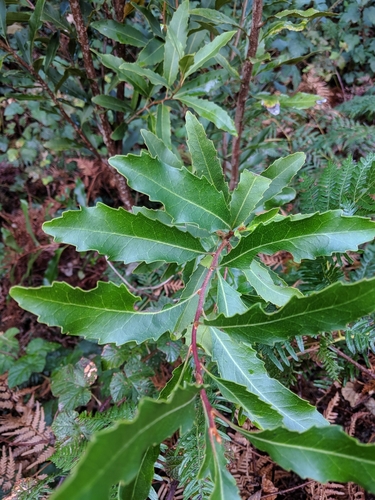
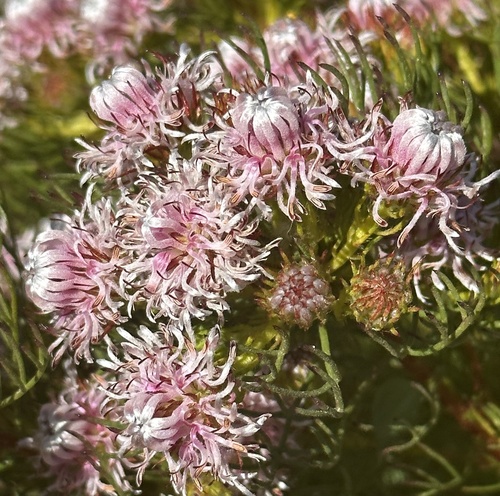
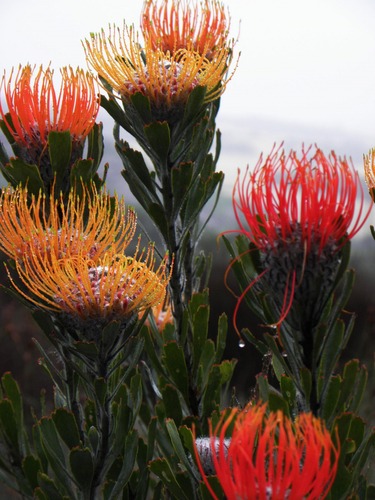
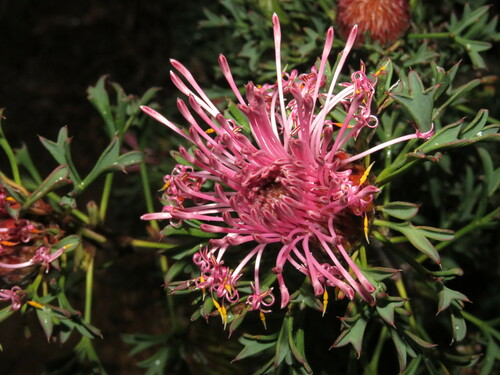
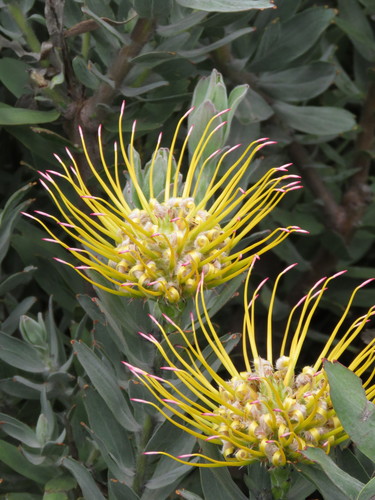
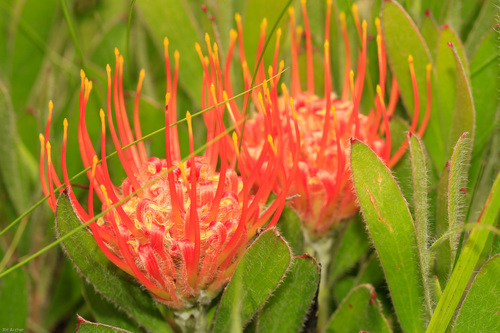
Leucospermum gerrardii Stapf is an evergreen, mat-forming evergreen shrub that reaches 20–40 cm (7.9–15.7 in) in height and grows up to 1 m (3.3 ft) in diameter. It produces upright branches that grow from an underground rootstock. These branches typically form a closed, evenly-heighted cover that creates an appearance somewhat similar to a cushion. Flower-bearing stems are slender, upright, 2–3 mm (0.079–0.118 in) thick, and initially covered in spiderweb-like hairs that are lost as the stems age. Its leaves are linear to inverted lance-shaped, sometimes curved sideways like a sabre, 5–9 cm (2.0–3.5 in) long and ¾–2 cm (0.3–0.8 in) wide, that gradually narrow into a distinct leaf stalk at their base. Leaves usually have an entire margin and end in a bony tip, but may sometimes have three or four teeth, each tipped with bone. They initially bear fine, soft hairs on their surface, but these hairs wear away quickly. Leaves also have a prominent pattern of raised, netted to parallel veins. Flower heads are egg-shaped, 4–7 cm (1.6–2.8 in) in diameter, and grow atop a 1–2 cm (0.39–0.79 in) long stalk. They most often sit individually, but sometimes occur in groups of two or three near the end of branches. The shared common base of flowers within a single head is cylinder-shaped, 1½–2½ cm (0.6–1.0 in) long and 3–4 mm (0.12–0.16 in) in diameter. This base is covered on its lower side by oval, pointy-tipped bracts that are about 1 cm (0.4 in) long and half as wide. These bracts are very densely covered in soft hairs, rubbery in consistency, and arranged in two or three whorls. The bracts that subtend each individual flower are narrower than the lower bracts, are oval with a pointy tip, about 1 cm long and 3 mm (0.12 in) wide, rubbery in consistency, and wrap around the base of the flower. They are thickly woolly at their base and end in a tuft of long straight hairs at their tip. The perianth is 3–3½ cm (1.2–1.4 in) long, initially yellow, and later turns orange to scarlet. The lower portion of the tetramerous perianth is fused into a tube. The middle portion, made up of the claws, is ruptured by the style at anthesis, and the broken parts coil. The lobe facing the center of the flower head has fine, very short, powdery hairs, while the remaining lobes are thickly covered in felty hairs. The upper portion of the perianth (or limbs) are lance-shaped and pointy at the tip, about ½ cm (0.2 in) long, with a dense covering of long straight hairs. The lance-shaped, pointy anthers attach directly to the upper part of the perianth, are about 3 mm (0.12 in) long, and lack a filament. The style is about 5 cm (2 in) long, tapers toward its tip, and curves slightly toward the center of the flower head. It is topped by a slight thickening called a pollen presenter, which has a slender cone shape with a pointy tip, is 2–2½ mm (0.08–0.1 in) long, and has a groove at its very end that functions as the stigma. The ovary is subtended by four nectar-producing, awl-shaped scales about 2 mm (0.08 in) long. This species mostly flowers between September and December. The genus Leucospermum falls in the subtribe Proteinae, which consistently has a basic chromosome number of twelve, with 2n=24 for this species. The dwarf pincushion occurs mainly in grassveld among granite and quartzite outcrops in high mountain areas at 1200–1800 m (4,000–6,000 ft) in the Makhonjwa Mountains near Barberton and in northwest Eswatini. A few small, isolated populations grow on grassland over Table Mountain Sandstone and Ecca Sandstone in central Natal, at 450–1100 m (1,500–3,500 ft) altitude. This species is often associated with underground serpentine deposits. Annual rainfall can reach 1000 mm (40 in) or 1500 mm (60 in) at higher altitudes, and falls mostly during the summer. Its flowers are mainly pollinated by birds. Seeds are released from the flower heads about two months after flowering, and are collected by ants that carry them to their underground nests. L. gerrardii plants survive the regular grass fires that kill their above-ground branches, because they can regenerate from their many spreading, underground stems.