About Leucospermum erubescens Rourke
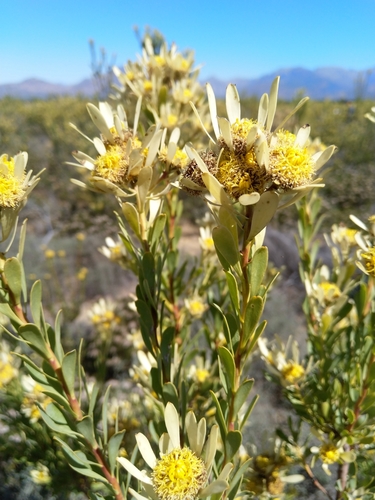
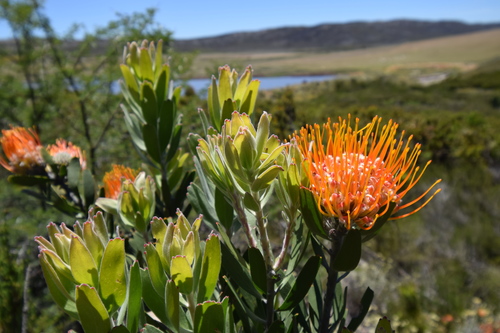
Commonly called the orange flame pincushion, Leucospermum erubescens Rourke is an evergreen upright shrub that reaches 1 to 1.5 meters tall, and at most 2 meters high. It grows from a single stem, with branches covered in smooth grey bark. Its upright flowering stems are 0.5 to 1 centimeter thick, and covered in a dense layer of fine crinkly hairs. Its hairless leaves point slightly upward, are somewhat overlapping, shaped oblong to lance-shaped with the widest section closer to the tip. The leaves are 7 to 8.5 centimeters long and 1 to 2 centimeters wide; the tip is more or less squared off, and often bears three, sometimes up to seven teeth near the tip. Oval flower heads are 5 to 6 centimeters in diameter, set on a 2 to 3 centimeter long stalk, and are usually grouped four to eight together near the end of stems. The flower heads are somewhat asymmetrical, with styles leaning slightly toward the stem. The common base of all flowers within a single head is an asymmetrical broad cone shape or half-sphere, around 1.3 centimeters in diameter, and is clearly distinct from the stalk. The bracts that subtend the base are broadly oval, 6 to 8 millimeters long and around 6 millimeters wide with a sharply pointed tip, velvety on the outside, and overlap each other neatly. The bracts subtending each individual flower wrap around the foot of the flower, have a rubbery texture, are around 1 centimeter long and 0.7 centimeters wide, thickly woolly hairy at the base and softly hairy further upward, with a sharply pointed tip. The 4-merous perianth is straight when in bud, 3 to 3.5 centimeters long, uniformly covered in silky hairs, yellow when opening but turning crimson as it ages. The lowest, fully fused part of the perianth, called the tube, is 1 to 1.2 centimeters long, slightly compressed from the sides, hairless at the base, widened and covered in fine powder where it joins the middle split section called claws, which are silky hairy and coil neatly when the flower opens. The upper part, called limbs, that enclosed the pollen presenter in the bud is made up of four narrowly oval lobes around 3 millimeters long, which are softly hairy and also bear long stiff hairs. A style 4 to 5.5 centimeters long emerges from the perianth; it bends very slightly toward the center of the flower head, initially yellow, turning crimson as it ages. The thickened tip of the style, called the pollen presenter, is cylinder-shaped with a blunt tip or a slight split into two, and is around 3 millimeters long. The ovary is subtended by four opaque awl-shaped scales around 2 millimeters long. This species has a very limited range on the northern foothills of the Langeberg, where it occurs between Muiskraal and Brandrivier in a narrow strip of arid fynbos bordering the Little Karoo, plus an isolated population at Warmbad on the Warmwaterberg. Plants grow on gravel flats or rocky hills of weathered Table Mountain Sandstone, at elevations between 450 and 600 meters. In these locations, annual precipitation is 250 to 375 millimeters, which falls mainly during winter. Nectar-feeding birds including the Cape sugarbird and several sunbirds pollinate the flowers. Large insects such as monkey beetles also visit the flowers, but do not necessarily brush against pollen presenters and may be inefficient pollinators. Fruits ripen roughly two months after flowering, then fall to the ground. Ants collect the fallen fruits and carry them underground into their nests. The soft, pale elaiosome on the fruit is eaten, leaving the hard, smooth seed stored underground. After a wildfire destroys all above-ground vegetation, the seeds germinate when temperatures are 5 to 10 °C at night and 15 to 20 °C during the day, and germination is stimulated by smoke residues in water. Leucospermum erubescens is cultivated as a cut flower, and grown as an ornamental in gardens.