About Leucospermum conocarpodendron (L.) H.Buek
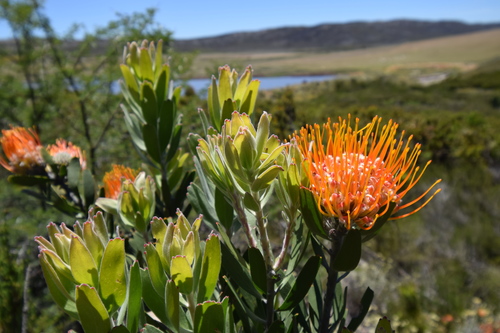
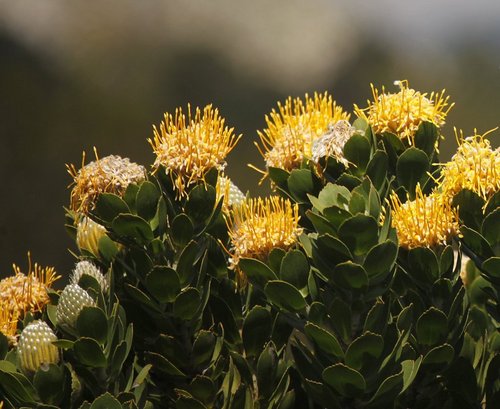
Leucospermum conocarpodendron (L.) H.Buek is an evergreen large shrub that reaches 3–5 m (9.8–16.4 ft) in height and 3–6 m (9.8–19.7 ft) in diameter, with a rounded rigid crown. This rigid structure comes from thick branching that occurs at roughly right angles. The plant has a sturdy trunk 15–40 cm (5.9–15.7 in) in diameter, covered in 3–5 cm (1.2–2.0 in) thick greyish, reddish, or blackish bark marked by a network of fissures. Flowering branches are rigid, 1–1½ cm (0.4–0.6 in) thick, and covered in a dense layer of white or greyish crinkly hairs, or long soft silky hairs. The leaves have no leaf stalk or stipules, and are shaped ovate to lance-shaped, with the greatest width usually beyond the midpoint. They measure 6–11½ cm (2.4–4.6 in) long and 2½–5 cm (1–2 in) wide, have blunt or pointed tips, and are shallowly or deeply incised with three to ten teeth. Depending on the subspecies, leaf surfaces are either hairless, or covered in a dense layer of soft, greyish, convoluted hairs, and may occasionally have a fringe of fine hairs. Flower heads grow atop a stalk around 1½ cm (0.6 in) long, and are globe-shaped to egg-shaped, 7–9 cm (2.8–3.5 in) in diameter. They occur individually, or most often in groups of two or three near the tip of the branch, and are often partially enclosed by leaves. The common base shared by all flowers in a single head is narrowly cone-shaped with a pointed tip, measuring 2½–3 cm (1–1.2 in) long and 1–1½ cm (0.4–0.6 in) in diameter. The bracts that subtend the entire flower head are oval with a pointed tip, 1¼–1½ cm (0.5–0.6 in) long and approximately 1 cm (0.39 in) wide, tightly overlapping, rubbery in texture, and covered in soft hairs. The bracts that support each individual flower enclose the base of the flower, have a sharply pointed tip, measure about 2 cm (0.79 in) long and about 1 cm (0.39 in) wide, are rubbery in texture, woolly at the base and less woolly toward the tip. The perianth is 3½–5 cm (1.4–2.0 in) long and yellow in color. The lower 1 cm (0.4 in) is fused, cylindrical, and hairless. When the flower opens, the free segments of the four perianth claws curl backward. The claws positioned to the sides and facing the rim of the flower head are densely covered in long hairs, while the claw facing the center of the head has a fine powdery coating or very short soft hairs. The perianth limbs are lance-shaped with a pointed tip, 6–8 mm (0.24–0.31 in) long, and have long hairs pressed against their surface; the limb facing the center of the head is the exception, with only a fine powdery coating. The style is stout, 1–1½ mm (0.04–0.06 in) thick and 4½–5½ cm (1.8–2.2 in) long. It initially bends toward the center of the flower head, and straightens as it ages. The style is capped by a slight thickening called the pollen presenter, which is broadly conical with a pointed tip, 4–5 mm (0.16–0.20 in) long and about 2 mm (0.079 in) wide. Four pointed lance-shaped scales around 2 mm (0.079 in) long subtend the ovary. The genus Leucospermum belongs to the subtribe Proteinae, which consistently has a basic chromosome number of twelve (2n=24). Leucospermum conocarpodendron subsp. conocarpodendron is endemic to the Cape Peninsula, limited to the eastern slopes of Devils Peak, the northern and western slopes of Table Mountain and the Black Table, extending to Llandudno. It grows mainly on heavy clay formed from weathered Cape Granite, and also grows on weathered Table Mountain Sandstone. It prefers well-drained north-facing and west-facing exposures. Leucospermum conocarpodendron subsp. viridum has a much wider distribution that borders the range of the nominal subspecies. It occupies the remaining area of the Cape Peninsula from Kirstenbosch to the Cape of Good Hope. It also occurs from the upper Berg River Valley, via Pringle Bay and Hermanus to Stanford. Isolated populations can also be found at Helderberg, Simonsberg, and Kogelberg near Durbanville. This subspecies grows on a range of different soil types, including Malmesbury gravel, sand from weathered Table Mountain Sandstone, dune sands, permanently soggy peat, and sometimes the heavy clay left by decomposed Cape Granite. It grows mostly between sea level and 150 m (490 ft), and sometimes occurs at up to 300 m altitude. At some sites, this pincushion is the dominant species and forms dense stands. Both subspecies have some resistance to the wildfires that occur in fynbos every one to two decades, because their trunks are covered in thick bark. After fire burns away the soft plant tissue, the plant regrows from the tips of its higher branches. Repeated mild burning produces an umbrella-shaped growth habit. Seed dispersal and survival for this species, like many Proteaceae, depends heavily on symbiosis with native ant species, particularly Anoplolepis steingroeveri and Pheidole capensis. These ants carry the fruits to their underground nests, where they eat the elaiosome, leaving the smooth, hard seed underground. This keeps the seed safe from consumption by rodents and birds, and safe from overhead fires. Seeds germinate after a fire, because larger temperature fluctuations occur after overhead vegetation is removed, and chemicals from charcoal seep into the ground with winter rains and soak the seeds. Seed dispersal distances are limited: in an experiment, seeds were moved an average of about 2 m (6½ ft), and at most about 10 m. The presence or absence of an elaiosome does not affect germination rate, but a field trial found that seeds without an elaiosome almost never survive a fire, while all seeds with an elaiosome germinated. This indicates that burial of seeds by ants is essential for survival.