About Leucaena leucocephala (Lam.) de Wit
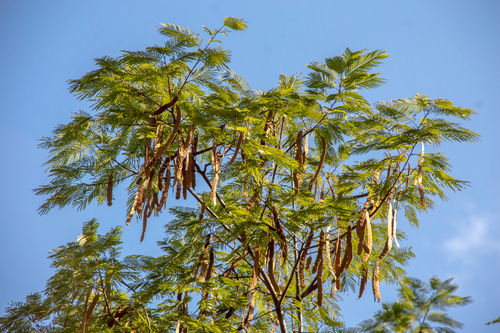
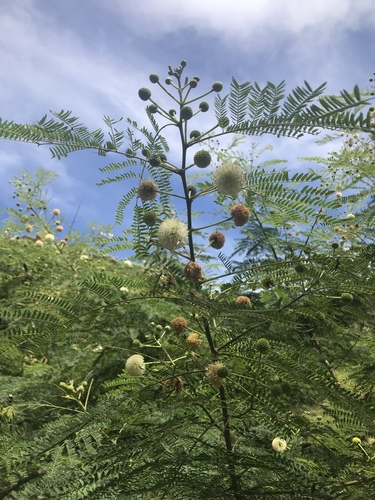
Leucaena leucocephala (Lam.) de Wit is a small tree that grows to a height of 7 to 18 meters (23 to 59 feet). Its bark is grey and cracked, and its branches do not have thorns. Each branch holds 6 to 8 pairs of leaf stalks, which in turn bear 11 to 23 pairs of leaflets. Each individual leaflet is 8 to 17 mm long, with a pale green upper surface and a whitish underside. Its inflorescence is a cream-colored puff that holds many stamens. After flowering, it produces flat, straight seed pods that measure 13 to 18 cm (5.1 to 7.1 in) long. As the pods mature, their color changes from green to brown, and each pod contains between 15 and 30 seeds.
Ecologically, Leucaena leucocephala is susceptible to insect infestations. In the 1980s, a psyllid pest attack caused widespread loss of this species across Southeast Asia. In India, the tree was initially promoted for afforestation because it grows very quickly. However, it is now considered unsuitable for urban planting, since it has a tendency to be uprooted during heavy rain and wind events. In Pune, eight out of every ten trees uprooted by wind are Leucaena leucocephala.
The seeds of Leucaena leucocephala contain mimosine, an amino acid that is known to be toxic to nonruminant vertebrates.
In the 1970s and 1980s, Leucaena leucocephala was promoted as a "miracle tree" thanks to its wide range of uses. It has also been called a "conflict tree", because while it is used for forage production, it also spreads like a weed in some locations. This legume is promoted in several Southeast Asian countries, including at least Burma, Cambodia, Indonesia, Laos, and Thailand. It is most importantly used as a source of high-quality animal feed, and residual material is also used for firewood or charcoal production.