About Acacia iteaphylla F.Muell. ex Benth.
Scientific Name
Acacia iteaphylla F.Muell. ex Benth.
Description
Size and Growth Habit
This shrub has a weeping growth habit, typically reaching 2 to 5 metres (6.6 to 16.4 ft) in height, with a crown width of 2 to 5 m (6.6 to 16.4 ft). Young plants are glabrous, with greenish bark that turns brown as the plant matures.
Foliage Features
Its slender grey-green foliage has pink-red new growth tips. The long, slender phyllodes are arranged alternately, feature a single prominent lengthwise vein, and grow up to 10 centimetres (3.9 in) long.
Flowering Period
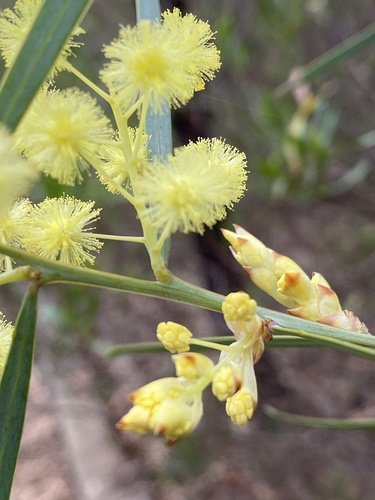
It produces yellow flowers between March and September. Flowers are arranged in small spherical clusters that form short compound clusters in the forks of phyllodes.
Flower Characteristics
Flower heads are 5 to 8 millimetres (0.197 to 0.315 in) in diameter, and hold 12 to 17 pale to lemon yellow flowers. After flowering, thin, leathery, light brown elongated flat seed pods form; pods are usually 5 to 13 centimetres (2.0 to 5.1 in) long and 6 to 12 mm (0.236 to 0.472 in) wide.
Seed Details
Pods contain hard black ellipsoidal seeds that measure 6 mm (0.236 in) long, with half that measurement in width.
Distribution
Native Range
It is native to the Flinders Range, Gawler Range, and Eyre Peninsula of South Australia. In its native range, it grows on hillsides among rocky outcrops, or along rocky creek beds.
Invasive Range in Eastern Australia
This shrub is now also found in parts of New South Wales and western Victoria, where it is classified as an invasive species. It is also invasive and naturalised in Western Australia.
Western Australia Distribution
It has a sporadic distribution across the South West, Wheatbelt, and Great Southern regions of Western Australia, where it grows in sandy soils within jarrah forest.
Cultivation
Commercial Availability
This shrub is sold commercially for cultivation as seedlings and in seed form. It tolerates both full sun and partial shade, grows well in saline soils, and is both frost tolerant and drought tolerant once established.
Garden Uses
It is used in gardens as an ornamental screen or low windbreak, due to its fast growth rate and attractive foliage. The best known cultivar of A. iteaphylla is a low-growing form called Acacia "Parsons Cascade".
Planting Requirements
Seeds require scarification or treatment with boiling water before planting.