About Lespedeza capitata Michx.
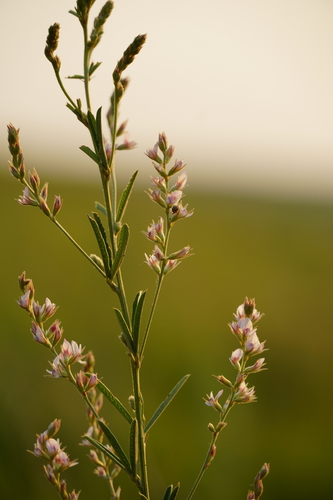
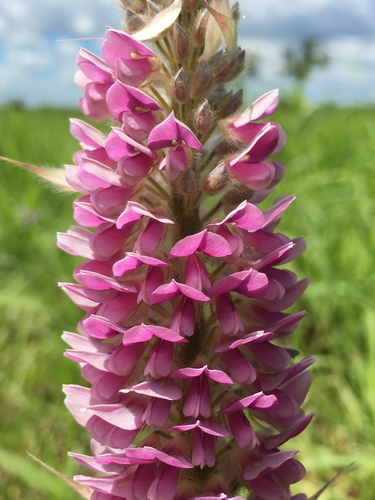
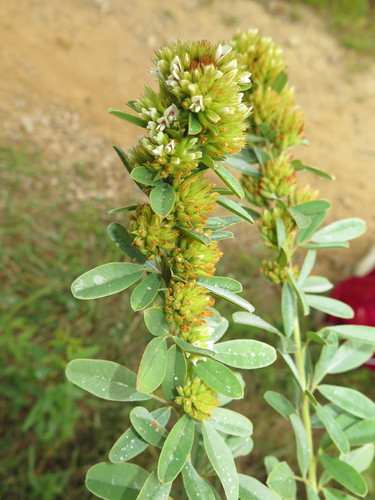
Lespedeza capitata Michx. is a perennial herb with erect stems that can reach up to 1.5 meters in height. Its taproot can grow over two meters deep into soil, and its lateral roots extend up to one meter horizontally. Its leaves are alternately arranged, each composed of multiple leaflets, and the entire plant is covered in silvery hairs. Flowers grow in somewhat rounded clusters at the top of each stem; individual flowers are white with a purple spot. This species is native to eastern North America, covering eastern Canada and the eastern half of the United States. In the wild, it grows in wooded areas, prairies, and disturbed habitats like roadsides. Lespedeza capitata is drought-tolerant and fixes nitrogen. It can be infected by the rust pathogen Uromyces lespedezae-procaumbentis, the tar spot fungus Phyllachora lespedezae, and experience herbivory from the insect Pachyschelus laevigatus. It serves as a host for many Lepidoptera species, including the eastern tailed blue, gray hairstreak, hoary edge, northern cloudywing, orange sulphur, silver-spotted skipper, southern cloudywing, and spring azure. Its seeds are favored by several bird species, most notably the northern bobwhite. Native American groups used this plant for a variety of medicinal purposes. It was utilized as moxa to treat rheumatism. The Comanche used its leaves to make tea. The Meskwaki made a poison antidote from its roots. The Pawnee called the plant parus-asu, meaning rabbit foot, due to the shape of its fruits, and brewed tea from its dried stems and leaves as a coffee substitute when coffee was unavailable. Among the Omaha and Ponca peoples, it is known as the male buffalo bellow plant.