About Lepus europaeus Pallas, 1778
Size
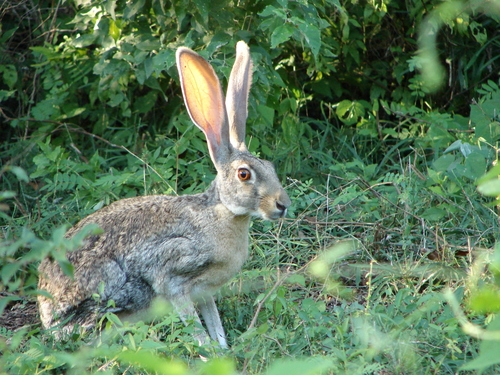
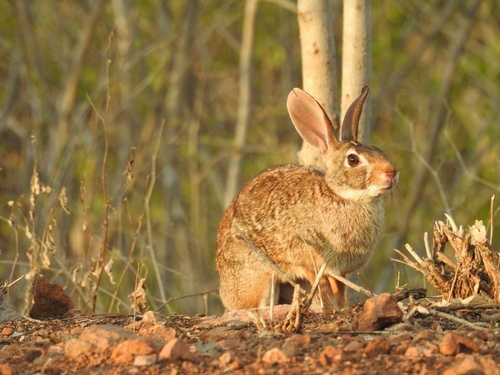
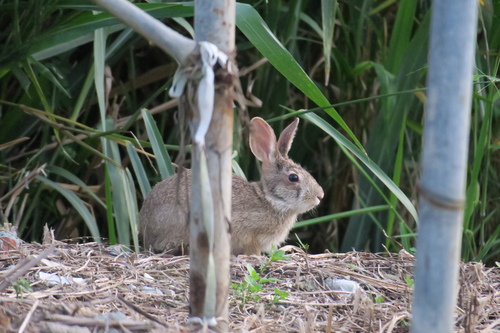
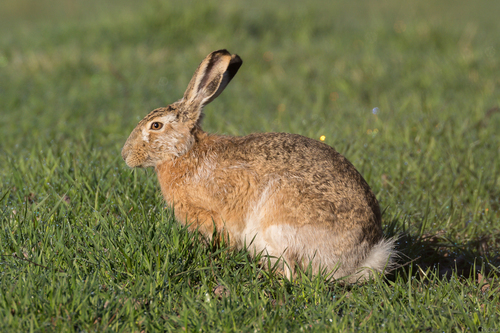
The European hare (Lepus europaeus Pallas, 1778) is a fast-running terrestrial mammal belonging to the family Leporidae. It is the largest hare species native to Europe, with a head-to-body length of 55 to 65 cm (22 to 26 in), a tail length of 7.5–14 cm (3.0–5.5 in), and a body weight of 3.5–5 kg (7.7–11.0 lb).
Limbs and Dentition
Its elongated ears measure 9.4 to 11.0 cm (3.7 to 4.3 in) from notch to tip, and its long hind feet are 14 to 16 cm (5.5 to 6.3 in) long. Its dental formula is 2/1, 0/0, 3/2, 3/3.
Build
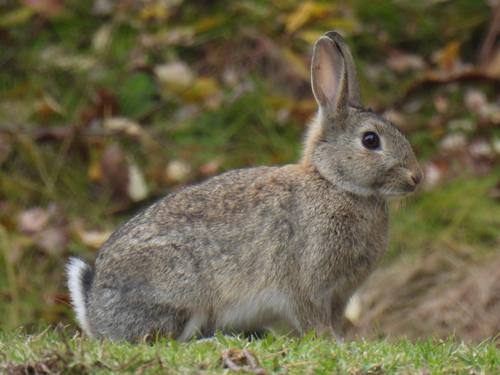
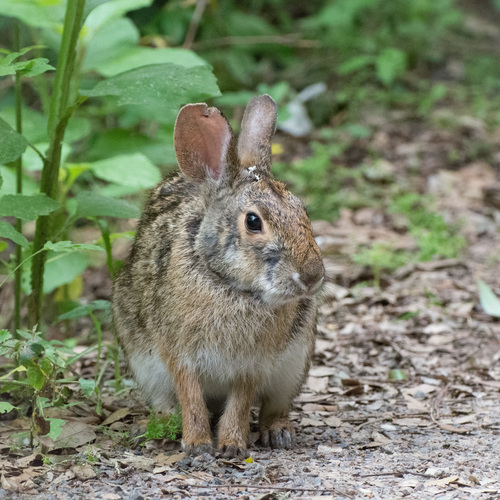
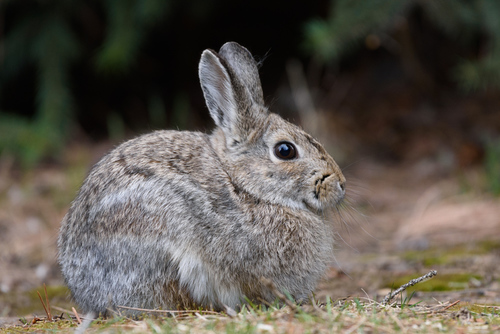
Compared to the European rabbit, the European hare is more slender. Its dark limb musculature provides excellent stamina for high-speed running across open country, in contrast to cottontail rabbits, which are built for short sprints in more heavily vegetated habitats.
Fur
Additional adaptations for endurance running include wider nostrils and a larger heart. The European hare also has a proportionally smaller stomach and caecum than the European rabbit. Its fur is grizzled yellow-brown on the back, becoming rufous on the shoulders, legs, neck, and throat, white on the underside, and black on the tail and ear tips. Fur on the back is typically longer and more curled than fur on the rest of the body. Fur colour mostly stays consistent year-round, though white areas develop on the sides of the head and base of the ears, and the hip and rump region may gain some grey.
Range
The European hare is native to most of continental Europe, ranging as far north as 60°N and as far east as Central Asia, and it has been expanding its range into Siberia. It may have been introduced to Great Britain between 500 and 300 BCE. It has also been introduced, mostly as a game animal, to North America (Ontario and New York State, with unsuccessful introductions in Pennsylvania, Massachusetts, and Connecticut), the Southern Cone (Brazil, Argentina, Uruguay, Paraguay, Bolivia, Chile, Peru, and the Falkland Islands), Australia, both islands of New Zealand, the south Pacific coast of Russia, and Ireland.
Steppe Density
The European hare primarily inhabits open fields and shelters in scattered vegetation; it is a versatile species that thrives in mixed farmland. In its native steppe habitat, populations are dispersed, with an average of roughly 2 individuals per 100 hectares. In milder climates, population densities can reach up to 275 hares per 100 hectares.
Elevation
A study in the Czech Republic found that hares are most numerous at elevations below 200 m (660 ft) with an average annual temperature of 10 °C (50 °F), and that population density is highest in warm and dry districts with mild winters. In Poland, the European hare is most abundant in areas with few forest edges, likely because foxes use forest edges as cover.
Farmland Habitat
The species requires cover such as hedges, ditches, and permanent cover areas that supply its varied diet, and it occurs at lower densities in large open fields. High cultivation leads to greater mortality of young hares. In Great Britain, the European hare is most frequently found on arable farms with crop rotation, fallow land, wheat, and sugar beet crops. On grass-dominated farms, its numbers increase with improved pastures, some arable crops, and patches of woodland. It is seen less often where foxes or common buzzards are abundant.
Hunting Pressure
It does not appear to directly compete with European rabbits. While European hares are shot as game when populations are plentiful, this activity is self-limiting and rarely occurs in areas where the species is scarce.
Breeding Season
European hares have an extended breeding season that runs from January to August. During this season, females (called does) are fertile, while males (called bucks) are fertile outside of October and November. After a reproductive lull in October, males' testes enlarge and become more active, regaining full function between December and February.
Mating System
Mating begins before ovulation; the earliest pregnancies of the season usually only produce a single foetus, and many miscarriages occur. Peak reproductive activity falls in March and April, when all females may be pregnant, most with three or more foetuses. The species' mating system has been described as both polygynous (single males mating with multiple females) and promiscuous. Females have six-week reproductive cycles and are receptive for only a few hours at a time, leading to intense competition among local males.
March Madness
At the peak of the breeding season, this activity is called "March madness", when normally nocturnal bucks become active during the day. In addition to dominant males subduing subordinates, females fight off numerous suitors if they are not ready to mate. Fights can be vicious and leave many scars on the ears. During these encounters, hares stand upright and attack each other with their paws, a practice called "boxing", and this activity is often between a female and a male rather than between competing males, as was previously believed. When the doe is ready to mate, she runs across the countryside, starting a chase that tests the stamina of the following males; she only stops to mate once one male remains.
Late Season
Female fertility continues through May, June, and July, but male testosterone production decreases and sexual behaviour becomes less prominent. Litter sizes shrink as the breeding season ends, and no females are pregnant after August. Males' testes reduce in size at this time, and sperm production ends by September.
Birth
Does give birth in depressions they dig in the ground. An individual female can produce two to four litters per year after a six-week gestation period.
Leverets
Litters can have up to ten young (called leverets), which have an average birth weight of around 130 grams (4.6 oz). Leverets are born fully furred and precocial, and are ready to leave the nest soon after birth—an adaptation to the lack of physical protection compared to that provided by a burrow.
Nursing
Leverets disperse during the day and gather in the evening near their birth site. Their mother visits to nurse them soon after sunset; the young suckle for around five minutes, urinating while nursing, and the doe licks up the urine. She then leaps away to avoid leaving an olfactory trail, and the leverets disperse again.
Growth
Young can eat solid food after two weeks and are weaned at three or four weeks old. While young of both sexes commonly explore their surroundings, natal dispersal tends to be greater in males. Sexual maturity is reached between 4 and 8 months of age.
Feeding
The European hare is primarily herbivorous and forages for wild grasses and weeds. With the intensification of agriculture, it has begun feeding on crops when its preferred foods are not available. In spring and summer, it feeds on soy, clover, corn poppy, grasses, and herbs.
Seasonal Foods
In autumn and winter, it primarily chooses winter wheat, and is attracted by hunters using piles of sugar beet and carrots as bait. It also eats woody material from shrubs and young fruit trees during winter. It avoids cereal crops when other more attractive foods are available, and appears to prefer diets high in energy, fats, and proteins over dietary fiber. When feeding on twigs, it strips off bark to eat the vascular tissues for their soluble carbohydrates.
Digestion
Compared to the European rabbit, food passes through the gut more rapidly in the European hare, though digestion rates are similar. It sometimes eats its own faeces to recover undigested proteins and vitamins. The total consumption of two or three European hares equals that of a single sheep.
Group Foraging
European hares forage in groups; group feeding benefits individuals because they can spend more time feeding while other hares act as lookouts for predators. However, the distribution of food changes these benefits. When food is well-spaced, all hares can access it. When food is more concentrated, only dominant hares can access it.
Competition
In small gatherings, dominant hares are more successful at defending food, but as more individuals join, they must spend more time driving other hares away. The larger the group, the less time dominant individuals have available to eat. Meanwhile, subordinate hares can access food while dominants are distracted. As a result, when hares forage in groups, all individuals fare worse when food is more concentrated.
Hunting
Across Europe, hunters harvest over five million European hares each year, making it likely the most important game mammal on the continent. This popularity has threatened regional varieties, such as those found in France and Denmark, through large-scale importing of hares from Eastern European countries like Hungary.
Beagling
Hares have traditionally been hunted in Britain via beagling and hare coursing. In beagling, the hare is tracked by a pack of small hunting dogs (beagles), followed by human hunters on foot. Britain's 2004 Hunting Act banned hunting hares with dogs, so the existing 60 beagle packs now use artificial trails, or hunt rabbits instead.
Coursing
Hare coursing with greyhounds was once an aristocratic pursuit, forbidden to lower social classes. More recently, informal unpermitted hare coursing on private land became a lower-class activity, and it is now illegal. Despite being illegal, hare coursing still occurs, often causing damage to agricultural land when hunters trespass on farms to pursue hares. In Scotland, concerns have been raised about the increasing number of hares shot under license.
Jugging
Hare meat is traditionally prepared by jugging: a whole hare is cut into pieces, marinated, and slow-cooked with red wine and juniper berries in a tall jug set in a pan of water. It is traditionally served with (or briefly cooked with) the hare's blood and port wine.
Meat Quality
Hare can also be cooked in a casserole. The meat is darker and more strongly flavoured than rabbit meat. Young hares can be roasted; the meat of older hares is too tough for roasting, and is typically slow-cooked.