About Leptopelis flavomaculatus (Günther, 1864)
This species, Leptopelis flavomaculatus, has the following physical description.
Adult Size
Adult males measure 44–50 mm (1.7–2.0 in) in snout–vent length, while adult females measure 60–70 mm (2.4–2.8 in).
Color and Markings
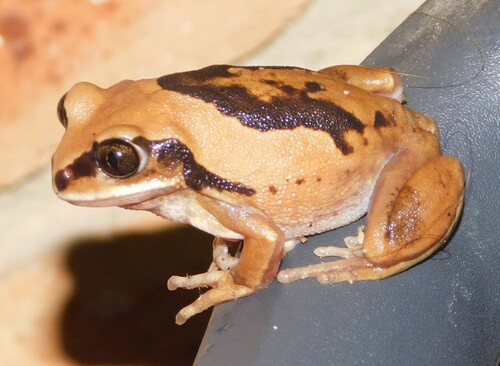
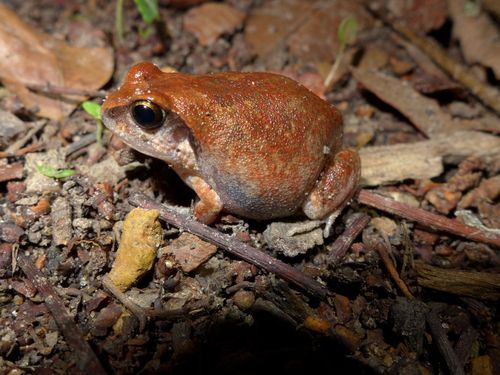
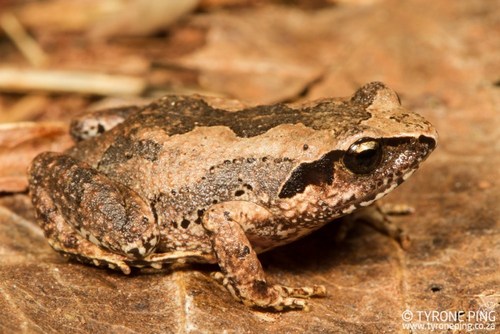
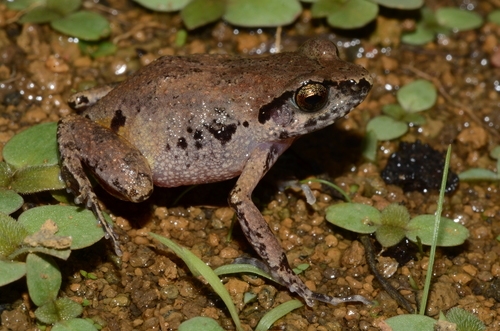
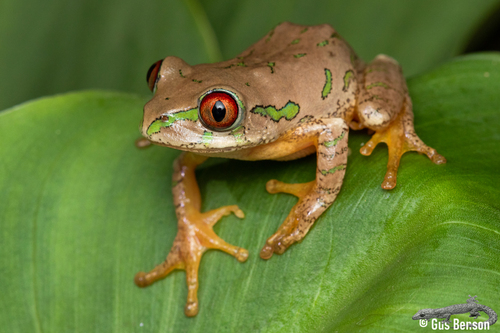
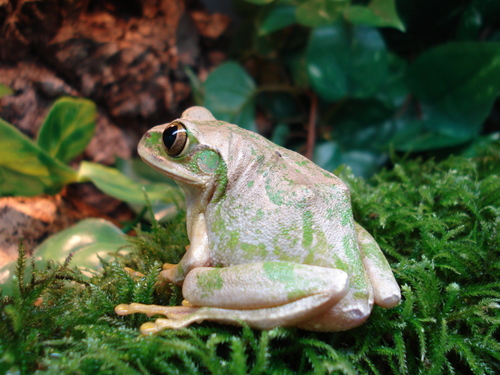
Its dorsum has two common color patterns: it is either uniformly green with white heels, or brown with a darker, forward-pointing triangle that has a blunt apex. There is a dark bar between the eyes and a dark canthal line on the head. Young, green specimens often have yellow spots.
Congener Comparisons
Leptopelis flavomaculatus is similar in appearance to Leptopelis vermiculatus, but it does not have the vermiculated dorsum that marks L. vermiculatus. It is also similar to Leptopelis christyi, but L. flavomaculatus is larger and has a dorsal triangle with a more blunt apex than L. christyi.
Habitat and Conservation Status
Habitat Preferences
For habitat and conservation status, the natural habitats of Leptopelis flavomaculatus are lowland and montane evergreen forests, and especially dry forests, found at elevations up to 1,600 m (5,200 ft) above sea level. It can live in both pristine and secondary forest habitats, and is often found along streams. It cannot survive in open habitats located outside of forest.
Breeding and Behavior
Males of the species call from either leaves or branches, typically 3–4 meters above the ground, or from the mouth of burrows dug in the ground. Based on similarity to other species in its genus, Leptopelis flavomaculatus is assumed to lay eggs in a nest located near water.
Threats and Protection
This species is often common in areas that have suitable habitat. However, it is threatened by habitat loss caused by agricultural expansion, logging, and expanding human settlements. It is known to occur in several protected areas.