About Leptodactylus podicipinus (Cope, 1862)
Adult Size
Leptodactylus podicipinus is a medium-sized species within its genus. Females have a snout-to-vent length ranging from 30 to 54 mm (1.2 to 2.1 in), while males measure between 24 and 43 mm (0.94 and 1.69 in).
Dorsal and Glandular Features
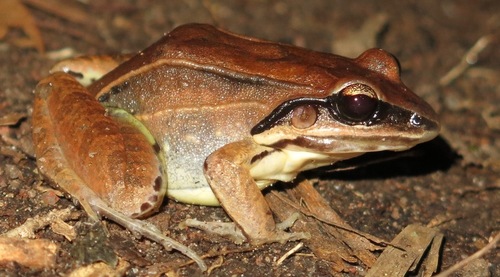
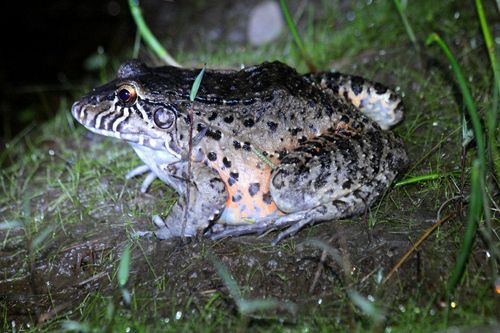
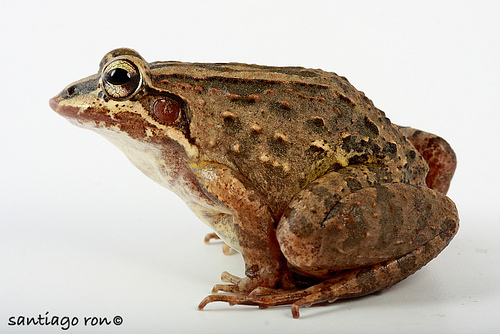
This species has short, poorly developed dorsolateral folds, with yellowish glandular patches located on the flanks and in the groin.
Body Coloration
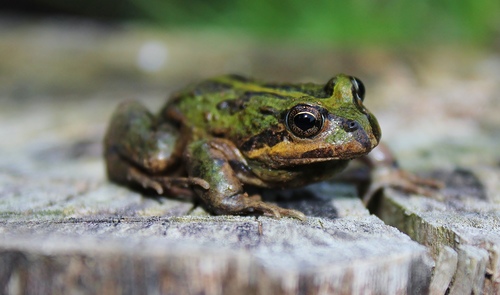
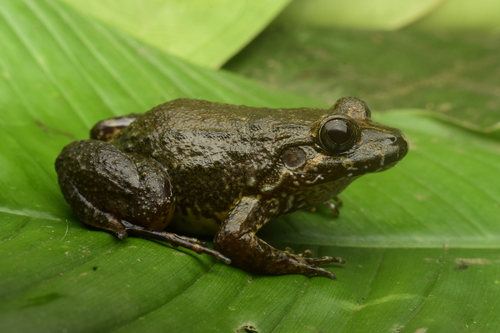
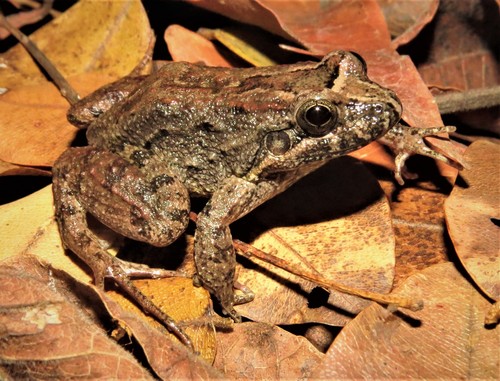
Its dorsal surface is brown, and its underparts are dark grey, typically marked with white spots or mottling; this patterning blends into mottling on the back of the thigh.
Toe Morphology
Toe tips are either straight or slightly bulbous.
Tadpole Characteristics
Tadpoles of this species grow to a total length of approximately 28 mm (1.1 in), and are brown, sometimes with white speckles on the tail.
General Distribution
Leptodactylus podicipinus is distributed across the northern half of South America. Its range extends from central and western Brazil southward to northern and eastern Bolivia, Paraguay, northeastern Argentina, and northern Uruguay.
Habitat
It typically lives in open areas near seasonally flooded rivers, moist grassland, and areas close to ponds, and occurs at altitudes up to 1,000 m (3,300 ft).
Digging Adaptations
Like other members of its genus, Leptodactylus podicipinus has a strong skull and legs adapted for digging; males use both their snout and legs when digging.
Foam Nest Trait
It also shares the genus characteristic of males creating foam nests for eggs.
Pantanal Nesting Behavior
In populations in Brazil’s Pantanal, males have been observed finding or digging ground depressions near pond edges, rather than in larger bodies of water, and build their foam nests inside these small, water-filled basins.
Nesting Behavior Significance
This behavior has not been observed in other populations across the species’ range, and it represents an intermediate stage between the subterranean nests of species in the Leptodactylus fuscus group and the floating nests of other less-derived species.