About Lepidium coronopus (L.) Al-Shehbaz
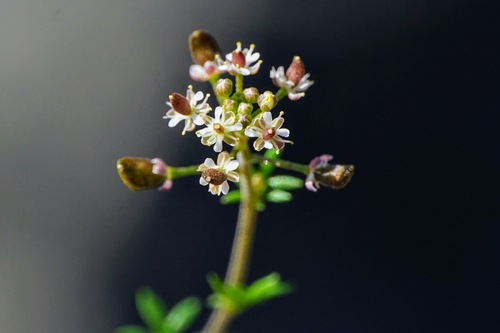
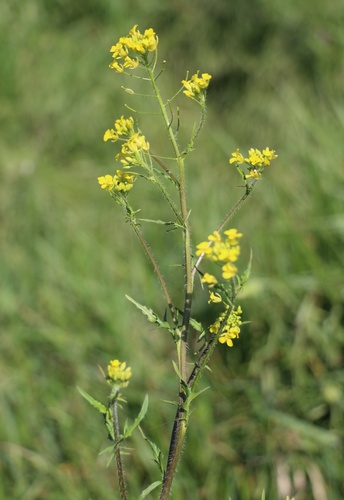
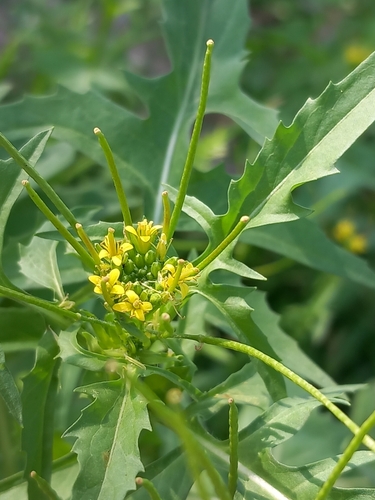
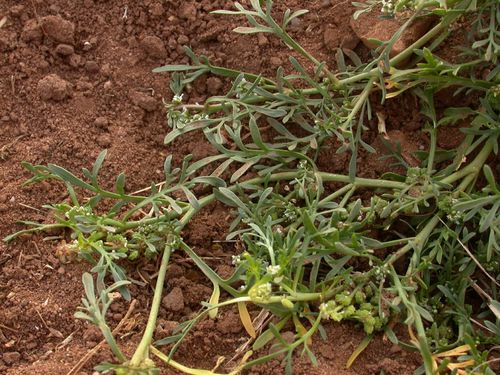
Lepidium coronopus (L.) Al-Shehbaz, commonly called Swine Cress, is a robust herb that most often grows as an annual, and rarely as a biennial. It is a low to short prostrate plant, usually producing multiple stems from its base; stems sprawl, trail, or spread, and only very rarely grow ascending. The plant reaches 5–12 cm (2.0 in – 4.7 in) in height, with hairless or nearly hairless stems that branch near their tips and grow 5–30 cm (2.0 in – 11.8 in) long. It produces two types of leaves: basal and cauline (stem-growing). Basal leaves form a rosette, with a 2–5 cm (0.79 in – 1.97 in) long petiole (leaf stalk), and are pinnatisect, meaning their lobes have incisions that extend almost or all the way to the midrib; the lobes are dark green and strap-shaped. Cauline leaves have short petioles or are stalkless, and are also pinnatisect or nearly unlobed. All leaves are dull blue-green or greyish green. Swine Cress is very similar in form to Lesser Swine Cress (Lepidium didymum), but the leaves of Lesser Swine Cress are edible. Other key differences between the two species are that L. didymum has 2 stamens, while L. coronopus has 6, and their fruits are very different. Lepidium coronopus blooms between May and August, or between June and September. Its small flowers are 0.2–0.4 cm (0.079 in – 0.157 in) wide, white or purplish, and grow in short clusters opposite leaves on racemes. The rachis is glabrous (hairless). Flowers have 4 obovate to oblong-shaped petals that are longer than the oblong-shaped sepals, and 6 stamens with small anthers. After flowering, it produces small fruits (seed capsules) 0.3–0.47 cm (0.12 in – 0.19 in) across, shaped like a kidney or ovate-cordate. The fruit surface is wart-like, irregularly wrinkled, and marked with pointed bumps. Each fruit holds only 1 or 2 seeds; the seeds are small, dirty yellowish, measure 1.1-1.5 by 1.3-1.7 mm, are elliptic and flattish, shaped like a pear or ovate-oblong, and are curved but not winged. Lepidium coronopus is native to temperate regions of Africa, western Asia, and Europe. In Africa, it is native to Algeria, Egypt, Libya, Morocco, and Tunisia. In western Asia, it is native to Armenia, Azerbaijan, the Caucasus, Dagestan (Russia), Georgia, Iran, Iraq, Israel, Jordan, Lebanon, Syria, and Turkey. In Europe, it is native to central Europe: Austria, Belgium, the Czech Republic, Germany, Hungary, the Netherlands, Poland, Slovakia, Switzerland, and Ukraine; northern Europe: Denmark, Finland, Ireland, Sweden, and the United Kingdom, where it is common on the coasts of southern England, Wales, and southern Ireland; south-eastern Europe: Albania, Bosnia and Herzegovina, Bulgaria, Croatia, Greece, Italy, Macedonia, Montenegro, Romania, Serbia, and Slovenia; and southwestern Europe: France, Portugal, and Spain. It has also become widely naturalised in many other regions: Norway in Europe; the Azores, Madeira Islands, Canary Islands, and South Africa in Africa; South Australia, Tasmania, Victoria in Australia, and New Zealand; North America, including New Brunswick, Nova Scotia, Ontario, and Quebec in Canada, and Alabama, California, Louisiana, Missouri, New Jersey, and Tennessee in the United States; and Chile in South America. It grows in wastelands, pathways, arable fields, abandoned fields, pastures, disturbed sites, and along roadsides. It prefers well-trodden areas or compacted soils, such as field gateways and entrances. It was previously used as a watercress alternative in salads, but was considered such poor quality that it was only deemed suitable for pigs to eat. It is reported to have a slight mustard taste.