About Lepechinia hastata (A.Gray) Epling
Species Identity and Growth Form
Lepechinia hastata (A.Gray) Epling is an aromatic perennial shrub that reaches 0.3 to 2.3 m (0.98 to 7.55 ft) in height.
Stem Characteristics
Its stems are 1 to 1.5 cm (0.39 to 0.59 in) thick and covered in dense short hairs.
Leaf Arrangement and Petiole
Like most species in the Lamiaceae family, this plant has oppositely arranged leaves, which attach to the stem via a petiole around 6.5 cm (2.6 in) long.
Upper Leaf Features
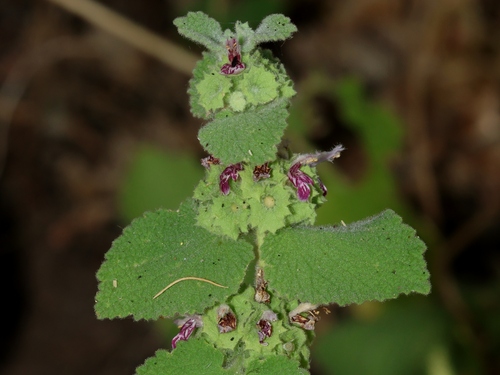
Upper leaves located near the inflorescence are ovate and sessile.
Full-Sized Leaf Dimensions
Full-sized leaves can grow up to 32 cm (13 in) long and 15 cm (5.9 in) wide.
Leaf Shape and Texture
Leaves have a hastate shape, with a cordate to auriculate leaf base and an acute leaf tip, and are covered in velvety trichomes over visible raised veins.
Inflorescence Structure
The inflorescence is an open panicle, with lateral branches that branch cymosely 2 to 3 times.
Inflorescence Bracts
The inflorescence bracts are linear and grow up to 1.1 cm (0.43 in) long.
Flower Clusters and Pedicels
Flowers grow in axillary, cymose clusters, and are borne on pedicels that elongate as the flower ages, reaching about 1.2 cm (0.47 in) in length at anthesis.
Calyx Morphology
The calyx is made of 5 sepals fused at the base; the calyx tube measures 2 to 4 mm (0.079 to 0.157 in) long at anthesis.
Corolla Features
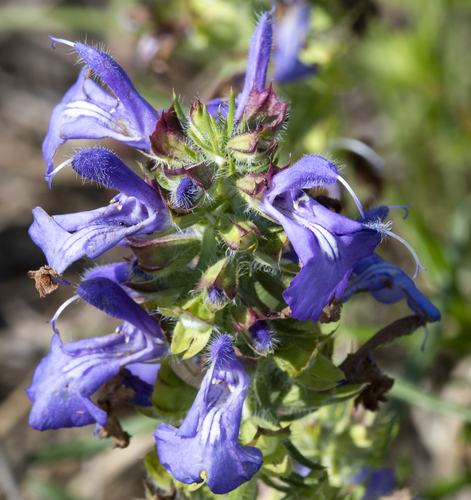
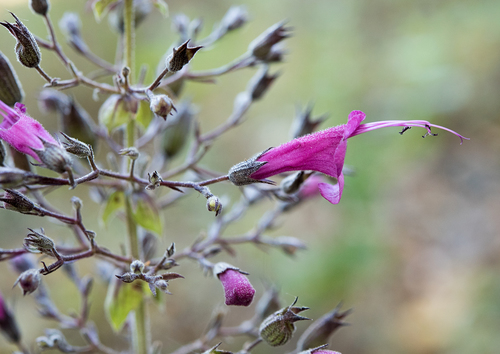
The corolla is 4-lobed, 11 to 21 mm (0.43 to 0.83 in) long, and colored purple-magenta.
Fruit Characteristics
The fruit splits into 4 glossy black nutlets, each about 5 mm (0.20 in) long and 2.5 mm (0.098 in) wide.
Traditional Medicinal Use
Historically, this species has been used as a natural remedy to treat uterine infections.
Cultivation Soil Requirements
It is cultivated as an ornamental plant, and can grow successfully in poor, dry soils.
Cultivation Light Requirements
It is recommended to grow this plant in locations that receive afternoon shade.
Cultivation Nomenclature Error
In cultivation, it is sometimes incorrectly labeled as Lepechinia salviae, a similar but separate species native to Chile.