About Lemna minor L.
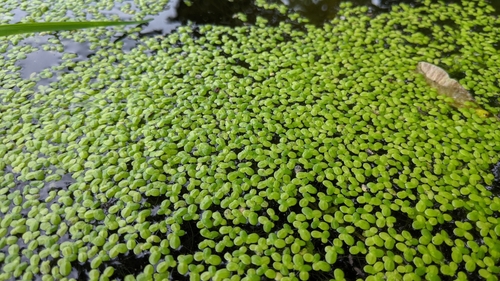
Lemna minor L. is a floating freshwater aquatic plant. Each individual plant has one to four leaves, each with a single root 1–2 cm long that hangs into the water. As new leaves grow, the plant divides to form separate new individuals. The leaves are oval, between 1–8 mm long and 0.6–5 mm broad, light green, with three (rarely five) veins and small air spaces that help the plant float. It reproduces mainly through vegetative division. Flowers are rarely produced, and measure around 1 mm in diameter; they consist of a cup-shaped membranous scale holding one ovule and two stamens. Its seeds are 1 mm long, with 8 to 15 distinct ribs. Birds play an important role in dispersing L. minor to new locations: the sticky roots allow the plants to stick to the birds' plumage or feet, letting them colonize new ponds. Lemna minor has a subcosmopolitan distribution. It is native across most of Africa, Asia, Europe, and North America, and grows in any area with freshwater ponds and slow-moving streams, except arctic and subarctic climates. It is not recorded as native to Australasia or South America, but has become naturalized in both regions. For optimal cultivation, Lemna minor requires a pH between 6.5 and 8, and can grow at temperatures between 6 and 33 °C. When growing conditions are suitable, colonies grow quickly and form a complete carpet across the surface of still pools. In temperate regions, when temperatures drop below 6 to 7 °C, the plant produces small, dense, starch-filled overwintering structures called turions. The plants become dormant, sink to the bottom of the water body to overwinter, and resume growth and float back to the surface the following spring. Cultivating duckweed generally requires some active management. Because these small free-floating plants can be blown into dense heaps by wind, leaving open water that allows algae to grow, long narrow ponds built perpendicular to the prevailing wind are recommended. Multiple inlets can achieve even distribution of added nutrients throughout the pond. Coordinated harvesting and nutrient replenishment are required to maintain a dense healthy plant cover on the water surface and prevent the layer from growing too thick for healthy growth. Fertilizer requirements for growing Lemna minor depend on the water source and the specific geographic strain of L. minor being grown. L. minor grown in rainwater-filled ponds needs additional applications of nitrogen, phosphorus, and potassium. To maintain high growth rates and high crude protein content, total Kjeldahl nitrogen should not drop below 20–30 mg/L. For phosphorus, good growth occurs at concentrations between 6 and 154 mg/L, and high phosphorus concentrations do not notably affect growth rates. Effluent from domestic animal production has very high concentrations of ammonium and other minerals, and often needs dilution to reach a balanced nutrient concentration. For L. minor isolate 8627 grown in swine lagoon liquid, the highest production rates were achieved when the liquid was diluted to 20% strength, which gives total Kjeldahl nitrogen of 54 mg/L, ammonium of 31 mg/L, and total phosphorus of 16 mg/L. Sewage water, which often already has adequate concentrations of potassium and phosphorus, can be used to grow duckweed, but its nitrogen concentrations need to be adjusted to the correct range.