About Layia carnosa (Nutt.) Torr. & A.Gray
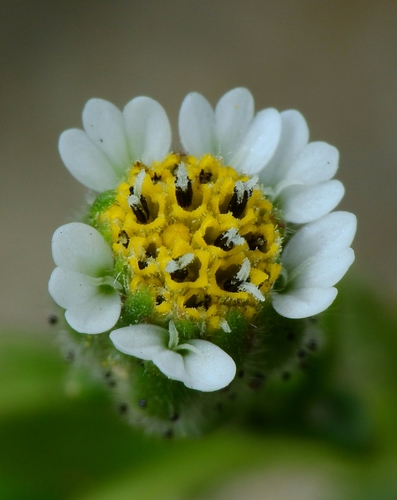
This species is a small annual herb that produces a short, glandular stem, which grows along the ground or is somewhat upright, reaching a maximum length of around 18 centimeters. Its fleshy green leaves are oval-shaped; larger leaves are roughly lobed and can grow up to 4 or 5 centimeters long. The inflorescence grows on a short peduncle. The flower head has a base of overlapping green phyllaries that form a cup, which holds several small white ray florets. The center of the flower head is filled with yellow disc florets that have purple anthers. The fruits are small achenes, which come in two types. Achenes from ray florets are hairy, curved, and have no pappus, while achenes from disc florets have a long, hairlike pappus. Beach layia germinates during the rainy season between fall and midwinter, blooms in spring from March to July, and finishes its full life cycle before the dry season from July to September. Its populations are typically patchy, and experience large annual changes in size alongside dynamic shifts in local distribution. These changes are linked to shifts in dune blowouts, sand remobilization, and natural dune stabilization in coastal dune ecosystems. Beach layia plants often grow in areas where sparse vegetation traps wind-dispersed seeds, without creating heavy shading. Seeds are dispersed by wind, mostly during late spring and summer. Beach layia is self-compatible, meaning it can be fertilized by its own pollen, and is capable of self-pollination. It is also visited by a variety of insects that may assist in cross-pollination. While the exact role of these pollinators is not currently clear, sexual reproduction does contribute to genetic diversity. Beach layia grows in open sandy soil spaces between low-growing perennial plants, in the Abronia latifolia—Ambrosia chamissonis herbaceous alliance (dune mat) and the Leymus mollis herbaceous alliance (sea lyme grass patches). Total vegetation cover in both of these communities is typically relatively sparse, and many annual species including beach layia colonize the open spaces between established, tufted perennials. Beach layia can also grow in narrow bands of moderately disturbed habitat along the edges of trails and roads within dune systems that are dominated by invasive species. Coastal dune systems are made up of a mosaic of vegetation communities across different successional stages. Beach layia grows in early to midsuccessional communities, in areas where sand is actively being deposited or eroded. Excessive sand movement prevents plants from becoming established, but areas with periodic moderate sand movement support these early successional communities. Wind-driven sand movement is essential for the development and long-term survival of a dune system. Wind is also specifically important to beach layia because it is the mechanism that disperses the plant's seeds. The achenes—small, dry, one-seeded fruits that do not open to release the seed—have pappus, feathery bristles that allow the achenes to be carried by wind for short distances. While not all seeds land on suitable habitat, this adaptation lets the small annual spread across the landscape into unoccupied areas. As a winter-germinating annual, beach layia requires rainfall during the winter months from November through February to germinate. Though it is relatively tolerant to the drought-like conditions of upland dunes, it needs some moisture through spring to avoid desiccation. Moisture also reduces the risk of burial, since dry sand is more mobile, and mortality caused by sand burial has been documented for this species. For individual beach layia plants to complete their life cycles and for populations to remain viable, they require four key resources: (1) Sandy soils with sparse native vegetation cover, (2) Rainfall during the winter germination period, (3) Full sun exposure for photosynthesis, and (4) An unknown degree of cross-pollination to contribute to genetic diversity.