About Hymenothrix dissecta (A.Gray) B.G.Baldwin
Scientific Classification and Common Names
Hymenothrix dissecta is a North American flowering plant species in the Asteraceae family, commonly known as yellow ragweed and ragleaf bahia.
Native Distribution
It is native to the western United States, reaching as far north as the Black Hills of South Dakota and Wyoming, and also grows in northern Mexico, specifically in Baja California, Chihuahua, Coahuila, and Sonora.
Habitat Types
This species occurs in a range of habitat types, from dry mountain slopes to roadsides.
Plant Growth Form
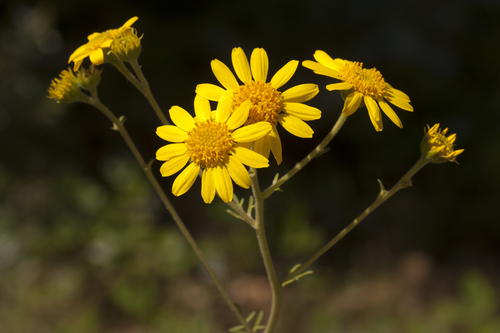
It is an annual or biennial herb that grows a spindly, branching, erect stem, with a height ranging from 20 centimeters to well over one meter.
Stem Characteristics
Its stems are reddish and typically glandular.
Leaf Characteristics
The small leaves are mostly found toward the base of the stem and are finely divided into linear lobes.
Inflorescence Structure
The spreading inflorescence bears several flower heads, each lined with hairy, glandular phyllaries.
Floret Characteristics
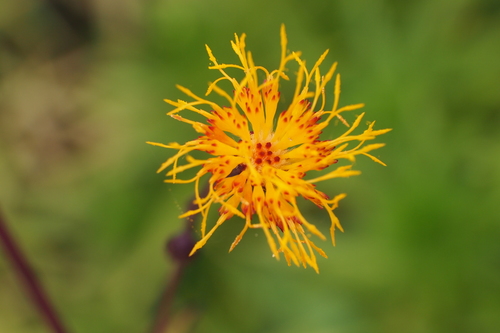
Each flower head has a fringe of rounded yellow ray florets roughly half a centimeter long, surrounding a center of yellow disc florets.
Fruit Characteristics
The fruit is a dark-colored achene 3 to 4 millimeters long.
Pappus Characteristics
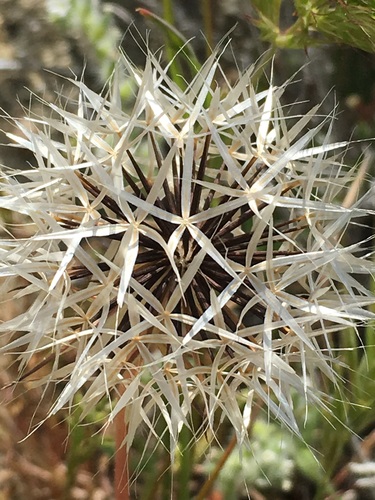
Any pappus present on the fruit is small and scale-like.
Initial Species Publication
American botanist Asa Gray first described this species as Amauria dissecta in 1849, from material collected in a valley between Guajuquilla and Mapimi in Chihuahua.
Taxonomic Reclassification
Bruce Gregg Baldwin reclassified it into the genus Hymenothrix in 2016, giving the current accepted scientific name Hymenothrix dissecta (A.Gray) B.G.Baldwin.