About Lathyrus sylvestris L.
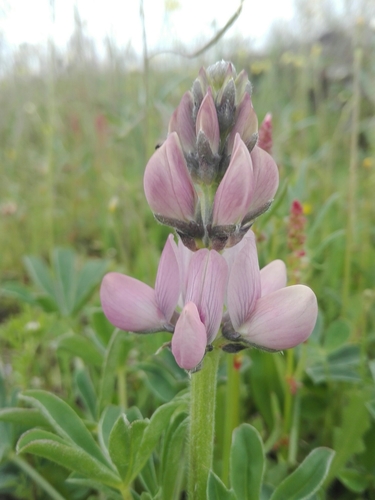
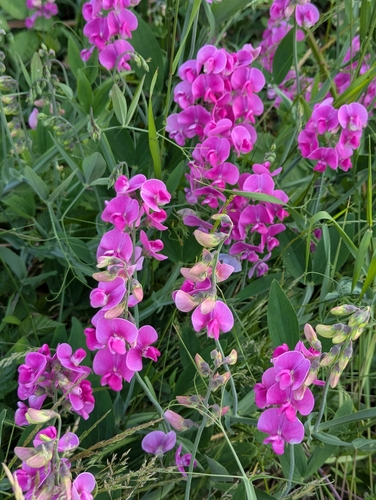
Lathyrus sylvestris L., commonly called the narrow-leaved everlasting-pea, is a perennial climbing plant. It can reach up to 200 cm (79 in) in height when climbing with its tendrils; without supporting structures, it only grows to around 75 cm (30 in) tall. Its stems are floppy, flat, and have distinct wide wings. Its leaves grow in an alternating arrangement, and have short, winged stalks and stipules. Leaf blades are pinnate, made up of one pair of narrow lanceolate leaflets with smooth entire margins, plus three tendrils. The inflorescence grows on a long stem and holds three to ten pinkish-red irregular flowers. Each flower has five sepals, five petals, ten stamens, and a single carpel. The petals have specialized structures: the uppermost petal is called the standard, the two lateral petals are called wings, and the two lowest petals are joined together to form the keel. After flowering, the plant produces a long seed pod that contains between five and fifteen seeds. This species is native to parts of Africa, Europe, and Asia. Its natural habitats include forest edges, sparse broad-leaved hillside forests, dry hillside meadows, hedgerows, embankments, and waste ground. It uses its tendrils to scramble over other plants, shrubs, and the lower branches of trees. The narrow-leaved everlasting-pea is sometimes planted alongside grass species to control erosion, and it grows well in highly disturbed habitats. One registered cultivar of this species is named 'Lathco'.