About Lathyrus odoratus L.
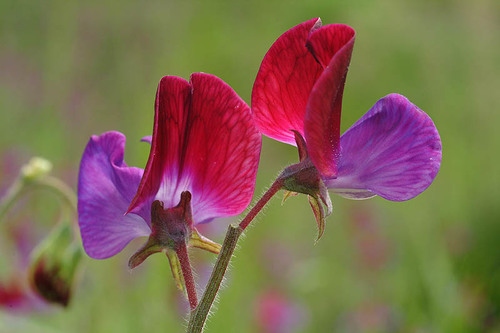
Lathyrus odoratus L., commonly known as sweet pea, is a flowering plant in the genus Lathyrus of the legume family Fabaceae. It is native to Sicily, southern Italy, and the Aegean Islands. It is an annual climbing plant that grows 1 to 2 metres (3 ft 3 in – 6 ft 7 in) tall when it has access to suitable supporting structures. Its leaves are pinnate, with two leaflets and a terminal tendril that twines around supporting structures to help the plant climb. Wild sweet pea plants have purple flowers 2–3.5 cm (3⁄4–1+1⁄2 in) wide; cultivated varieties have larger flowers that vary widely in color. The blooms are typically strongly scented. This annual species may be confused with the everlasting pea, Lathyrus latifolius, which is a perennial. Unlike the edible pea, there is evidence that seeds of Lathyrus genus plants are toxic if eaten in large quantities. A related species, Lathyrus sativus, is grown for human consumption, but when it makes up a major part of a person’s diet, it causes toxic symptoms called lathyrism. In rat studies, animals fed a diet made up of 50% sweet pea seeds developed enlarged adrenals, compared to control animals fed edible peas. The main effect of sweet pea toxicity is thought to impact collagen formation. Symptoms are similar to those of scurvy and copper deficiency, which both share the common feature of preventing proper formation of collagen fibrils. Sweet pea seeds contain beta-aminopropionitrile, which prevents collagen cross-linking by inhibiting the enzyme lysyl oxidase and thus stopping the formation of allysine, which leads to loose skin. Recent experiments have attempted to develop this chemical as a treatment to prevent disfiguring skin contractions after skin grafting. Sweet peas have been cultivated since the 17th century, and a very large number of cultivars are available commercially. They are grown for their flower colors, which are usually pastel shades of blue, pink, purple, and white including bi-colors, and for their intense, unique fragrance. Gardeners grow them for personal enjoyment or for exhibition, and they are also used in the floristry trade. The large, pea-shaped seeds are sown in cold frames in spring or autumn. Seeds benefit from pre-soaking or chipping with a sharp blade before sowing. Young plants or plug plants are also available for planting later in the growing season. Plants are grown up canes, and new shoots are regularly pinched out to encourage a bushy growth habit and higher flower yields. Plants typically reach 1–2 metres (3 ft 3 in – 6 ft 7 in) in height, and flowers appear in midsummer, continuing to bloom for many weeks if the plants are regularly deadheaded. More than 50 cultivars have earned the Royal Horticultural Society's Award of Garden Merit. In the United Kingdom, the National Collection of Sweet Peas was founded by Roger Parsons in 1991, when Parsons offered to host a collection of Lathyrus at Hotham Park, Bognor Regis. At that time, Parsons worked as Head of Parks and Landscape for Arun District Council. The collection gained National Collection status in 1993, and it currently holds around 1300 species and cultivars from across the world. English Sweet Peas, run by Phil Johnson, now includes Roger Parsons Sweet Peas, and Johnson will maintain and expand the National Collection. Johnson has submitted an application to Plant Heritage to become the collection’s new custodian.