About Kennedia nigricans Lindl.
Taxonomic Identity
Kennedia nigricans, a species formally described as Kennedia nigricans Lindl., is a trailing or twining shrub, or a vigorous woody climber.
Growth Size
It typically climbs to a maximum height of 4 m (13 ft) and spreads up to 6 m (20 ft).
Leaf General Characteristics
Its leaves are dark green, trifoliate, and measure 70–180 mm (2.8–7.1 in) in length.
Petiole and Stipule Features
They grow from a petiole that is 10–30 mm (0.39–1.18 in) long, with 4.5 mm (0.18 in) long stipules at the leaf base.
Terminal Leaflet Characteristics
The leaflets have an egg shape; the terminal leaflet is 30–90 mm (1.2–3.5 in) long and 20–70 mm (0.79–2.76 in) wide, growing on a petiolule up to 17 mm (0.67 in) long.
Lateral Leaflet Characteristics
The lateral leaflets are smaller and grow on a short petiolule.
Flower Inflorescence Structure
The flowers are arranged in groups of up to fifteen, borne on a peduncle 20–130 mm (0.79–5.12 in) long.
Individual Flower Dimensions
Each individual flower is 30–33 mm (1.2–1.3 in) long, and sits on a pedicel 100–150 mm (3.9–5.9 in) long.
Sepal Characteristics
The five sepals are 12–14 mm (0.47–0.55 in) long, with triangular or lance-shaped teeth around 4 mm (0.16 in) long; the upper two sepals are joined along most of their length.
Petal Coloration
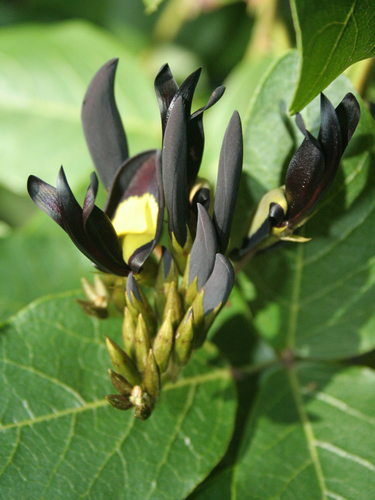
Petals range in color from violet or purple to almost black, combined with yellow-orange.
Petal Dimensions
The standard petal is 22–27 mm (0.87–1.06 in) long, the wing petals are 28–30 mm (1.1–1.2 in) long, and the keel petal is about 27 mm (1.1 in) long.
Flowering Period and Fruit
Flowering occurs between July and November, and the fruit produced is a pod 46–70 mm (1.8–2.8 in) long.
Native Distribution and Habitat
In its native range, black kennedia grows on coastal dunes, along creek margins, and on flats in the Esperance Plains, Jarrah Forest and Swan Coastal Plain biogeographic regions of south-western Western Australia.
Naturalised Range
It is also naturalised in other parts of Western Australia, as well as in South Australia and Tasmania.
Cultivar Registration
In horticulture, a cultivar named Kennedia nigricans 'Minstrel' was registered with the Australian Cultivar Registration Authority by Goldup Nursery of Mount Evelyn, Victoria in September 1985.
Cultivar Characteristics
This cultivar was selected from a batch of seedlings in 1983, and has a pale, almost white coloration in place of the species' typical yellow marking.
Horticultural Uses
This vigorous climbing species is widely used in horticulture to cover embankments or unsightly structures.
Cultivation Requirements
It adapts to a wide range of soil types, and prefers a sunny growing position.
Stress Tolerance
It is drought resistant and has some degree of frost tolerance.
Species Propagation
The species can be propagated from scarified seed or cuttings taken from semi-mature growth.
Cultivar Propagation
The cultivar must be propagated from cuttings to retain its true characteristics.