About Larix laricina (Du Roi) K.Koch
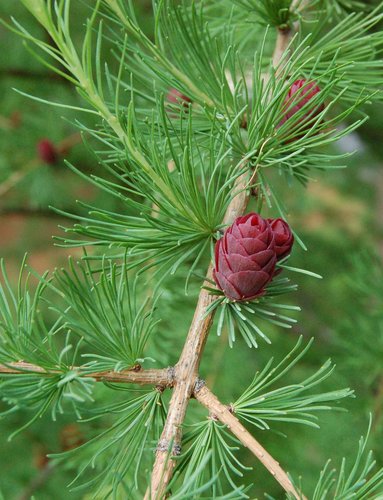
Larix laricina, commonly called tamarack, is a small to medium-sized boreal deciduous conifer that most commonly grows in lowland wetland areas including swamps, fens, and bogs. Mature specimens reach 15–23 m (49–75 ft) in height, with trunks up to 60 cm (24 in) in diameter. Mature trees have reddish bark, while younger trees have smooth, gray bark. Its light blue-green needle-like leaves grow 2.5 cm (1 in) long, forming clusters of 10–20 on long woody spur shoots. Before shedding in autumn, the leaves turn bright yellow, leaving shoots bare until the following spring. Tamarack produces the smallest cones of any larch, which measure only 1–2.3 cm (3⁄8–7⁄8 in) long and hold 12–25 seed scales. The cones start bright red, then turn brown before opening to release seeds once mature, 4 to 6 months after pollination. Tamarack is extremely cold tolerant, able to survive temperatures as low as at least −62 °C (−80 °F), and commonly grows at the Arctic tree line along the edge of the tundra. Trees growing in these harsh northern climate conditions are smaller than those growing farther south, often reaching only 3 m (10 ft) tall. While tamarack can tolerate a very wide range of soil conditions, it grows most commonly in swamps, bogs, or muskegs in wet to moist organic soils such as sphagnum, peat, and woody peat. It also grows on mineral soils ranging from heavy clay to coarse sand, so soil texture does not appear to limit its growth. Though tamarack can grow well on calcareous soils, it is not abundant in the limestone areas of eastern Ontario. Tamarack is typically the first forest tree to colonize filled-lake bogs. In the North American Great Lakes region, tamarack may establish first in sedge mats or sphagnum moss, or may not appear until the bog shrub stage. Further north, it acts as the pioneer tree in the bog shrub stage. It is fairly well adapted to reproduce successfully after wildfires, so it is one of the most common pioneer species on boreal forest sites immediately following fire. A central Alaskan population of tamarack, separated from eastern Yukon populations by a gap of roughly 700 kilometres (430 mi), is classified as the distinct variety Larix laricina var. alaskensis by some botanists, while other botanists argue that the population is not distinct enough to warrant separate variety status. Tamarack wood is tough, durable, and remains flexible when cut into thin strips. Algonquian peoples historically used this wood to make snowshoes and other products that require toughness. Naturally curved sections from tamarack stumps and roots are also favored for creating the angled knee joints used in wooden boat construction. Today, tamarack wood is used mainly for pulpwood, and also for posts, poles, rough lumber, and fuelwood; it is not considered a major commercial timber species. Tamarack wood is also used as kickboards in horse stables. 19th-century older log homes often incorporated tamarack logs alongside other species such as red oak or white oak. Hewn tamarack logs have a coarse, grainy surface texture. Tamarack is also cultivated as an ornamental tree for gardens in cold regions. Several dwarf cultivars have been developed and are sold commercially, and tamarack is commonly used for bonsai. Tamarack poles were used to build corduroy roads because of the wood's natural rot resistance. Before 1917, surveyors in Alberta used tamarack posts to mark the northeast corner of surveyed sections within townships; the rot-resistant wood was readily available in local bush areas at the time, and was light to carry. This same rot resistance made tamarack a common choice for early water distribution systems. Aboriginal peoples of Canada's northwest regions used the tree's inner bark as a poultice to treat cuts, infected wounds, frostbite, boils, and hemorrhoids. The outer bark and roots are reported to have been combined with another plant to treat arthritis, colds, and general aches and pains. Many types of wildlife use tamarack for food and nesting. Porcupines eat the inner bark, snowshoe hares feed on tamarack seedlings, and red squirrels eat the tree's seeds. Birds that frequently visit tamarack trees during the summer include the white-throated sparrow, song sparrow, veery, common yellowthroat, and Nashville warbler.