About Larix kaempferi (Lamb.) Carrière
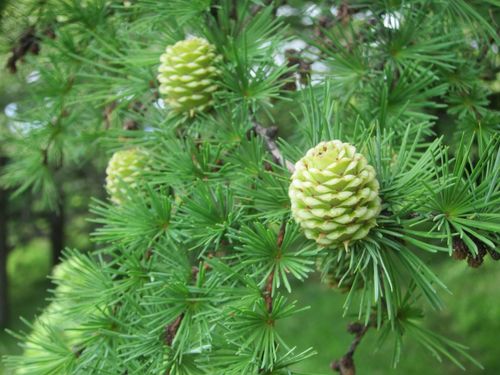
Larix kaempferi (Lamb.) Carrière, commonly called Japanese larch, known as karamatsu in Japanese, is a larch species native to Japan. It is native to the mountain areas of the Chūbu and Kantō regions in central Honshū. It is a medium-sized to large deciduous coniferous tree, growing 20–40 m tall, with a trunk that can reach up to 1 m in diameter. Its crown is broadly conical; both main and side branches grow horizontally, and side branches only droop very rarely. Shoots show two distinct forms: long shoots, typically 10–50 cm long that hold several buds, and short shoots, only 1–2 mm long that hold just a single bud. Its leaves are needle-like, light glaucous green, and 2–5 cm long. Before dropping in autumn, they turn bright yellow to orange, leaving pinkish-brown shoots bare until the following spring. Its cones are erect, ovoid-conical, and 2–3.5 cm long, with 30–50 reflexed seed scales. Immature cones are green, turning brown and opening to release seeds when they mature 4–6 months after pollination. Old cones commonly stay on the tree for many years, fading to a dull grey-black colour. It grows at altitudes up to 2,900 m on well-drained soils, and does not grow in waterlogged ground. Its scientific name honours Engelbert Kaempfer, and it also has the synonym Larix leptolepis. Japanese larch is an important timber tree for forestry plantations. It is grown across central and northern Japan, as far north as Hokkaidō, and also widely in northern Europe, especially in Ireland and Britain. Its wood is tough and durable, used for general construction work. Small larch poles are commonly used for fencing. In cultivation, Larix kaempferi is grown ornamentally in parks and gardens, and it is also widely used as bonsai material. Two dwarf cultivars, 'Blue Dwarf' which grows 1.5 m tall and broad, and 'Nana' which grows 1 m tall and broad, have earned the Royal Horticultural Society's Award of Garden Merit.