About Abies procera Rehd.
Species Introduction
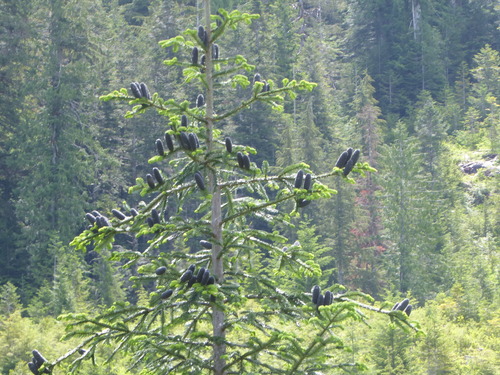
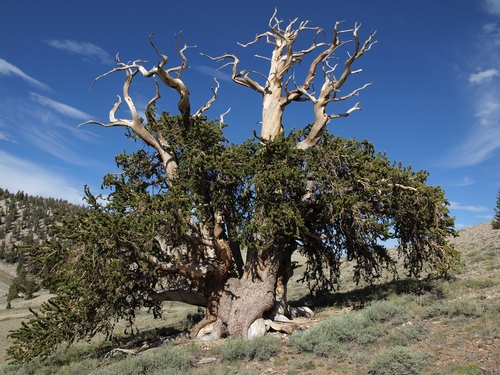
Abies procera Rehd. (noble fir) is a large evergreen conifer with a narrow conical crown.
Size
It typically grows up to 70 meters (230 ft) tall with a trunk diameter of up to 2 m (6 ft 7 in), and rarely reaches 90 m (295 ft) tall and 2.7 m (8 ft 10 in) thick.
Bark Characteristics
Young trees have smooth, gray bark with resin blisters; old trees develop red-brown, rough, fissured bark that is usually less than 5 centimeters (2 in) thick, with reddish inner bark.
Leaf Structure
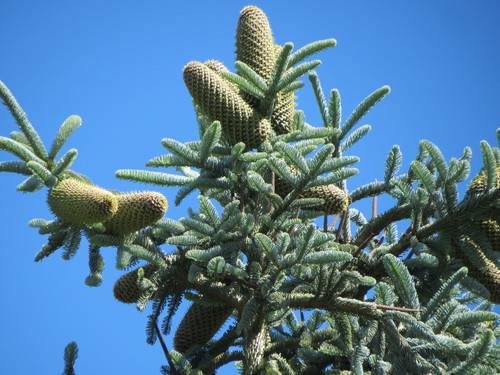
Its leaves are needle-like, 1–3.5 cm (1⁄2–1+1⁄2 in) long, glaucous blue-green on both upper and lower surfaces with prominent stomal bands, and have a blunt to notched tip. Leaves are arranged spirally on the shoot, but twist slightly into an S-shape to curve upward above the shoot.
Cone Characteristics
Cones are upright, 11–22 cm (4+1⁄4–8+3⁄4 in) long and 6 cm (2+1⁄4 in) thick, with purple scales that are almost completely hidden by long, protruding yellow-green bract scales. They ripen to brown and disintegrate to release winged seeds in fall.
Seed Production
Viable seeds are only produced every few years.
Lifespan
This species can live up to 200 years, and it is the tallest true fir in the world.
Native Distribution
This species is native to the Cascade Range and Pacific Coast Ranges of western Washington and Oregon, as well as the extreme northwest of California.
Elevation Range
It is a high-altitude tree, typically found at elevations of 300–1,500 m (980–4,920 ft), often growing above 600 m (2,000 ft), and only rarely reaches the tree line.
Related Species
It is closely related to Abies magnifica (red fir), which replaces it further southeast in southernmost Oregon and California.
Species Differentiation
The two species are most easily distinguished by noble fir having a groove along the midrib on the upper side of leaves, which red fir lacks. Red fir also tends to have less closely packed leaves that leave the shoot bark visible between leaves, while the shoot is largely hidden in noble fir. Red fir cones also mostly have shorter bracts, except in A. magnifica var. shastensis (Shasta red fir); this variety hybridizes with noble fir and is itself a hybrid between noble fir and red fir.
Shade Tolerance
Unlike Shasta red fir, noble fir is shade-intolerant, which leaves its lower trunk without branches.
Associated Vegetation
Noble fir grows alongside Douglas-fir and western hemlock at middle elevations, and alongside Pacific silver fir and mountain hemlock at higher elevations.
Habitat Climate
It grows in cool, humid areas similar to those occupied by Pacific silver fir.
Disturbance Response
While it benefits from occasional disturbances (such as the 1980 eruption of Mount St. Helens), it is very susceptible to fire but is usually protected by its moist growing environment.
Damage Resistance
It is relatively resistant to damage from wind, insects, and disease.
Substrate Requirements
Although its roots grow slowly, it can survive in rocky soil as long as the soil stays moist.
Traditional Indigenous Use
The Paiute people used the foliage of this species to treat coughs and colds.
Historical Naming
Loggers early recognized its superior light, strong wood, and called it "larch" to avoid confusing it with inferior firs.
Modern Wood Uses
Today the wood is used for specialized applications including ladders, general structural use, and paper manufacture. It may have been used for the frames of the Royal Air Force's Mosquito bombers during World War II.
Horticultural Introduction
David Douglas sent noble fir seeds to Britain in 1830, introducing the species to horticulturists there.
Christmas Tree Use
It is a popular and favored Christmas tree.
Cultivar Award
The prostrate gray cultivar A. procera (Glauca Group) 'Glauca Prostrata' has earned the Royal Horticultural Society's Award of Garden Merit.
Naturalized Range
Noble fir has become naturalized in Britain (particularly Scotland) and Denmark.