About Larix gmelinii (Rupr.) Kuzen.
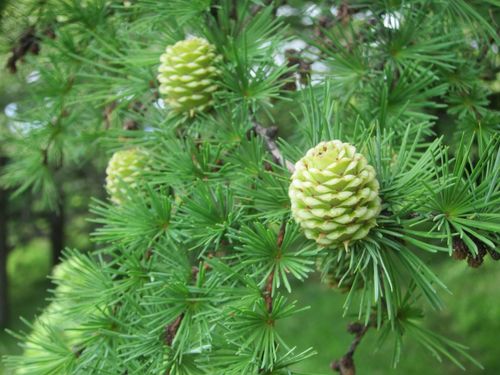
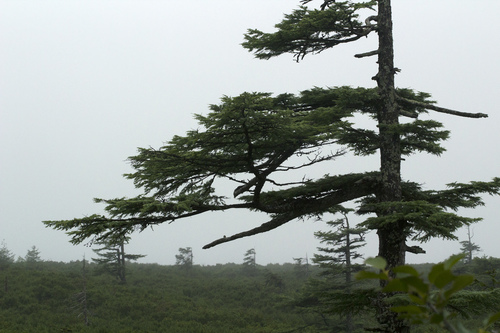
Larix gmelinii (Rupr.) Kuzen. is a medium-sized deciduous coniferous tree that grows 10–30 m tall, and rarely reaches 40 m in height. It has a trunk that can grow up to 1 m in diameter. Its crown is broadly conical, with both main and side branches held level, and side branches only rarely droop. Its shoots are dimorphic: growth is split between long shoots, which are typically 5–30 cm long and bear multiple buds, and short shoots, which are only 1–2 mm long and hold only a single bud. Its leaves are needle-like, light green, and 2–3 cm long. Before falling in autumn, the leaves turn bright yellow to orange; they leave variably downy reddish-brown shoots bare until the following spring. Its cones are erect and ovoid, measuring 1–2 cm long, rarely up to 2.5 cm; the variety Larix gmelinii var. principis-rupprechtii produces cones that are 2–4 cm long. Cones hold 15–25 moderately reflexed seed scales; var. principis-rupprechtii has 26–45 seed scales. Immature cones are green or red, and rarely purple; they turn brown and open to release seeds when mature, 3–5 months after pollination. Old cones commonly stay on the tree for many years, fading to dull grey-black. Larix gmelinii forms large forests across the eastern Siberian taiga. It grows at altitudes between 50 and 1,200 m, on both boggy and well-drained soils, including shallow soils that overlie permafrost. It has two unique traits: it is the northernmost tree in the world, and the most cold-hardy tree in the world. Its northernmost populations reach as far as 73° 04' 32" N 102° E in the Taymyr Peninsula tundra, where it grows in creeping forms. It also occurs as comparatively vertically growing single trees and small groups, forming subtundra sparse forests at 72° 55' 07" N 106° 08' E, 72° 31' N 105° 03' E at Lukunsky grove, and 72° 28' N 102° 15' E at Ary-Mas. All of these northern forest stands are located on the Taymyr Peninsula, in the Khatanga river basin. As the most cold-hardy tree in the world, it tolerates temperatures below -70 °C in the Oymyakon–Verkhoyansk region of Yakutia. One individual tree in Yakutia has been recorded as 919 years old. Dahurian larch is occasionally cultivated in botanical gardens in Europe and North America. It does not grow easily in regions with mild winters, because it is adapted to a long winter rest period. Warm winter weather in Britain can trigger it to leaf out as early as January, and the tender young new leaves are then killed by later frosts. In its native range, daily minimum temperatures do not rise above freezing until late May or June, and no further frost occurs until after the short summer ends. The caterpillars of the tortrix moth Cydia illutana feed on the cone scales of Larix gmelinii.